


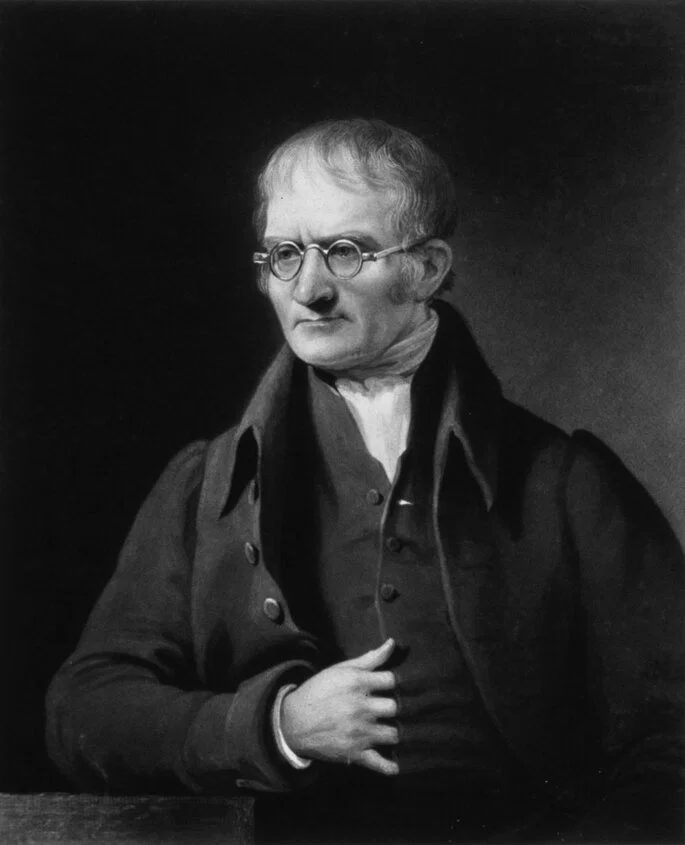
John Dalton didn’t just guess about atoms. He published the first scientifically grounded atomic theory between 1803 and 1807. Before him, ideas about matter were mostly philosophical. He made them measurable.
His vision was simple. Atoms were the basic building blocks. They were simple particles. They combined to create everything we see and know. This wasn’t abstract speculation. It was a framework for chemistry.
The Billiard Ball Analogy
People often call the Dalton model the “billiard ball” model. Why? Because it fits the description perfectly. He viewed the atom as a solid sphere. It was compact. It was uniform.
Imagine a pool table. The balls are hard. They don’t squish. They bounce off each other. That’s how Dalton imagined atoms interacting. They were indivisible. They were solid.
“The atom is a solid, compact sphere.”
This visualization helped early chemists. It gave them a physical way to think about reactions. Matter wasn’t continuous. It was chunky. It was discrete.
Why It Mattered
This shift was huge. It moved science from the realm of philosophy to empirical observation. Dalton’s work laid the groundwork for modern chemistry.
It wasn’t perfect. We now know atoms aren’t solid. They have complex internal structures. But the core idea remained. Matter is made of distinct units.
The billiard ball image stuck. It’s easy to remember. It’s tangible. It captures the essence of early atomic theory.
Beyond the Surface
Dalton’s theory explained how elements combine. It accounted for conservation of mass. It provided a logical structure for chemical formulas.
Without this foundation, later discoveries might have struggled. Scientists like Thomson and Rutherford built on these initial concepts. They tore down the solid sphere. They found electrons. They found nuclei.
But it started with Dalton. It started with the idea of the solid, indivisible atom.
The Legacy of Solidity
Today, we know the billiard ball is wrong. Atoms are mostly empty space. They’re fuzzy clouds of probability.
Yet, the simplicity of Dalton’s model serves a purpose. It helps beginners visualize chemical bonds. It provides a mental shortcut.
Science moves in layers. We add complexity. We refine our understanding. But we rarely discard the basic intuition entirely.
The billiard ball remains a useful metaphor. Even if it’s physically inaccurate. It captures a moment in time. A moment when atoms became real.
Before John Dalton, the idea that matter was made of tiny, indivisible bits was already floating around. Demócrito and Leucipo tossed out the concept centuries ago. Then came William Higgins, Antoine Lavoisier, and Joseph Louis Proust, adding their own slices to the puzzle. Dalton didn’t invent his theory from scratch. He built it on their shoulders.
He took their scattered observations and forged them into a coherent system. His goal? To explain how elements behave and combine. The result was a set of postulates that would dominate chemistry for decades.
Dalton noticed patterns. Two elements are distinct because their atoms have different masses and sizes. Compounds aren’t new substances in a magical sense. They are just atoms of different elements rearranging themselves. Simple. Logical.
But the real breakthrough came when he tried to quantify the unquantifiable. He created a table of relative atomic weights. Hydrogen was the baseline. Everything else was measured against it.
Mapping atomic weights relative to hydrogen
This table wasn’t just a list. It was an attempt to order the periodic table before there was a periodic table. He included the heavy hitters: oxygen, nitrogen, carbon, sulfur, and phosphorus. But he didn’t stop at the obvious. He dug into metals too. Copper, tin, magnesium, sodium, potassium, zinc, silver, gold.
Each entry represented his best guess at an element’s mass. For a long time, this was the only reference scientists had for comparing atoms. It gave chemists a common language. You didn’t just say “this is heavy.” You said “this weighs three times as much as hydrogen.”
But here is where the model cracked. Dalton’s numbers were wrong. Not by a little. By a lot. Why? Because he didn’t know about molecules.
He assumed the simplest ratio of atoms. If hydrogen combined with oxygen to make water, he thought it was one hydrogen atom and one oxygen atom. HO. In reality, water is H2O. Oxygen exists naturally as O2, a diatomic molecule. Dalton’s ignorance of molecular structure corrupted his entire table. He thought oxygen was only sixteen times heavier than hydrogen. It’s actually thirty-two times heavier relative to the same number of atoms in their standard states.
The error propagated. Every compound he studied was likely misassigned in its atomic ratio. His weights were consistent within his flawed logic, but inconsistent with physical reality.
The sphere: indivisible and identical
So how did Dalton visualize these mysterious particles? He didn’t see them as complex structures. He saw them as solid spheres.
His model had distinct characteristics that defined the atom for a generation:
- Indivisible : You cannot cut an atom. It is the smallest unit of matter. Break it, and you no longer have the element. This held true until the discovery of subatomic particles, but in Dalton’s time, it was an absolute law.
- Identical within an element : All atoms of gold are exactly the same. Same mass. Same size. Same properties. Isotopes weren’t known. The idea that a single element could have atoms with different weights was unimaginable.
- Conservation : Atoms are neither created nor destroyed in chemical reactions. They just shuffle positions. This explained why mass is conserved in reactions.
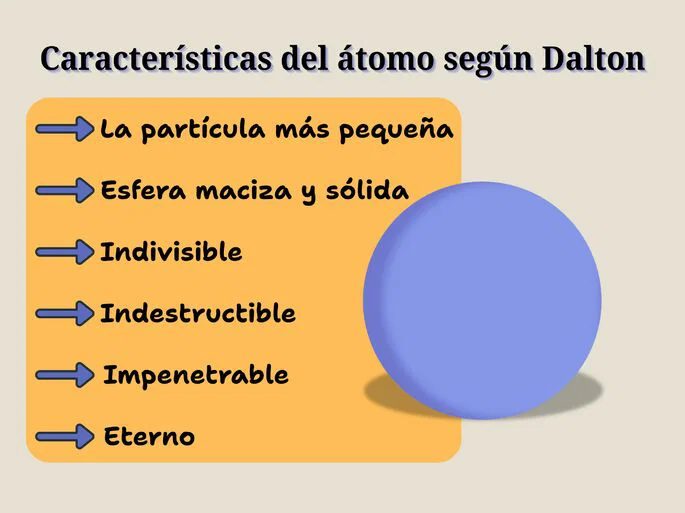


John Dalton’s vision of the atom was simple. It was a solid sphere. A billiard ball. It couldn’t be cut. It couldn’t be broken. It just was. This was the foundation of modern atomic theory, even if parts of it were wrong. We knew atoms were the building blocks of everything. We knew they didn’t vanish in chemical reactions. But we had no idea what they actually looked like inside.
Dalton’s model wasn’t perfect. It was limited by the tools of his time. He saw the macroscopic results of chemistry. He didn’t see the subatomic world. Yet, his framework allowed science to move forward. It gave scientists a language to discuss matter. Without this starting point, we wouldn’t have the complex quantum models we use today.
The Core Postulates of Atomic Theory
Dalton proposed five main ideas to explain how matter behaves. These postulates were bold for their time. They relied on observation and logic, not advanced machinery.
Matter is made of tiny, indivisible particles. Everything around us consists of these units. They are solid. They are spherical. You can’t split them further. At least, that’s what Dalton thought.
Atoms of the same element are identical. Every carbon atom acts the same way. They have the same mass. The same size. Different elements have different masses. Dalton introduced the concept of relative atomic weight. He compared everything to hydrogen. Hydrogen became the baseline.
Chemical reactions are rearrangements. Atoms don’t disappear. They don’t appear out of nowhere. They just shuffle positions. The total mass stays constant. This was a direct application of Antoine Lavoisier’s law of conservation of mass.
Compounds form from simple ratios. When different atoms join, they do so in small whole numbers. Dalton believed the simplest ratio was always the rule. Water, for instance, was seen as one hydrogen atom plus one oxygen atom. HO. Not H2O. He guessed the proportions were minimal.
Atoms are eternal. They don’t change nature. They just move. A carbon atom from the Big Bang is still a carbon atom. It never becomes nitrogen. It never decays. It just sits there, waiting to bond.
“The atom remains the same in all respects, preserving its identity since the beginning of the universe.”
The Historical Foundations Dalton Built Upon
Dalton didn’t work in a vacuum. He stood on the shoulders of giants. Two specific laws guided his thinking.
First was the Law of Conservation of Mass. Antoine Lavoisier proved that mass isn’t lost in reactions. It just changes form. Dalton took this literally. If mass is conserved, atoms must be conserved too. They can’t be created or destroyed. They can only be rearranged.
Second was the Law of Definite Proportions. Joseph Louis Proust showed that compounds always contain elements in fixed ratios. Water is always hydrogen and oxygen in a specific weight ratio. Dalton pushed this further. He assumed the ratio was always the simplest possible. One-to-one. He missed the complexity of multiple bonding possibilities.
These laws provided the skeleton for Dalton’s model. They explained what happened. They didn’t explain how the atoms themselves were structured. That gap remained empty for decades.
Where Dalton Got It Wrong
The billiard ball model has a major flaw. It’s too solid. It’s too simple.
It ignored subatomic particles. We now know atoms aren’t indivisible. They contain protons, neutrons, and electrons. Even those are made of smaller things like quarks. Dalton had no way to detect these particles. So he assumed the atom was a solid block. This was incorrect.
It failed to account for isotopes. Dalton claimed all atoms of an element are identical. That’s not true. Isotopes exist. Carbon-12 and Carbon-14 are both carbon. They have different masses. They have different numbers of neutrons. Dalton’s model couldn’t explain why two atoms of the same element might behave slightly differently in mass.
It misunderstood molecular states. Dalton didn’t realize some elements exist as molecules. Oxygen in nature is O2. Two atoms bonded together. When Dalton measured its mass, he treated it as a single unit. This led to errors in calculating atomic weights. He assigned the mass of an O2 molecule to a single atom.
He underestimated combining ratios. Dalton thought atoms always joined in the simplest ratios. He thought water was HO. It’s H2O. Iron and oxygen can form FeO or Fe2O3. The ratios aren’t always one-to-one. They depend on valence electrons. Dalton didn’t know about valence electrons.
He ignored nuclear changes. Atoms aren’t eternal. They can change. Nuclear fusion and fission alter the nucleus. An atom can turn into a different element. Ionization changes its charge. Isotope formation changes its mass. Dalton’s “unchanging” atom doesn’t survive contact with a particle accelerator.
Why This Model Still Holds Value
Dalton was wrong about the details. But he was right about the concept. He established that matter is discrete. Not continuous. You can’t have half an atom. Or a quarter of an atom in a chemical reaction. That boundary was crucial.
Without Dalton, chemistry would still be alchemy. Vague and mystical. He gave it structure. He gave it math. He allowed scientists to predict how substances would react. He created the periodic table’s ancestor.
We don’t use the billiard ball model for research. We use quantum mechanics. We use electron clouds. We use probability functions. But we start with Dalton’s basic premise. Matter is made of atoms. Atoms are the smallest units in chemical reactions. Atoms combine in specific ways.
The errors in his model were just stepping stones. Each mistake pointed to a new discovery. The wrong atomic weight led to the discovery of isotopes. The assumption of indivisibility led to the electron. The belief in eternal atoms led to nuclear physics.
Dalton’s sphere was solid. It was impenetrable. It was simple. It was also wrong. And that’s okay. Science isn’t about getting it right the first time. It’s about getting close enough to ask the next question. The atom is not a billiard ball. It’s a messy, chaotic, energetic system. But it’s still made of atoms. And that idea started with a man looking at a marble-like sphere.
So the next time you see water, remember. It’s not just H2O. It’s a complex dance of particles that Dalton couldn’t see. But he figured out the dance steps. We just added the music. And the choreography is still changing.