


The nights are getting longer. You can feel it in the air, but you see it in the sky. October brings the first winter constellations crawling up the eastern horizon. It is a subtle shift, but a definitive one.
Then there is the clock change. October 29 marks the end of daylight saving time. One hour lost. The sun sets earlier. Summer is officially gone. No use arguing with it.
But the sky has a consolation prize. Two bright planets and the moon are lining up for a rendezvous. Venus and Mars are putting on a show. They are not just sitting there. They are dancing. And if you look at the right time, with the right eyes, you can see something even stranger. The zodiacal light.
The Planetary Trifecta
Venus and Mars are having a moment. The moon is tagging along. This is not a rare event every week. You have to know where to look. The eastern sky after sunset is your stage. Venus is the brightest object in the night sky. It dominates. Mars is red. It is distinct.
People ask where to find this spectacle. Look low. Look east. Just after twilight fades. The moon will be nearby. It might be a crescent. It might be a half-moon. The geometry changes. But the alignment is the key.
This is what astronomers call a conjunction. It is a close approach in the sky. Not in space, but in our view. The planets are millions of miles apart. But from Earth, they appear neighbors. It is an optical illusion. A beautiful one.
Why does this matter? It is a reminder that the night sky is not static. It moves. It changes. We are not stuck. We can watch the planets shift. We can track their paths. It connects us to the mechanics of the solar system.
The Ghostly Glow: Zodiacal Light
Then there is the faint glow. The zodiacal light. It is not a constellation. It is not a planet. It is sunlight reflecting off dust.
This dust forms a disk around the sun. It lies in the plane of the solar system. When you look toward the horizon at twilight, you see the edge of this disk. It looks like a pyramid of light. Faint. Elusive.
It is easiest to see in early spring or late autumn. October is one of those times. The sky must be dark. No moonlight. No city lights. You need a rural location. The light is washed out by urban glow.
How do you see it? You wait for twilight to end. You look east. You look down. It is a triangular glow. It stretches upward from the horizon. It fades into the stars.
This dust is debris from comets. It is rock and ice. Tiny particles. They scatter sunlight. The effect is subtle. But it is real. It is the same material that makes up meteor streams.
Why Look Up Now?
We spend so much time indoors. Screens. Work. Heat. October forces a pause. The days shrink. The nights expand. It is a natural cue to look up.
The zodiacal light is not just pretty. It is a map of our solar system. It shows the plane of the planets. It
The season shift is visible. Summer’s final glow still lingers in the western sky at dusk, but the eastern and southern horizons have already surrendered to the classic October constellation patterns. The transition is abrupt if you look up with intent.
The most prominent feature is the Great Square of Pegasus. This geometric marker forms from the four main stars of the body of the winged horse. It anchors the autumn sky. Surrounding this central square are other recognizable fall figures. The sea-goat Capricornus hangs low. The chained princess Andromeda stretches out nearby. Perseus, the hero, stands ready with his sword.
When to Watch Orion and Taurus
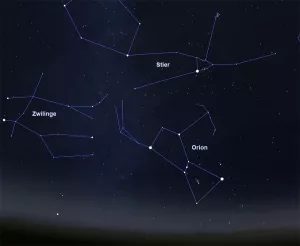
After midnight, the calendar accelerates. The first winter signs begin their ascent in the east. The hunter Orion rises quickly. Its three belt stars are impossible to miss. They form a precise, straight line. Nearby, the Bull Taurus glows with a reddish eye.
Astrophotographers and casual stargazers alike are tracking a specific event. The moon and Taurus have a close encounter on October 9 and 10. This is not a coincidence of timing. It is a predictable celestial alignment.
On the first night of this pair, the nearly full moon sits extremely close to Aldebaran, the star at the center of Taurus’s fiery eye. By the second night, the moon moves directly between the Bull’s horns. It is a striking visual contrast. The dark cratered surface of the moon against the bright star fields.
Cassiopeia and the Dipper’s Low Arc
Two other constellations define the October sky due to their extreme positions. They are always visible, but their height varies wildly.
Cassiopeia forms a distinct “W” shape. Tonight, that W sits high overhead. It is nearly at the zenith. You do not need to look far to see it. It dominates the upper sky.
Conversely, the Big Dipper—the asterism part of Ursa Major—dips incredibly low. It appears to skim the horizon. The handle seems to sweep along the edge of the visible world. This low trajectory makes it harder to observe through atmospheric haze.
Why do these positions matter? They provide immediate orientation. If the W is high, you are looking north correctly. If the Dipper is low, you know your latitude and the time of night. It is a simple check.
The stars are not static. They drift. What is high tonight will be different next month. But for now, the autumn shapes hold firm. Orion waits in the east. Pegasus claims the center. The moon chases the Bull.

Venus and Mars Align in October Morning Sky
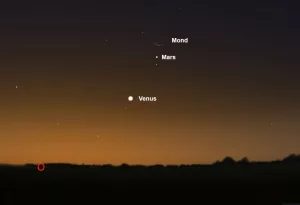
The morning sky belongs to Venus this October. That bright light spot over the east horizon pops up around 05:00 am. It’s the morning star. Mars shows up too. It’s darker. Reddish. You won’t see much of it at the start of the month. It gets better as October goes on.
The Big Rendezvous
Look up on the mornings of October 16 and 17. You’ll catch a special show. Mars and Venus get close. Venus sits just three finger widths to the lower left of Mars.
The moon joins the party. A thin crescent of the waning moon slides past them. On October 16 it passes just above the pair. The next day, October 17, it slips below them.


