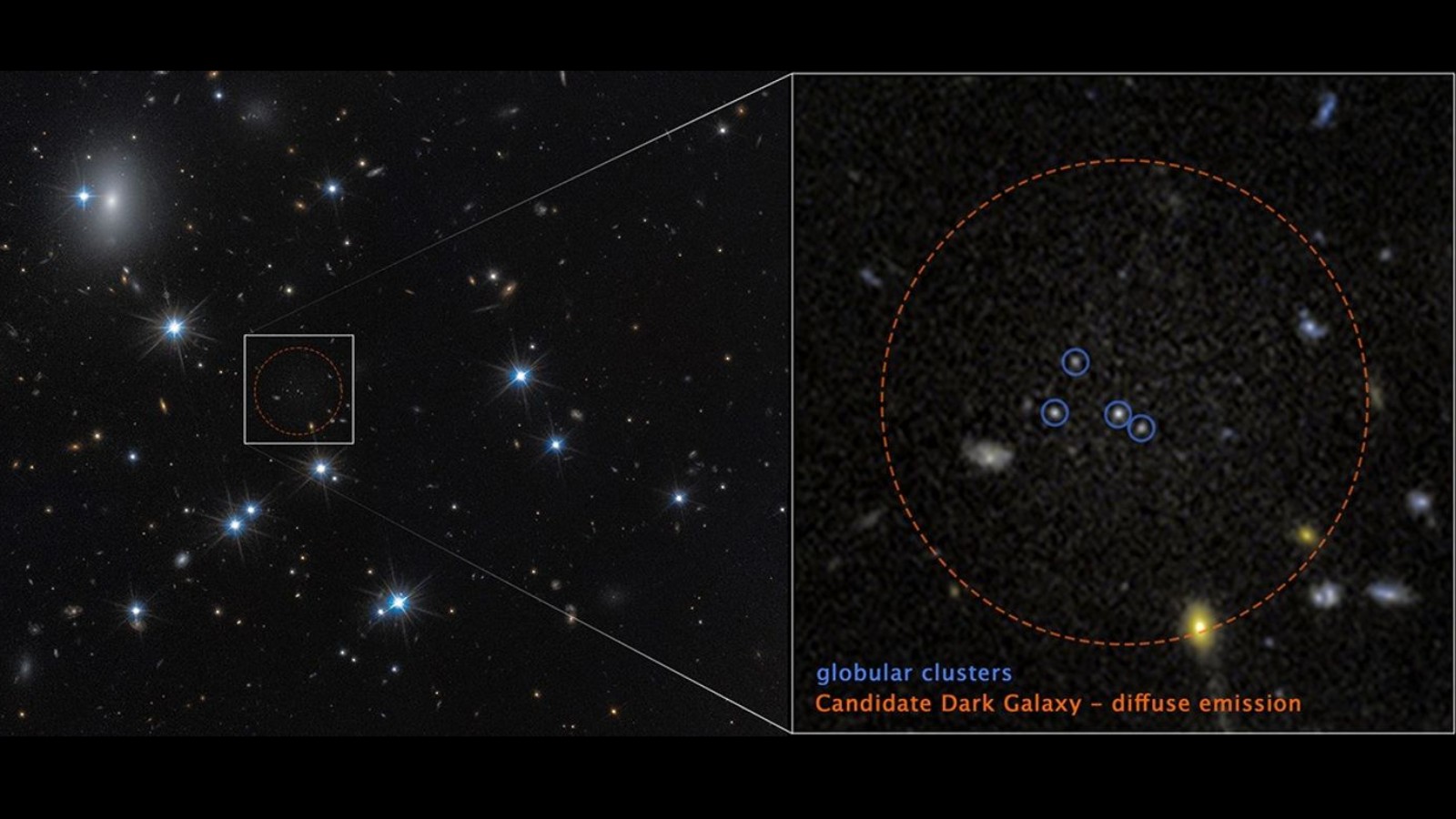
Astronomers have identified an exceptionally dark-matter-dominated galaxy, designated CDG-2, which is 99% dark matter by mass. This discovery, made using the Hubble and Euclid Space Telescopes, challenges our understanding of how galaxies form and evolve. It also showcases the power of new observational techniques in detecting structures previously hidden in plain sight.
The Ghostly Nature of CDG-2
Located approximately 245 million light-years away, CDG-2 is an almost invisible galaxy due to its extremely low star count. Standard galaxies are held together by dark matter, which outweighs visible matter roughly five to one. However, CDG-2 is an extreme outlier: dark matter makes up 99% of its total mass.
The reason this is significant is because dark matter, while undetectable by light, exerts a gravitational pull that governs the structure of galaxies. Without it, galaxies would fly apart. CDG-2’s extreme composition suggests that some galaxies may form in environments where dark matter dominates almost completely.
How Was This Galaxy Detected?
The team discovered CDG-2 while studying dense clusters of stars, called globular clusters. These clusters often hint at the presence of faint, nearby galaxies. After identifying ten low-brightness candidates, researchers turned to Hubble, Euclid, and the Subaru Telescope in Hawaii for confirmation.
Hubble data revealed four tightly grouped globular clusters in the Perseus galaxy cluster (300 million light-years away). Further observations revealed a faint glow surrounding these clusters, confirming the existence of a hidden, nearly invisible galaxy.
“This is the first galaxy detected solely through its globular cluster population,” says David Li of the University of Toronto.
The Mystery of Missing Stars
CDG-2’s faintness suggests it once held more stars, but these have likely been stripped away by gravitational interactions with other galaxies. Globular clusters, however, are dense enough to resist such disruption, making them the only remaining tracers of this ghostly galaxy.
The galaxy contains approximately 6 million sun-like stars, but the bulk of its mass is still dark matter. This means that CDG-2 could be a relic of the early universe, where dark matter halos formed first, and visible matter accumulated later.
Implications and Future Research
The discovery of CDG-2 provides a rare glimpse into a galaxy pushed to the extreme end of dark matter domination. Studying such objects helps astronomers refine their models of galaxy formation and better understand the distribution of dark matter in the universe. Future research will focus on finding similar extreme galaxies to test whether CDG-2 is an anomaly or part of a larger population.
This discovery reinforces the idea that dark matter is not just a mysterious component of the universe but an active force shaping the structure of galaxies.