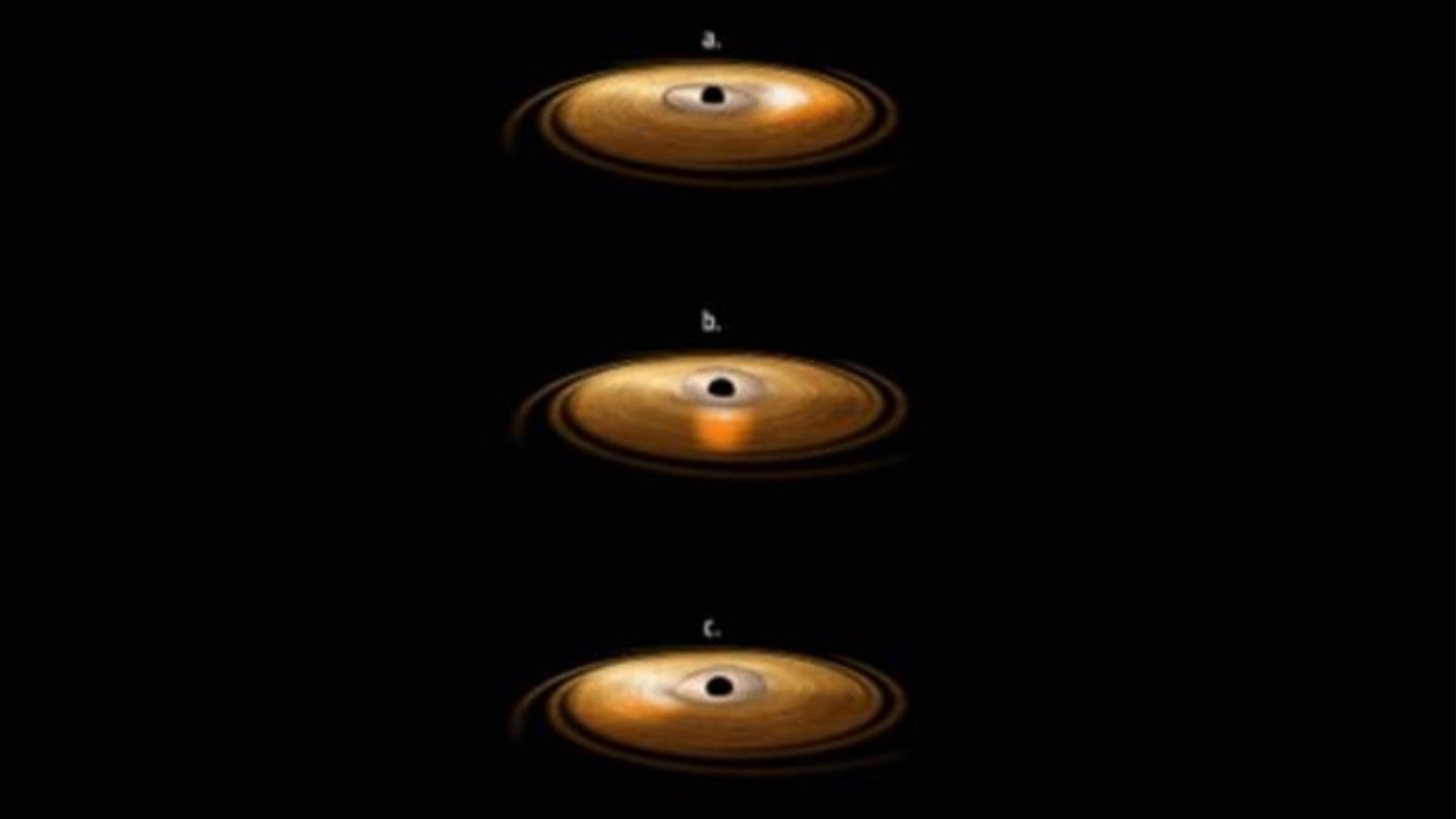
Astronomers have directly observed a supermassive black hole twisting the fabric of spacetime around itself, confirming a century-old prediction from Albert Einstein’s theory of general relativity. The phenomenon, known as frame-dragging or the Lense-Thirring effect, was detected in a star being torn apart by the black hole’s gravity, providing unprecedented evidence of how these cosmic giants warp reality.
The Science Behind Spacetime
Einstein’s 1915 theory proposed that mass distorts spacetime – the unified concept of space and time – creating what we experience as gravity. More massive objects create greater distortions. In 1918, Josef Lense and Hans Thirring mathematically showed that rotating massive objects would drag spacetime along with their motion, like a spinning top pulling water in a whirlpool. This effect has been notoriously difficult to measure directly.
Why this matters: The confirmation of frame-dragging offers a new tool for studying black holes. We can now probe their spin, how they devour matter (through tidal disruption events, or TDEs), and the powerful jets of energy they emit.
Wobbling Evidence from a Stellar Feast
The observation centers on a tidal disruption event (TDE) called AT2020afhd, where a star ventured too close to a supermassive black hole. The black hole’s gravity stretched the star into a strand of material – a process nicknamed “spaghettification” – before consuming it. As the stellar debris swirled into an accretion disk around the black hole, the team noticed a rhythmic wobble in its X-ray and radio emissions.
This wobble, repeating every 20 Earth-days, was not random. It matched the expected signature of frame-dragging: the black hole literally twisting the space around it.
How the Observation Was Made
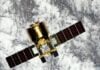
The team used data from NASA’s Neil Gehrels Swift Observatory (X-ray observations) and the Karl G. Jansky Very Large Array (radio waves) to track the TDE. Unlike previous TDEs, AT2020afhd exhibited short-term signal changes that couldn’t be explained by ordinary energy release. This confirmed the team’s suspicion that the black hole was dragging space around itself.
“Our study shows the most compelling evidence yet of Lense-Thirring precession… a black hole dragging space time along with it,” said Cosimo Inserra of Cardiff University. “This is a real gift for physicists.”
Gravitomagnetism and Future Research
The discovery suggests that rotating massive objects generate a “gravitomagnetic field,” similar to how rotating charged objects create magnetic fields. This opens new avenues for understanding black hole physics and the extreme environments around them. Further analysis could refine our understanding of frame-dragging and its implications for the universe.
In conclusion: The observation of spacetime being dragged by a black hole is not just a confirmation of Einstein’s theory but a crucial step in unlocking the mysteries of these cosmic behemoths. It provides a new method for probing black holes, their feeding habits, and the violent processes they trigger, offering deeper insight into the most extreme physics in the cosmos.