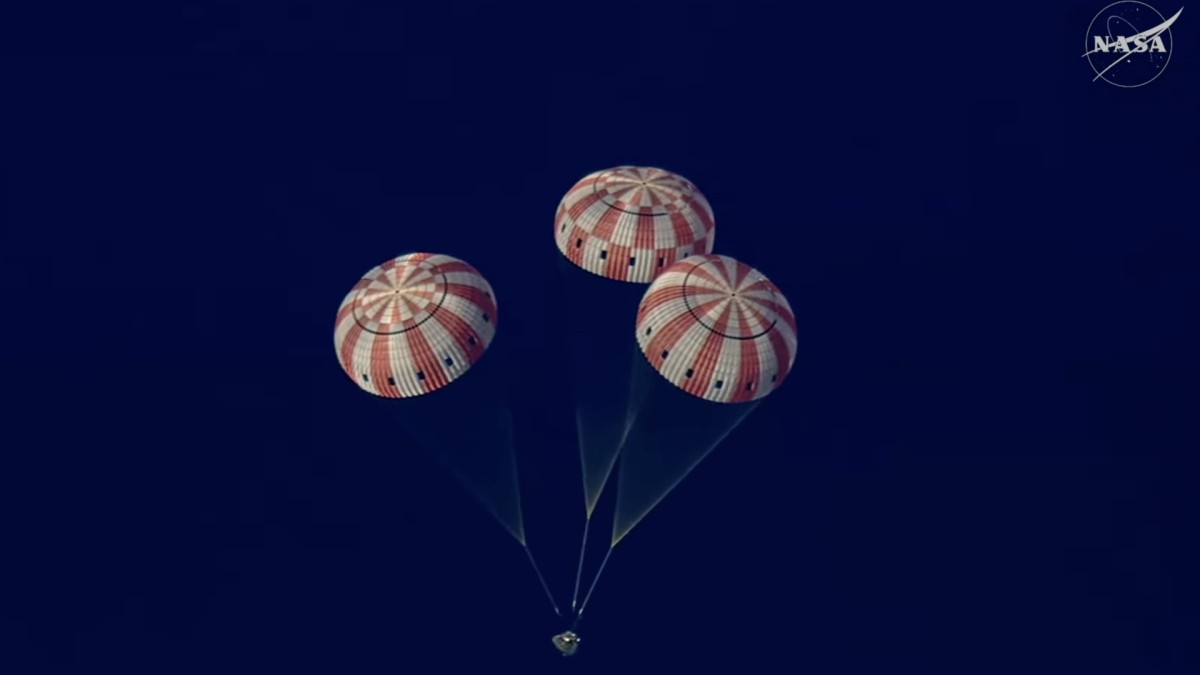
The Artemis II mission has officially concluded, with the crew module Integrity successfully splashing down in the Pacific Ocean off the coast of San Diego at 5:07 p.m. PT. Despite a high-stakes final descent, the four-person crew returned to Earth safely, marking a pivotal milestone in NASA’s modern lunar exploration program.
A High-Stakes Descent
The final half-hour of the mission was a complex series of technical maneuvers designed to ensure a safe reentry into Earth’s atmosphere. The crew—Commander Reid Wiseman, Pilot Victor Glover, Christina Koch, and Jeremy Hansen —navigated several critical phases:
- Separation and Reorientation: The crew module detached from its service module and performed a “raise burn” to optimize its trajectory for reentry.
- The Communications Blackout: As the spacecraft hit the atmosphere, the crew experienced a planned six-minute blackout, during which no signals could be transmitted.
- Parachute Deployment: The descent concluded with the deployment of three large red-and-white parachutes to stabilize the module upon impact.
Upon hitting the water, the crew was reported as “green”—mission terminology indicating that all personnel are healthy and all systems are functioning correctly. The only minor technical issue reported was a non-functional satellite phone.
Why This Mission Matters
The Artemis II mission was more than just a flight; it was a rigorous test of human endurance and hardware reliability. By looping around the Moon, the crew traveled further from Earth than any human being in history.
This mission serves three strategic purposes for NASA and the United States:
- Technical Validation: It tested the life-support systems and flight controls necessary to sustain humans in deep space, providing the data needed for a planned moon landing in 2028.
- The Path to Mars: The Moon serves as a “proving ground.” NASA intends to master long-term human survival in lunar environments before attempting the much more ambitious journey to Mars.
- Geopolitical Competition: The mission is part of a broader “space race” context. The U.S. is working to establish a consistent lunar presence to maintain leadership in space exploration, particularly as China accelerates its own lunar ambitions.
Looking Ahead
The successful return of the Artemis II crew validates the hardware and procedures required for the next era of deep-space exploration. This mission has bridged the gap between the Apollo era and the future of human habitation on other worlds.
“The moon looks smaller than it did yesterday,” Commander Wiseman remarked during the descent, a lighthearted moment that underscored the successful completion of their lunar loop.
The successful splashdown confirms that NASA’s systems are capable of supporting humans in deep space, setting the stage for the first crewed lunar landings in over half a century.