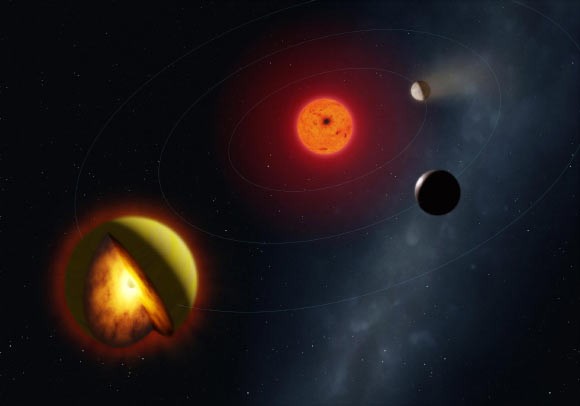
Astronomers have discovered a unique exoplanet, L 98-59d, that appears to be entirely covered in molten rock and harboring vast amounts of sulfur deep within its interior. This finding challenges current classifications of exoplanets and suggests the potential for a previously unknown class of worlds in the Milky Way.
Discovery Details
L 98-59d resides in a five-planet system, L 98-59, located approximately 34.5 light-years from Earth in the Volans constellation. The host star, an M-dwarf named TOI-175, is smaller and cooler than our Sun, yet the planet receives four times more radiant energy than Earth.
Orbiting its star every 7.5 days, L 98-59d is 1.6 times the size of Earth. Researchers, led by Harrison Nicholls at the University of Oxford, reconstructed the planet’s five-billion-year history by linking telescope observations with physical models of planetary interiors.
A Global Magma Ocean
The study reveals that L 98-59d likely possesses a global magma ocean thousands of kilometers deep beneath its surface, composed of molten silicate—similar to Earth’s lava. This molten reservoir allows the planet to retain extremely high levels of sulfur within its interior over geological timescales.
The magma ocean also enables the planet to maintain a thick, hydrogen-rich atmosphere containing sulfurous gases such as hydrogen sulfide. Normally, this atmosphere would dissipate into space due to radiation from the host star. However, the planet’s internal heat and magma ocean help it retain this volatile-rich envelope.
Implications for Exoplanet Diversity
The research suggests that L 98-59d could be the first discovered member of a larger population of gas-rich, sulfurous exoplanets with long-lived magma oceans. This implies that the diversity of worlds beyond our Solar System may be greater than previously assumed.
According to Dr. Nicholls, “This discovery suggests that the categories astronomers currently use to describe small planets may be too simple.” The planet is unlikely to support life, but its existence underscores the wide variety of planetary environments beyond Earth.
The findings were published in Nature Astronomy on March 16, 2026.
This discovery raises the question of how many other extreme planets await detection, challenging our current understanding of planetary formation and evolution.