The Moon is currently in a Waxing Gibbous phase, meaning it’s almost fully illuminated. As of today, March 31, 2026, approximately 97% of the Moon’s visible surface is lit by the Sun. This makes for an excellent viewing opportunity, even without specialized equipment.
What You Can See Tonight
For casual observers, the Moon’s brighter regions – like the Kepler Crater, Mare Vaporum, and Mare Serenitatis – will be readily visible. Using binoculars enhances the experience, revealing features like the Mare Nectaris, Alphonsus Crater, and Endymion Crater. Those with telescopes can explore even finer details, including the Descartes Highlands, Caucasus Mountains, and the small Linne Crater.
Next Full Moon: April 1st
The next Full Moon is predicted to occur in North America on April 1st. This means that by tomorrow night, the entire visible surface of the Moon will be brightly lit.
Understanding Lunar Phases
The Moon orbits Earth roughly every 29.5 days, cycling through eight distinct phases. These phases aren’t about the Moon changing shape, but rather the varying amounts of the sunlit side we see from Earth.
Here’s a breakdown of each phase:
- New Moon: The Moon is positioned between Earth and the Sun; the side facing us is entirely unlit and therefore invisible.
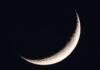
- Waxing Crescent: A sliver of light appears on the right side (in the Northern Hemisphere), growing night by night.
- First Quarter: Half of the Moon is illuminated on the right side, resembling a half-circle.
- Waxing Gibbous: More than half of the Moon is lit, but it’s not yet full.
- Full Moon: The entire face of the Moon is brightly lit and fully visible.
- Waning Gibbous: The Moon begins to lose light on its right side (Northern Hemisphere).
- Third Quarter (Last Quarter): Another half-Moon, but this time the left side is lit.
- Waning Crescent: A thin sliver of light remains on the left side before the cycle restarts.
The Moon’s phases are a predictable and visually striking phenomenon caused by simple orbital mechanics. By understanding them, you can easily track the Moon’s progress and enjoy its beauty in the night sky.