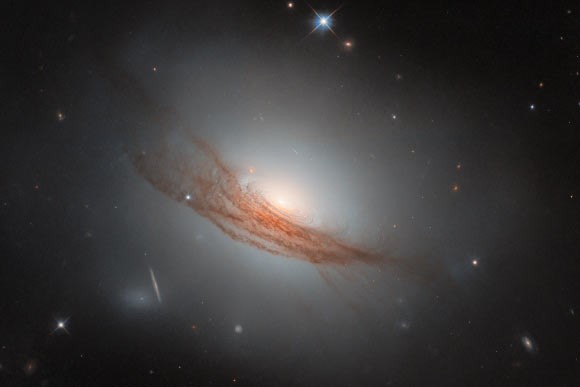
A new image from the NASA/ESA Hubble Space Telescope showcases the lenticular galaxy NGC 7722, revealing striking dust lanes that hint at its tumultuous past. Located 187 million light-years away in the Pegasus constellation, this galaxy offers astronomers valuable clues about galactic evolution.
A Galaxy Between Types
NGC 7722 doesn’t neatly fit into the standard categories of spiral or elliptical galaxies. Instead, it occupies a middle ground as a lenticular galaxy – a type characterized by a central bulge and a disk, but lacking the prominent spiral arms of its more familiar cousins.
“Lenticular galaxies are less common because they can be tricky to classify, often appearing as a blend of spiral and elliptical features,” explain Hubble astronomers. NGC 7722 exemplifies this ambiguity, displaying an extended halo and bright central bulge reminiscent of ellipticals, while still retaining a visible disk with concentric rings.
The Story in the Dust
The most captivating feature of NGC 7722 is the long, winding lanes of dark red dust encircling its outer disk and halo. These aren’t just aesthetic; they are strong evidence of a past galactic merger.
“Dust lanes like these are not uncommon in lenticular galaxies, and they stand out against the broad, smooth halo of light that typically surrounds them.”
Astronomers believe these structures formed when NGC 7722 collided with another galaxy, reshaping its structure and enriching it with new dust. This process is thought to be a key mechanism in the formation of lenticular galaxies.
Unraveling Galactic Evolution
The precise origins of lenticular galaxies remain a mystery, but gravitational interactions and mergers are increasingly recognized as significant drivers of their formation. These events can strip galaxies of their gas reserves while simultaneously introducing fresh dust, altering their appearance and evolution.
Hubble’s Wide Field Camera 3 captured the latest image, bringing these dust lanes into sharp detail. This observation contributes to our growing understanding of how galaxies change over cosmic time, a critical part of understanding the universe itself.
In conclusion, NGC 7722 stands as a testament to the dynamic processes that shape galaxies. Its unique structure and striking dust lanes provide a visible record of its past interactions and offer insight into the broader mechanisms of galactic evolution.