It sounds like a sci-fi plot twist. Or just bad weather.
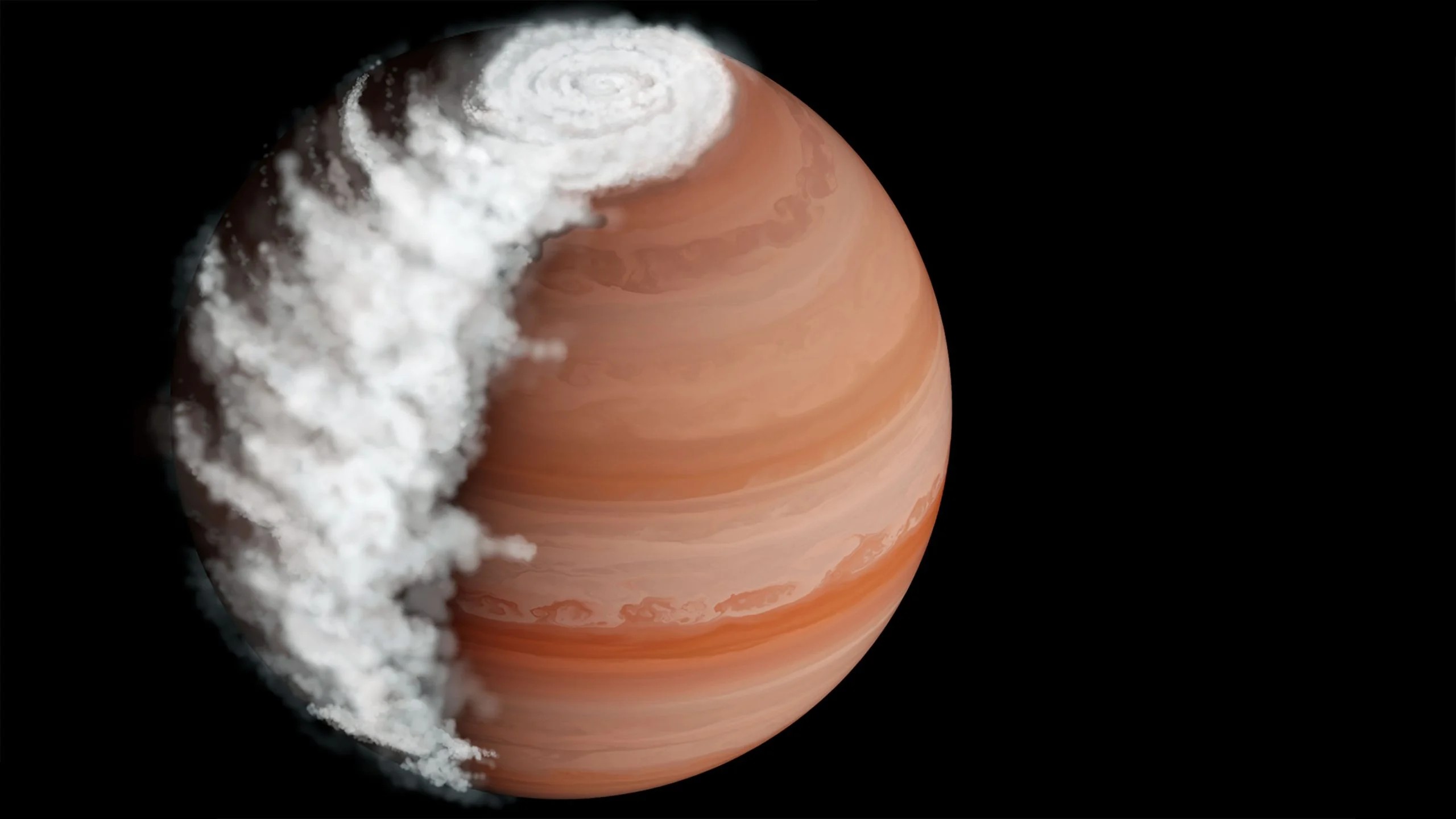
On the exoplanet WASP-94-Ab, the morning starts thick with fog. Not water vapor. Rock. Literally. Clouds made of magnesium silicate hang low in the sky, obscuring everything below them.
Then comes the day side. The heat hits. 1,832°F. And those rocky clouds? Gone. Evaporated.
The evening clears up completely. It is a daily cycle. A dramatic, violent, repeatable shuffle of matter that scientists at the James Webb Space Telescope have finally watched in high definition.
“General cloudiness has been a thorn our side… it’s like trying to look at the planet trough a foggy window.” — David Sing, Johns Hopkins
This is Hot Jupiter territory. The planet orbits impossibly close to its star, far closer than Mercury is to the sun. Located nearly 700 years out in Microscopium. Too far for a photo. Too close to see through a traditional telescope.
We have the JWST for that.
The morning vs. evening divide
The team didn’t just stare at the planet. They tracked the light as it passed its star. Transit spectroscopy. But instead of averaging the whole disk, they looked at the edges.
The leading edge is morning. The atmosphere moves from night into day. Cold. Condensing. Clouds form out of silicates in the dark, lifting into the higher, cooler atmospheric layers.
The trailing edge is evening. Day into night. But by then the atmosphere has been roasted. The clouds hit temperatures exceeding 1,00°C. They vanish. Vaporized before sunset.
Is it wind pushing the clouds down? Maybe. The hot dayside forces the atmosphere downward. Hides the remnants deep inside the planetary interior. Or is it purely thermal? Like mist burning off Earth pavement in August, only extreme enough to turn rocks to gas.
Either way the dichotomy is real. Mornings are cloudy. Evenings are clear.
That separation matters. It fixes the math.
A clearer chemistry problem
Here is the puzzle scientists had for years.
When looking with Hubble, or older telescopes, we got an averaged view. Cloudy parts. Clear parts. Squished together. The data suggested this planet had hundreds of times more carbon and oxygen than Jupiter. Impossible. Planet formation models couldn’t handle it. The numbers just didn’t fit the theory of how giant planets build themselves.
With JWST isolating the clear evening side, they could measure the chemistry directly. Without the fog blocking the signal.
The new answer? It isn’t exotic.
It isn’t a chemical miracle. The oxygen and carbon levels are only about five times higher than Jupiter’s. Totally normal. Reasonable.
The mystery was just bad visibility. The cloud layer had been masking the baseline data all along.
Not unique anymore
This isn’t an anomaly. At least not yet.
The team used this finding to check seven other gas giants. They found similar morning-to-evening cloud shifts on two of them. WASP-39b and WASP-17b. Both showing signs of diurnal cycles.
If the weather turns over on three giants this close to home (relatively speaking) who else is doing it?
“We saw a real dichotomy… and that changes our whole picture.” — David Sing
Next up? They have a massive data pipeline running. More JWST time. More clouds to hunt. Even a planet with a wobbly, eccentric orbit that sits right in the habitable zone will get scanned.
The sky on WASP-94b is clearing out tonight. What we find there might look familiar. Or it might look entirely alien. The data will tell us. Or the fog will roll back in.