Forget fiction. The real thing is walking around in China.
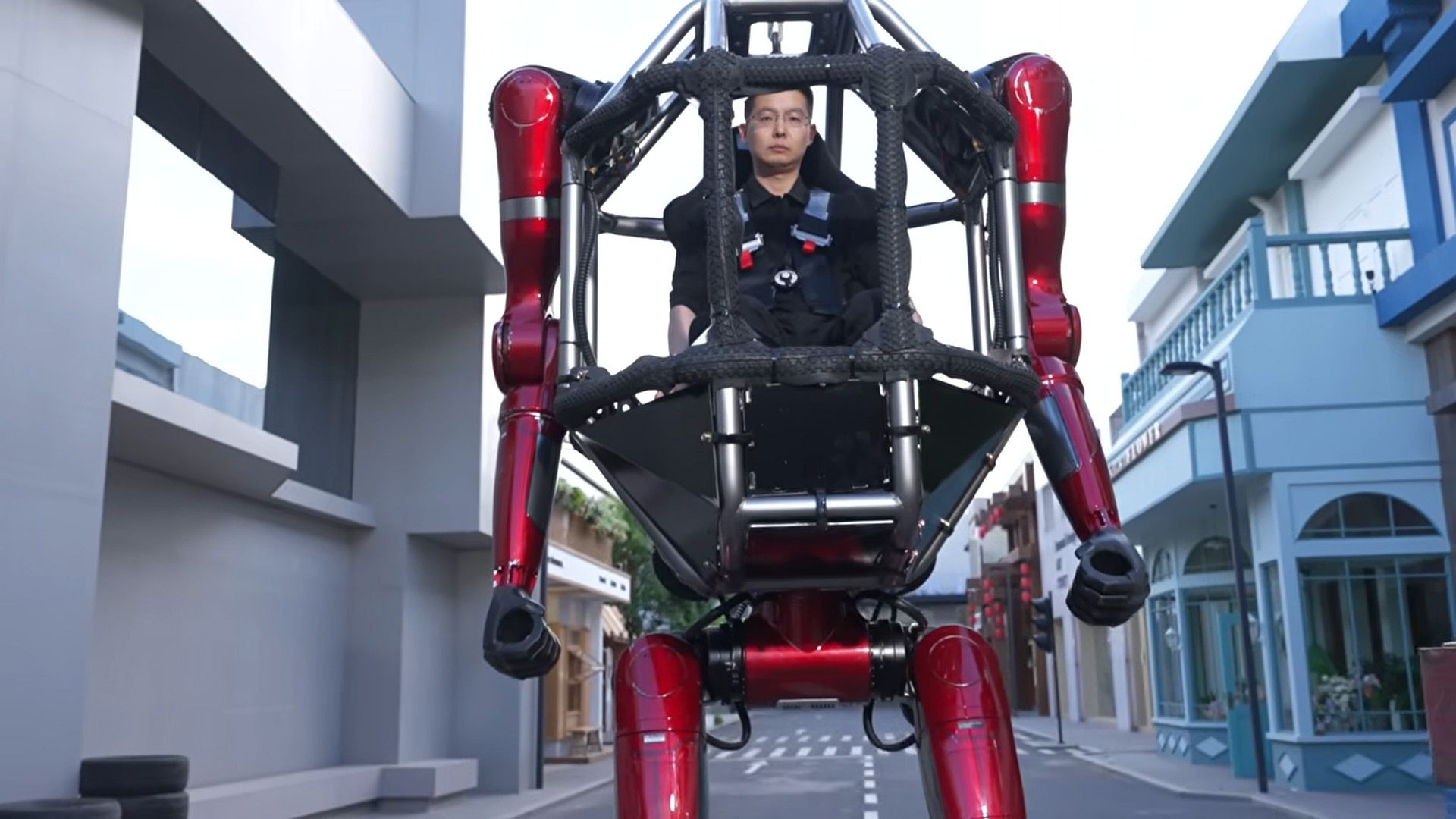
Chinese engineers built a humanoid robot that switches modes on the fly. Four legs. Then two. It looks like a cross between the Power Loader from Aliens and those mobile suits from Gundam. Unitree is the developer. They call this beast the GD01.
The GD01 walks upright. It smashes through a high wall of cinder bricks. Then it reconfigures to walk on all fours.
Cinematic? Yes. Practical? Maybe.
Here are the hard numbers. It stands nearly 10 feet tall. It weighs 1,100 pounds (500 kg) with a pilot inside. And the best part? You can actually buy it. Starting at 3.9 million RMB. That is $572,00 for the civilian transport bot.
The build is serious. Titanium alloy skeleton. Aerospace-grade aluminum. A carbon-fiber shell wraps the whole thing. Unitree calls it the world’s first mass-produceable “transformable mecha.” They also added a polite note to use it in a “friendly and safe manner.” Because why not.
But getting in isn’t graceful. The video shows an operator awkwardly climbing up the machine’s leg just to reach the cockpit. Awkward. And interestingly? The first shots show remote control. No human in the seat. Just a camera view. So who is driving it?
Unitree isn’t new to this. A robotics startup based in Hangzhou, China. They are famous for smaller, cheaper bots. Look at their catalog. The R1-D torso costs $4,290. The H1 general-purpose model is $90,000. Equipped with LiDAR, depth cameras, and the proprietary M107 motor. That motor prioritizes torque, speed, and agility.
At a recent spring gala in February, these smaller humanoids were breakdancing. Synchronized routines. Complex martial arts. Impressive, sure. But the GD01? It’s built for rough ground.
They haven’t dropped a technical paper on it yet. But you can see the DNA. Unitree makes quadruped robots too. The B2 model climbs stairs. It stays upright after heavy hits. It leaps across gaps. Even swaps legs for wheels if you want.
These quadrupeds run on fish-eye binocular cameras. Seeing front, bottom, sides all at once. Perception algorithms drive the movement. Self-developed motors. Controllers. Reducers. It is a vertical stack of in-house tech.
So we have a million-dollar robot that dances on all fours. Do we really need to smash through brick walls with it? Probably not.
But they sold it. The question isn’t if it works.