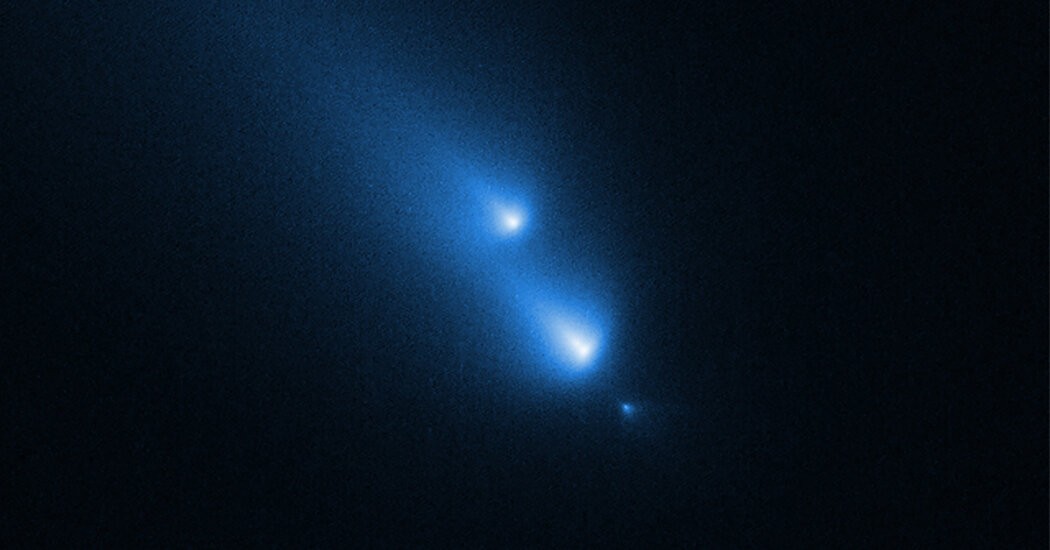
Astronomers have witnessed a rare event: the disintegration of comet C/2025 K1 (ATLAS), captured in unprecedented detail by the Hubble Space Telescope. The comet, roughly five miles long, began to break apart between November 8th and 10th, fragmenting into four or possibly five distinct pieces surrounded by vaporized ice.
Why This Matters
Cometary breakups are not uncommon. These icy bodies often disintegrate as they approach the sun, where intense heat causes their volatile components to vaporize explosively. However, directly observing the initial stages of this process is rare, providing astronomers with a unique opportunity to study the inner structure of a comet.
The Observation
While ground-based telescopes detected only faint smudges of light, Hubble’s high resolution revealed each fragment clearly. This allowed scientists to analyze the comet’s icy core as it fractured, offering insights into the forces at play during its demise.
Comet K1’s Discovery and Significance
Comet K1 was first identified in May by the Asteroid Terrestrial-impact Last Alert System (ATLAS), a NASA-funded network designed to detect potentially hazardous space objects. This system is also responsible for spotting other notable comets, including the interstellar visitor 3I/ATLAS.
The Fate of Comets
Comets frequently journey through our solar system, with some venturing dangerously close to the sun. Many do not survive this close proximity, their nuclei shattering into smaller pieces that either melt away or are ejected back into space.
“This is the sort of thing that’s happening all the time in the solar system,” explains planetary scientist John Noonan of Auburn University. “But it’s unusual to see a comet just beginning to break apart.”
The Hubble Telescope observation provides a rare glimpse into this destructive process, furthering our understanding of cometary composition and behavior. The fragmentation of K1 underscores the dynamic and often violent nature of our solar system.