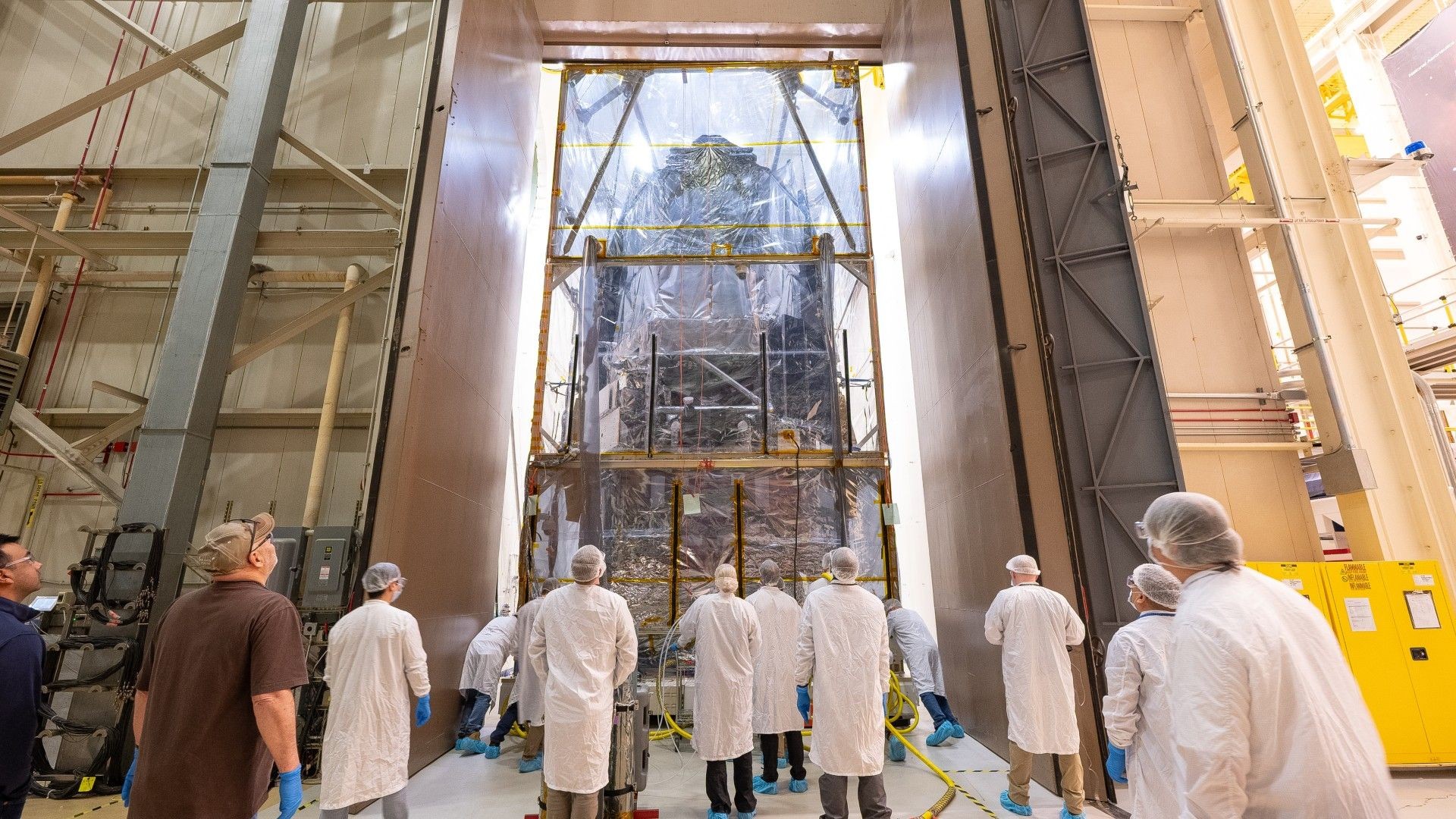
NASA’s Nancy Grace Roman Space Telescope, a $4 billion next-generation observatory, has successfully completed critical vibration and acoustic testing, bringing it one step closer to launch. These tests simulate the extreme conditions of liftoff, ensuring the telescope and its instruments survive the journey into orbit.
What Was Tested?
Engineers at NASA’s Goddard Space Flight Center subjected Roman to two key trials:
- Acoustic Testing: The telescope was placed in a soundproof chamber and exposed to noise levels up to 138 decibels – comparable to a jet engine at close range. This simulates the intense sound pressure experienced during launch. As Cory Powell, the lead structural analyst, explains: “The acoustics can produce very high loads on a large structure like Roman.”
- Vibration Testing: Roman was mounted on a shaker table, replicating the violent vibrations of a rocket launch. This ensures all components remain intact under stress.
Why This Matters 🔭
These tests aren’t just a formality; they’re essential to protecting a massive investment. The Roman Space Telescope represents cutting-edge astrophysics, promising to revolutionize our understanding of the universe.
This new telescope is not just another Hubble. It features an 8-foot mirror, offering a field of view 100 times larger than Hubble’s. Moreover, Roman includes a coronagraph, a specialized instrument that blocks out starlight to reveal hidden planets orbiting distant stars.
What Will Roman Discover? 🌌
Once operational (estimated for fall 2026), the Roman Space Telescope is expected to:
- Map large-scale cosmic structures.
- Measure the effects of dark energy and dark matter.
- Detect black holes at extreme distances.
- Potentially identify tens of thousands of exoplanets – planets orbiting other stars.
These capabilities mean the Roman Space Telescope could dramatically accelerate our search for habitable worlds and unveil previously hidden aspects of the universe.
The successful completion of these tests is a major milestone. It confirms that Roman is on track to deliver groundbreaking scientific data, pushing the boundaries of space exploration.