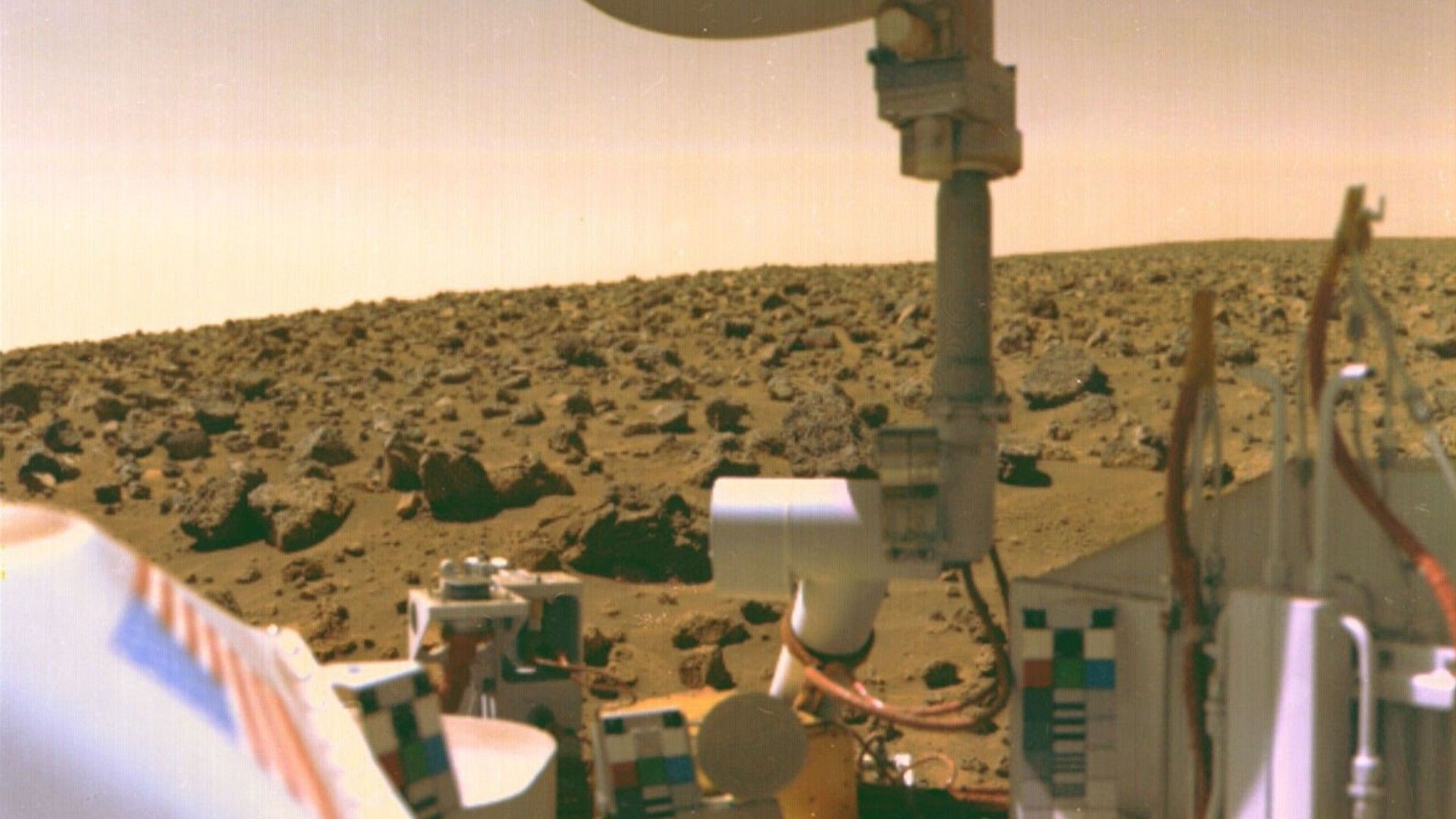
Fifty years after the Viking missions landed on Mars in 1976, scientists are revisiting data that suggests the Red Planet might not be as lifeless as previously believed. The initial conclusion – that Mars lacked life – stemmed from an apparent mismatch: three life-detection experiments produced positive results, yet the Gas Chromatograph-Mass Spectrometer (GC-MS) failed to find organic molecules, the building blocks of life.
The Original Dismissal
At the time, the Viking Project Scientist Gerald Soffen declared, “No bodies, no life,” dismissing the positive results because the GC-MS didn’t detect expected organic compounds. This interpretation stuck, becoming the dominant narrative in astrobiology for decades. The apparent absence of organics was attributed to an unknown oxidant destroying them, while unexpected gas releases were blamed on terrestrial contamination or atmospheric interference.
Re-Evaluating the Data
Now, a team led by Steve Benner argues that the GC-MS did detect organic molecules – just in a degraded form. The instrument heated Martian soil samples to vaporize any organics, but instead of finding them, it detected an unexpected surge in carbon dioxide and traces of methyl chloride. The original Viking team believed this meant no organics existed, requiring a mysterious oxidant to explain the other positive life-detection tests.
However, Benner’s team points to a critical discovery made in 2008: perchlorate on the Martian surface. Perchlorate is an oxidant, but not strong enough to account for the Label Release experiment’s results. The key insight came from Rafael Navarro-González in 2010, who demonstrated that organics combined with perchlorate produce methyl chloride and carbon dioxide – precisely what Viking’s GC-MS detected.
The BARSOOM Model
This reinterpretation strengthens the case that the three original life-detection experiments – measuring radioactive carbon metabolization, oxygen emission, and carbon fixing – may have genuinely detected Martian life. Benner and his colleagues propose a model they call BARSOOM (Bacterial Autotrophs that Respire with Stored Oxygen On Mars) to explain how such microbes could exist. These hypothetical bacteria would use photosynthesis, storing oxygen for nighttime respiration, aligning with the oxygen emissions Viking observed.
The Lost Debate
Benner believes the initial dismissal of Viking’s data stifled scientific debate for half a century. Instead of a thorough discussion, the narrative became fixed: Mars is lifeless. He now calls for a renewed examination of the evidence, arguing that the original misinterpretation has set astrobiological research back decades.
The question of whether Viking found life on Mars remains open, but the re-evaluation of old data suggests that the Red Planet’s potential for life may have been overlooked for too long. This calls for a re-examination of existing evidence, rather than relying solely on modern missions that may be operating under biased assumptions.