


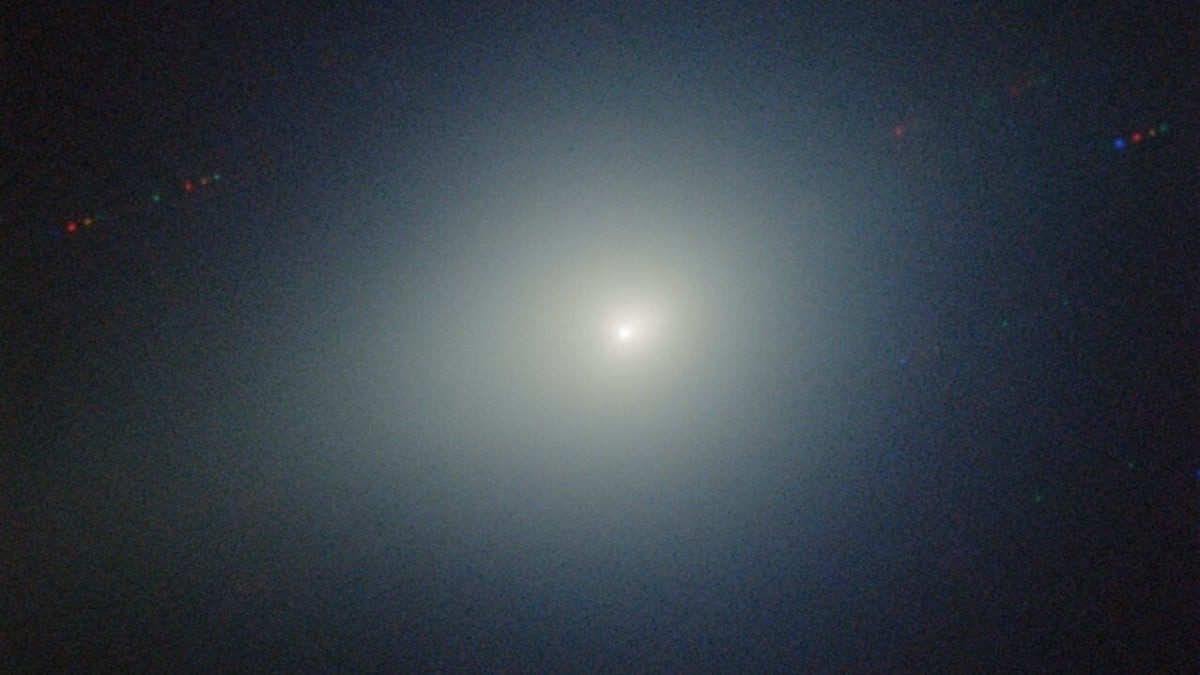
The comet 3I/ATLAS, a visitor from beyond our solar system, is undergoing a striking transformation as it recedes from the sun: shifting from reddish to greenish hues. This color change isn’t just aesthetic; it provides astronomers with valuable clues about the comet’s composition and behavior, offering a rare glimpse into materials originating from another star system.
The Color Shift Explained
The comet initially appeared redder as it approached the sun, a result of gases in its coma (the cloud of gas and dust surrounding the nucleus) heating up and emitting light. This process occurs when frozen materials sublimate directly into gas, bypassing the liquid phase. As 3I/ATLAS moved away from the sun, new gases began escaping, some of which emit a faint green glow detectable by telescopes like Gemini North in Hawaii.
This shift is significant because it demonstrates how the comet reacts to solar heat and releases different compounds over time. By tracking these changes, scientists can better understand what 3I/ATLAS is made of and how interstellar objects behave.
X-Ray Observations Reveal Hidden Gases
Complementing the visible light observations, the European Space Agency’s XMM-Newton spacecraft observed the comet in X-rays for nearly 20 hours. X-rays, though invisible to the human eye, are produced when gases flowing off the comet collide with the solar wind. This collision reveals gases like hydrogen and nitrogen, which are difficult to detect through other means.
These X-ray observations are especially valuable because they allow scientists to identify gases that would otherwise remain hidden. The data confirms that 3I/ATLAS possesses a unique composition compared to comets formed within our solar system.
A Rare Interstellar Visitor
Comet 3I/ATLAS is only the third confirmed interstellar object to be sighted, following ‘Oumuamua (2017) and Comet 2I/Borisov (2019). Traveling at roughly 137,000 mph, it’s a transient visitor that will not return, having been ejected from another star system hundreds of millions of years ago.
The comet’s high speed is a crucial detail: it means the object is passing through rather than being captured by our sun’s gravity. This makes it an exceptional opportunity for study, as scientists can analyze materials from a different stellar neighborhood without the complications of long-term orbital interactions.
What Makes 3I/ATLAS Unique?
Early data suggests the comet’s carbon dioxide-to-water ratio differs from those found in our solar system, and researchers have detected unusual amounts of metals and dust. Despite speculation about alien spacecraft, NASA officials emphasize that the observed differences are consistent with a cometary body from a different stellar environment.
As NASA scientist Tom Statler aptly put it: “It’s different, and yet it’s still coffee.” In this case, the comet resembles those native to our solar system but exhibits exciting, unique characteristics.
Multiple spacecraft, including Hubble, James Webb, and others, have been directed toward 3I/ATLAS to gather as much data as possible before it exits the solar system. The latest observations are also being shared with the public through real-time telescope events, allowing for increased transparency and engagement in the scientific process.
The study of 3I/ATLAS offers an unprecedented chance to learn about the formation and evolution of objects beyond our solar system, providing insight into the diverse range of materials that exist across the galaxy.


