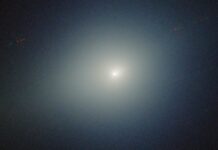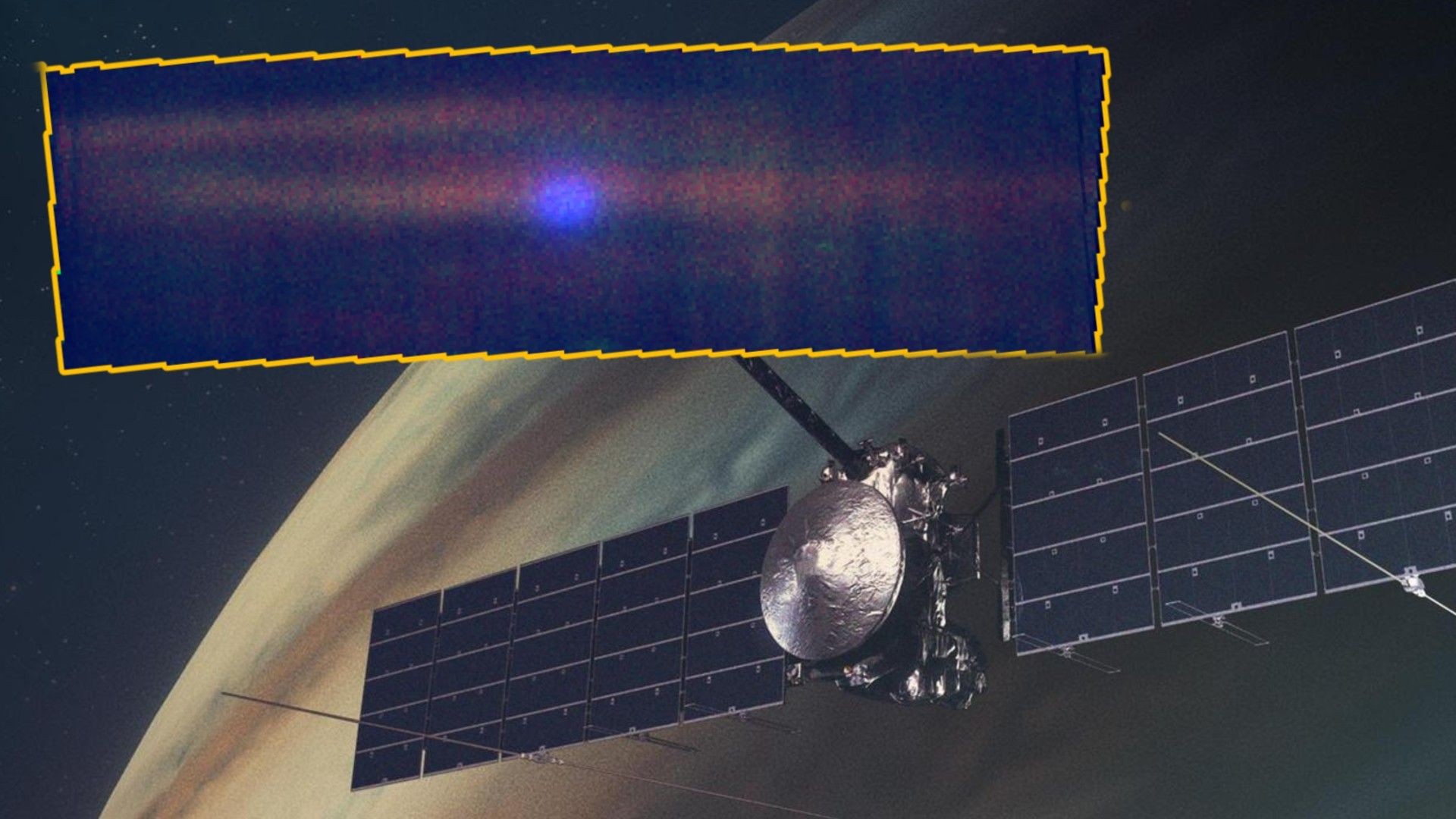
A NASA spacecraft, the Europa Clipper, has unexpectedly captured a high-resolution ultraviolet image of the interstellar comet 3I/ATLAS. This observation isn’t part of the Clipper’s primary mission to search for life on Jupiter’s moon Europa, but a fortunate alignment that allows scientists to study the comet’s composition as it makes a rare close approach to Earth.
Comet 3I/ATLAS: A Speedy Interstellar Visitor
The comet 3I/ATLAS is currently traveling at approximately 153,000 mph (246,000 km/h), and will reach its closest point to Earth overnight on December 18-19. At a distance of about 168 million miles (270 million kilometers), the comet is within range for amateur astronomers to observe—though it will appear as a fast-moving green dot.
The Europa Clipper, however, obtained an even closer view on November 6, capturing the image from roughly 102 million miles (164 million km) away using its Europa Ultraviolet Spectrograph (Europa-UVS). This instrument allowed for seven hours of observations, revealing details beyond what the human eye can perceive.
Why Ultraviolet Observations Matter
Ultraviolet (UV) light is invisible to humans, but crucial for understanding the chemical makeup of celestial objects. By analyzing the wavelengths of UV radiation emitted by 3I/ATLAS, NASA scientists can determine the elements and compounds that are vaporizing from the comet’s nucleus as it warms up. This process creates the comet’s temporary atmosphere, known as the coma.
“The Clipper’s observations of 3I/ATLAS will be key in analyzing the elements spewing out of the comet and forming the makeshift atmosphere, or coma, around it.”
This is the same technology that will be used to probe Europa for signs of life, analyzing geysers for chemical clues about the moon’s subsurface ocean. The Clipper is scheduled to arrive at Jupiter in April 2030, but the current observation provides valuable data in the meantime.
Key Findings and Future Analysis
Prior observations indicate that 3I/ATLAS is rich in carbon dioxide ice and releases diatomic carbon (C2) gas, giving it a distinctive greenish glow in optical images. The latest UV image will help confirm these findings and provide a more detailed spectroscopic analysis of the comet’s composition. NASA plans to release these findings as soon as they are available.
The comet is also heading toward a close approach to Jupiter in March 2026, before the Clipper begins its search for extraterrestrial life on Europa. This unexpected alignment highlights the versatility of space missions and the potential for serendipitous scientific discoveries.
The Europa Clipper’s observation of 3I/ATLAS serves as a reminder that even seemingly unrelated celestial events can provide valuable insights into the workings of our solar system and beyond.