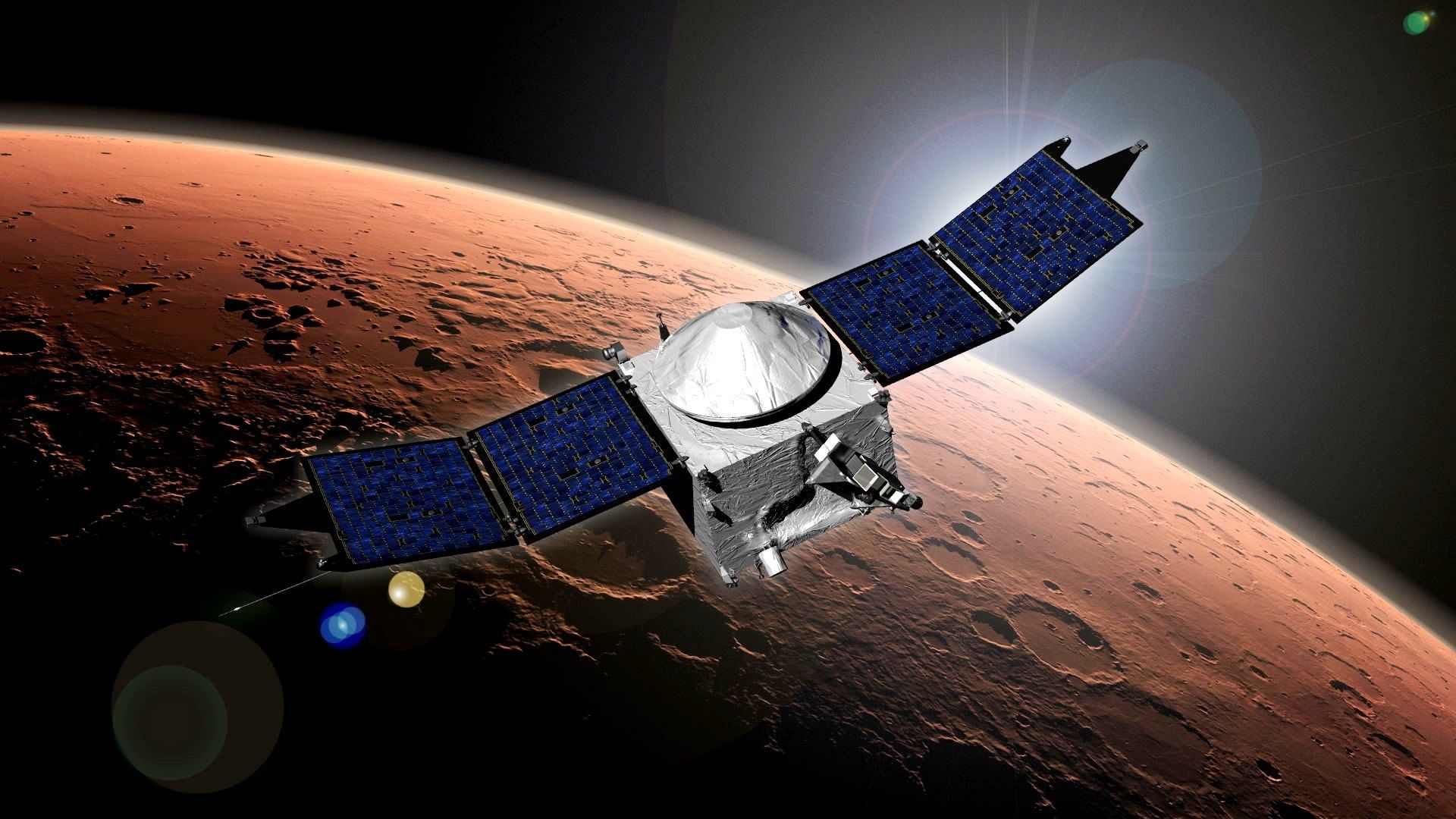
NASA will resume efforts to communicate with the Mars Atmosphere and Volatile Evolution (MAVEN) orbiter today, January 16th, after a month of radio silence. The spacecraft abruptly stopped responding to signals on December 6th, following a routine pass behind Mars that temporarily blocked communications with Earth.
The core issue: MAVEN’s unexpected behavior. When it re-emerged, the Deep Space Network could not re-establish contact. Preliminary data suggests the orbiter was rotating erratically and had drifted from its planned orbit—a critical deviation that raises concerns about its operational status.
The agency paused all communications with Mars missions from December 29th until today to avoid interference from the peak of the solar conjunction. This period, when the sun sits between Earth and Mars, disrupts radio signals due to increased solar particle activity. Attempts to image MAVEN via the Curiosity rover also failed; it was not detected overhead.
Why this matters: MAVEN is more than just a science mission. While it has significantly advanced our understanding of Mars’ atmospheric loss—explaining why the planet transformed from a potentially habitable world to a cold, dry desert—it also serves as a vital communications relay for surface missions like Curiosity and Perseverance. Losing MAVEN strains the remaining orbital assets and requires NASA to adjust rover operations, potentially slowing down scientific output.
Launched in 2013 and originally designed for just one year, MAVEN has exceeded expectations, operating for over a decade. However, the spacecraft has faced technical hurdles. In 2022, it spent three months in safe mode due to failing inertial measurement units (IMUs), critical for orientation. The team switched to a backup IMU, which also showed accelerated wear, pushing them to develop an alternative “all-stellar” navigation system.
The outlook is grim. Louise Prockter, director of NASA’s planetary science division, admitted the chances of recovery are “very unlikely.” While MAVEN has enough fuel for years to come, its current state leaves its future uncertain. The mission was extended through September 2025, but this incident raises questions about long-term operational sustainability for aging deep-space probes.
NASA’s renewed contact attempt today will determine whether MAVEN can be brought back online. If not, the loss will be a setback for Mars exploration, underscoring the fragility of robotic missions in the harsh environment of space.