NASA has released two breathtaking images captured during the Artemis II mission, offering humanity a rare and profound view of our home planet and the lunar landscape from deep space. These photographs, released by the White House and NASA, mark a significant milestone in lunar exploration, capturing phenomena that few humans have ever witnessed.
The “Earthset”: A Poignant View of Home
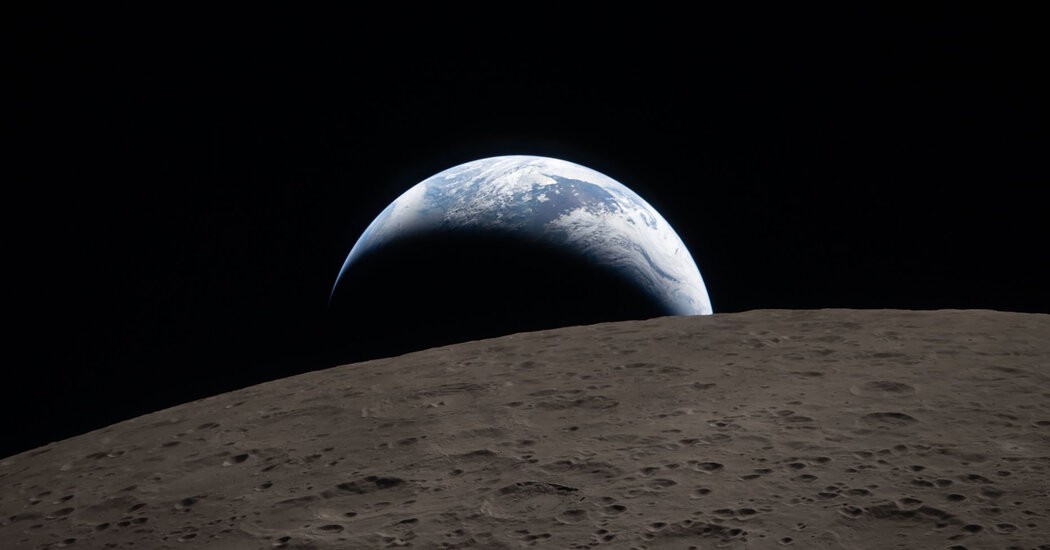
The first image captures a phenomenon known as “Earthset.” As the mission crew transitioned toward the far side of the moon, they witnessed the blue, swirling crescent of Earth dipping below the lunar horizon.
This moment occurred just minutes before the crew entered a 40-minute radio blackout —a period where the moon’s mass physically blocks all communication between the spacecraft and Earth. The image serves as a powerful visual reminder of our planet’s isolation in the vastness of space, containing every person and history known to man.
This view is being compared to the iconic “Earthrise” captured by Apollo 8 astronauts in 1968. While Earthrise signaled the beginning of our journey to the moon, these new images represent a sophisticated return to lunar orbit, utilizing modern technology to document our cosmic neighborhood.
A Unique Celestial Alignment
As the astronauts emerged from the radio silence on the other side of the moon, they were met with a second extraordinary sight: a solar eclipse viewed from a lunar vantage point.
The second photograph reveals the sun slipping behind the moon, creating a glowing halo around the lunar rim and illuminating the wispy edges of the solar atmosphere. The composition also captures a dense field of celestial bodies, including:
– Saturn
– Venus
– A vast array of distant stars
Pilot Victor Glover noted the technical difficulty of capturing such scenes. He described how the soft glow of Earth provided enough ambient light to illuminate the moon’s topography, allowing the crew to discern the hills and valleys of the lunar surface even in the darkness.
The Human Element: Beyond Evolution
The mission has highlighted not just the technical success of the flight, but the profound psychological impact of deep-space travel. Glover expressed the difficulty of articulating the experience, noting that the human eye and mind may not be biologically “wired” to process such immense, alien vistas.
“Humans probably have not evolved to see what we’re seeing,” Glover remarked. “It is truly hard to describe. It is amazing.”
Conclusion
The images from Artemis II provide more than just scientific data; they offer a transformative perspective on Earth’s place in the solar system. By capturing Earthset and a lunar-perspective eclipse, NASA has bridged the gap between technical achievement and the profound human awe of exploring the unknown.