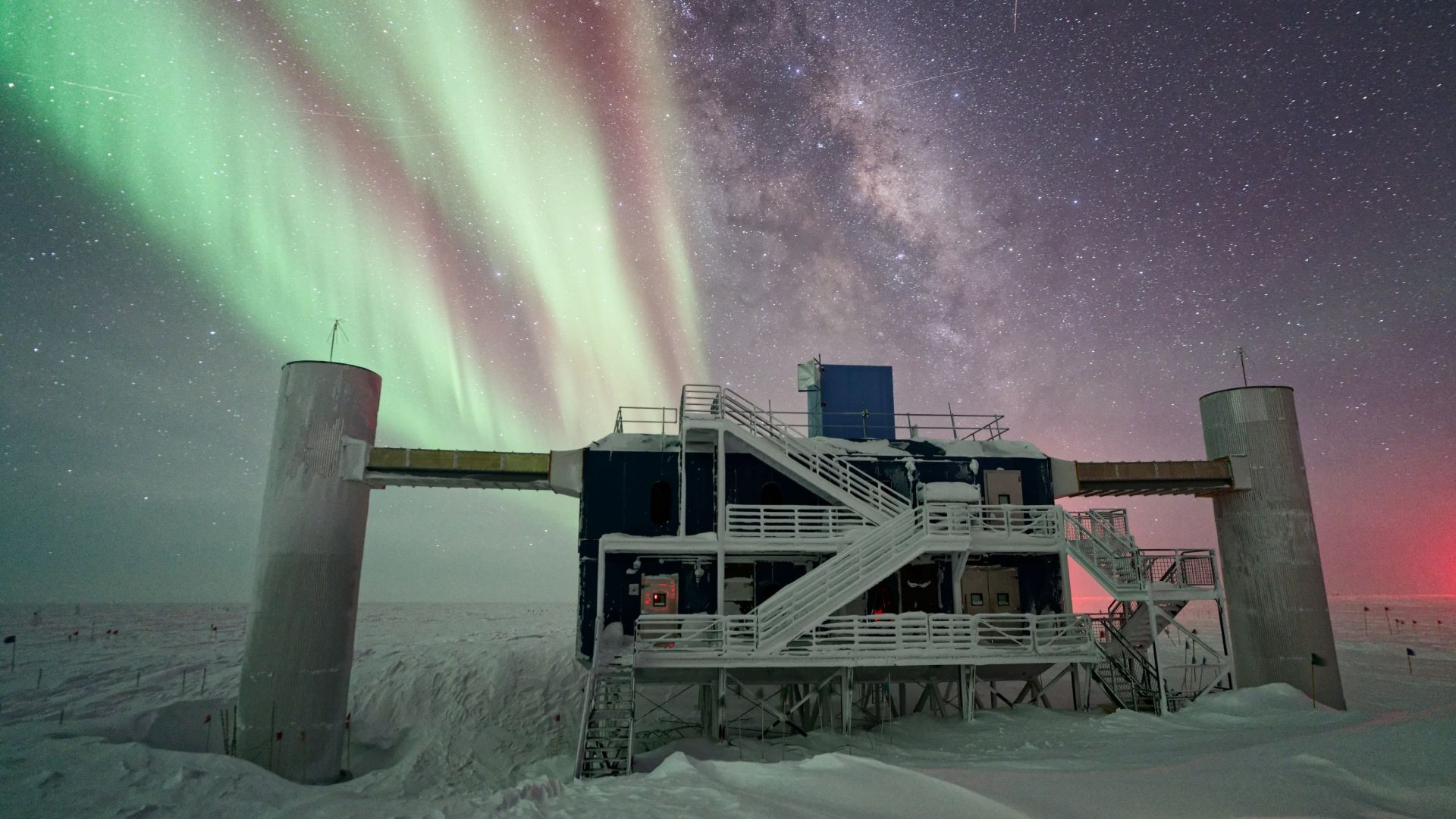
The IceCube Neutrino Observatory, a unique physics lab buried deep in the Antarctic ice, has undergone its first major expansion in 15 years. Scientists added over 600 new sensors to the detector, growing it from 86 to 92 strings of neutrino detectors spread across a cubic kilometer of ice near the Amundsen-Scott South Pole research station. This upgrade aims to unlock new insights into some of the universe’s most elusive particles and violent cosmic events.
The Hunt for ‘Ghost Particles’
Neutrinos, often called “ghost particles,” are nearly massless and chargeless subatomic particles that pass through matter with incredible ease. Trillions flow through every person on Earth every second. Detecting them is extremely challenging due to their lack of interaction with other matter, making the South Pole’s deep, clear ice an ideal environment. The observatory works by detecting the faint flashes of light produced when neutrinos do interact with the ice, creating secondary particles.
Why Neutrinos Matter
Understanding neutrinos is critical for unraveling some of the universe’s most fundamental mysteries. They are created in high-energy processes such as the Big Bang, stellar fusion, and supernova explosions. By studying them, scientists can reconstruct past events that shaped the cosmos. IceCube has already made significant breakthroughs:
– Successfully traced a neutrino to a distant blazar (a supermassive black hole galaxy).
– Mapped the distribution of matter within the Milky Way.
The Upgrade and Its Goals
The U.S. National Science Foundation (NSF) funded the upgrade, which involved drilling over a mile into the Antarctic ice over three field seasons (2023-2026). The six new strings incorporate advanced detector modules with multiple photosensors.
This enhancement will allow scientists to:
– Improve measurement of neutrino oscillations : The transformation of neutrinos into different types, providing better insight into cosmic rays.
– Detect more extraplanetary neutrinos : From supernovas and other high-energy sources beyond our solar system.
– Calibrate existing data : Refine the data collected over the past 15 years for even greater accuracy.
The IceCube upgrade is not just about building a bigger detector; it’s about sharpening our ability to listen to the universe’s most subtle signals and gain insights into phenomena that would otherwise remain hidden.
The upgrade of the IceCube Neutrino Observatory represents a significant step forward in high-energy astrophysics, promising to reveal more about the universe’s hidden forces and extreme events.