


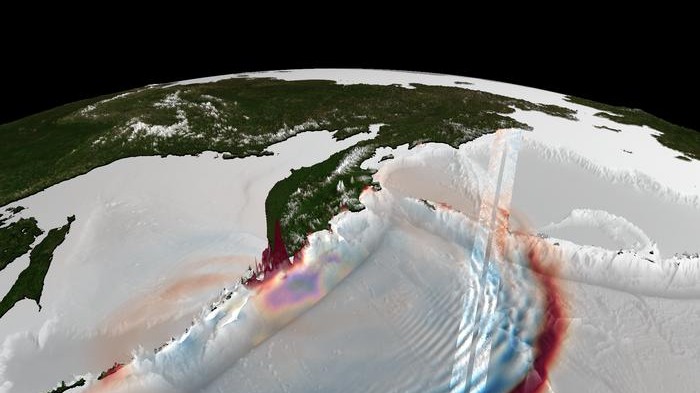
On July 29, 2025, a massive magnitude 8.8 earthquake struck off the coast of Russia’s Kamchatka Peninsula. The rupture occurred deep beneath the Pacific Ocean at a subduction zone —a geological boundary where one tectonic plate is forced beneath another. This sudden movement displaced a massive column of water, triggering a tsunami that raced across the ocean at speeds comparable to a jet airplane, eventually striking coastlines with waves exceeding 55 feet (17 meters).
While scientists have long understood the mechanics of how earthquakes trigger tsunamis, capturing the exact moment of “tsunamigenesis”—the birth of the wave—has historically been nearly impossible. New research suggests that the key to unlocking these mysteries lies not in the ocean, but in orbit.
The Limitation of Traditional Monitoring
For decades, tsunami detection has relied heavily on Deep-ocean Assessment and Reporting of Tsunamis (DART) buoys. These sensors are vital for early warning systems, but they have a fundamental flaw: they are “point” instruments.
A DART buoy measures pressure changes at a single specific location. While this tells scientists that a wave is passing by, it provides a narrow, one-dimensional view. It is like trying to understand the shape of a massive storm by looking through a single straw; you can feel the pressure, but you cannot see the structure, direction, or full scale of the event.
A New Perspective from Space
The breakthrough came from an unexpected source: the Surface Water and Ocean Topography (SWOT) satellite. Originally designed by NASA and the French Space Agency to study global ocean circulation and water levels, SWOT provides a high-resolution, two-dimensional view of the ocean surface with centimeter-level precision.
A research team led by Ignacio Sepúlveda of San Diego State University utilized SWOT to observe the Kamchatka event. In a stroke of scientific luck, the satellite passed just 375 miles from the epicenter only 70 minutes after the earthquake.
The resulting imagery was unprecedented. Instead of a single data point, researchers captured a complete visual map of:
– The massive leading wave of the tsunami.
– A “train” of smaller, trailing waves known as dispersive waves.
Solving the Modeling Gap
The high-resolution data from SWOT revealed a significant problem in current scientific modeling. When researchers attempted to recreate the Kamchatka tsunami using standard “long-wave” models—the industry standard for most tsunami simulations—the models failed. They could not account for the trailing dispersive waves captured by the satellite.
To bridge this gap, the team had to move toward more sophisticated Boussinesq-type models. These advanced simulations can account for the complex physics of dispersive waves, which are often overlooked by simpler systems.
By using these advanced models alongside satellite data, the team achieved a historic milestone: they were able to pinpoint the exact origin of the tsunami to within approximately six miles (10 km) of the trench. This level of precision in identifying the source of a tsunami has never been achieved before.
Why This Matters for Global Safety
This discovery is more than just a technical achievement; it is a leap forward for disaster preparedness. The ability to see the “full picture” of a tsunami in the open ocean allows scientists to:
- Refine Forecasting: By understanding how dispersive waves behave, scientists can create more accurate models of wave height and timing.
- Improve Near-Trench Observations: Most dangerous tsunamis are generated in the “near-trench” area, which has always been difficult to monitor.
- Enhance Early Warnings: Combining satellite imagery with DART buoy data will lead to more reliable predictions, potentially allowing for faster evacuations and saved lives.
“In the long term, we will improve our models because we will start to know much better what is going on in that near-trench area,” says Ignacio Sepúlveda.
Conclusion: By repurposing ocean-monitoring satellites to capture the complex structure of tsunami waves, scientists can now bridge the gap between earthquake detection and coastal impact, paving the way for more accurate and life-saving early warning systems.


