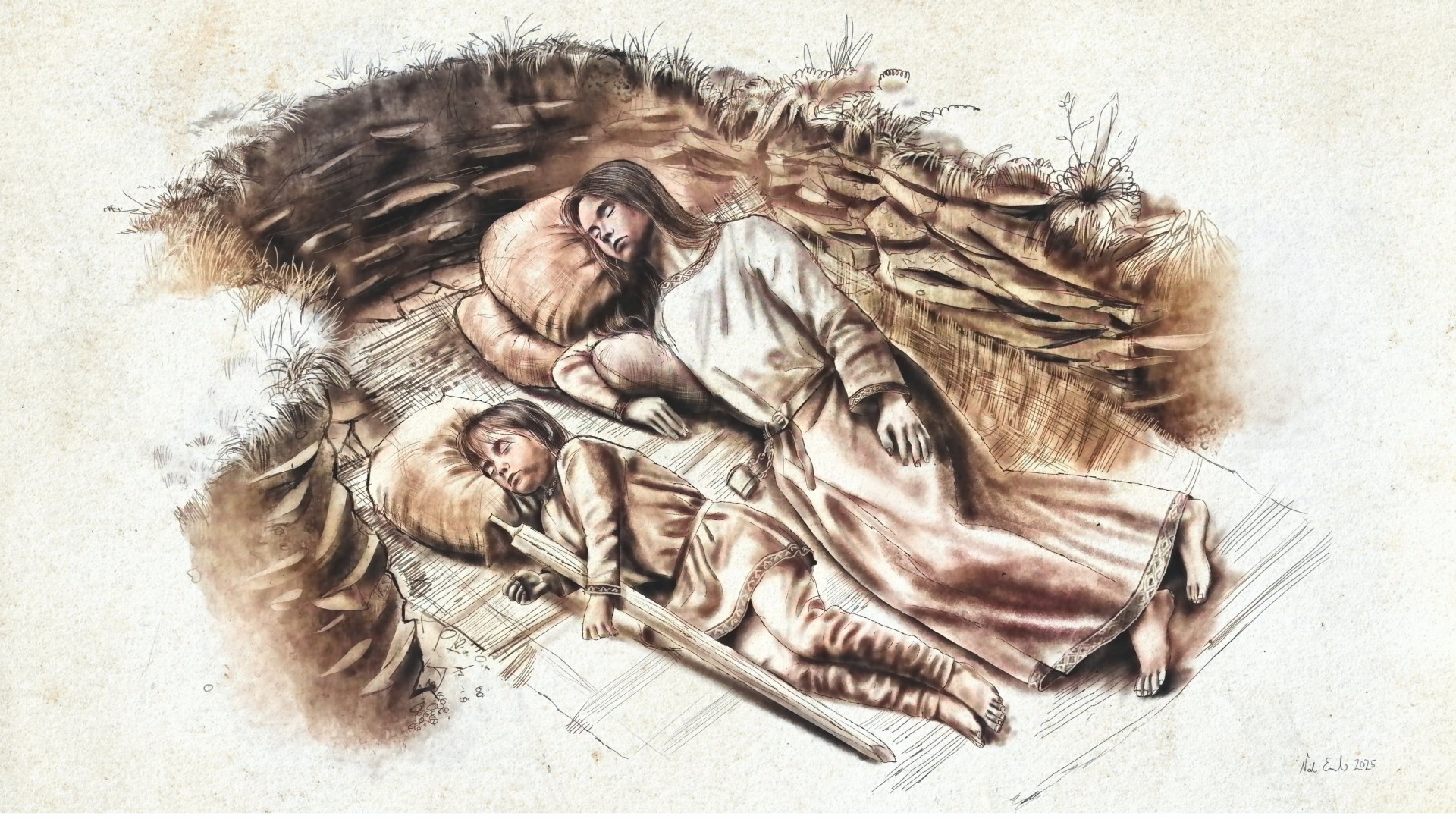
Recent DNA analysis has provided a poignant breakthrough in the study of an Anglo-Saxon double burial discovered in southwest England. What was once a mysterious pairing of two skeletons has been confirmed as a brother and sister, offering a rare and intimate glimpse into the familial bonds of the 7th century.
The Discovery in Cherington
In September 2024, archaeologists excavating an Anglo-Saxon cemetery in the village of Cherington uncovered a unique grave dating back to the second half of the 7th century. The burial contained two individuals:
– A young boy, aged approximately 7 or 8, found clutching an iron sword.
– A teenage girl, buried with a necklace and a cylindrical metal workbox, likely used for storing thread or cloth.
While the physical proximity of the bodies was noted during the initial excavation, it was the recent genetic testing conducted by scientists at the Francis Crick Institute in London that confirmed their biological connection.
A Story Told Through Positioning
The way the siblings were laid to rest suggests a deeply personal ritual. The teenage girl was positioned at a slightly higher level than the boy, seemingly propped up—perhaps by pillows that have since decayed. She was turned toward him in a protective posture.
“To me, that is a signal of what her role was before he died,” explained Jacqueline McKinley, an osteoarchaeologist with Wessex Archaeology. “She was somebody who would look after him, who would look over him.”
This specific arrangement suggests that the girl may have acted as a caregiver for her younger brother during his final days, a detail that adds significant human emotion to the archaeological record.
The Mystery of Their Deaths
The fact that both children were buried in the same grave at the same time has led researchers to suspect a common cause of death. The leading theory is that a rapidly acting infectious disease may have claimed both lives.
McKinley suggests a likely scenario where the sister contracted an illness while caring for her brother. However, confirming this remains a scientific challenge. While further DNA analysis could identify certain pathogens, many life-threatening bacteria—such as those causing sepsis or meningitis —do not leave detectable traces in skeletal remains.
Why This Matters for History
Finding confirmed biological siblings in a single grave is relatively rare in Anglo-Saxon burials. This discovery is particularly significant when compared to other recent finds in nearby Wiltshire, where double burials have been found but DNA has shown no direct familial links (such as parents/children or siblings).
This distinction is vital for historians because it helps differentiate between two types of social structures in early medieval England:
1. Biological Kinship: Direct blood relations buried together.
2. Social Kinship: The practice of adoption, fostering, and extended family networks, where individuals were buried together based on social bonds rather than genetics.
The Cherington find provides a definitive example of the former, offering a rare, high-resolution look at the biological reality of the Anglo-Saxon family unit.
Conclusion
The DNA confirmation of these siblings transforms a mere archaeological find into a profound narrative of caregiving and loss. While the exact pathogen remains unknown, the burial serves as a powerful testament to the familial ties that endured even in the face of sudden tragedy.