Archaeological research suggests that humans living 40,000 years ago in Europe may have used a rudimentary form of writing, predating the earliest known writing systems – like cuneiform – by over 30,000 years. This discovery challenges long-held assumptions about the timeline of human communication and cognitive development.
The Discovery: Engraved Artifacts in Germany
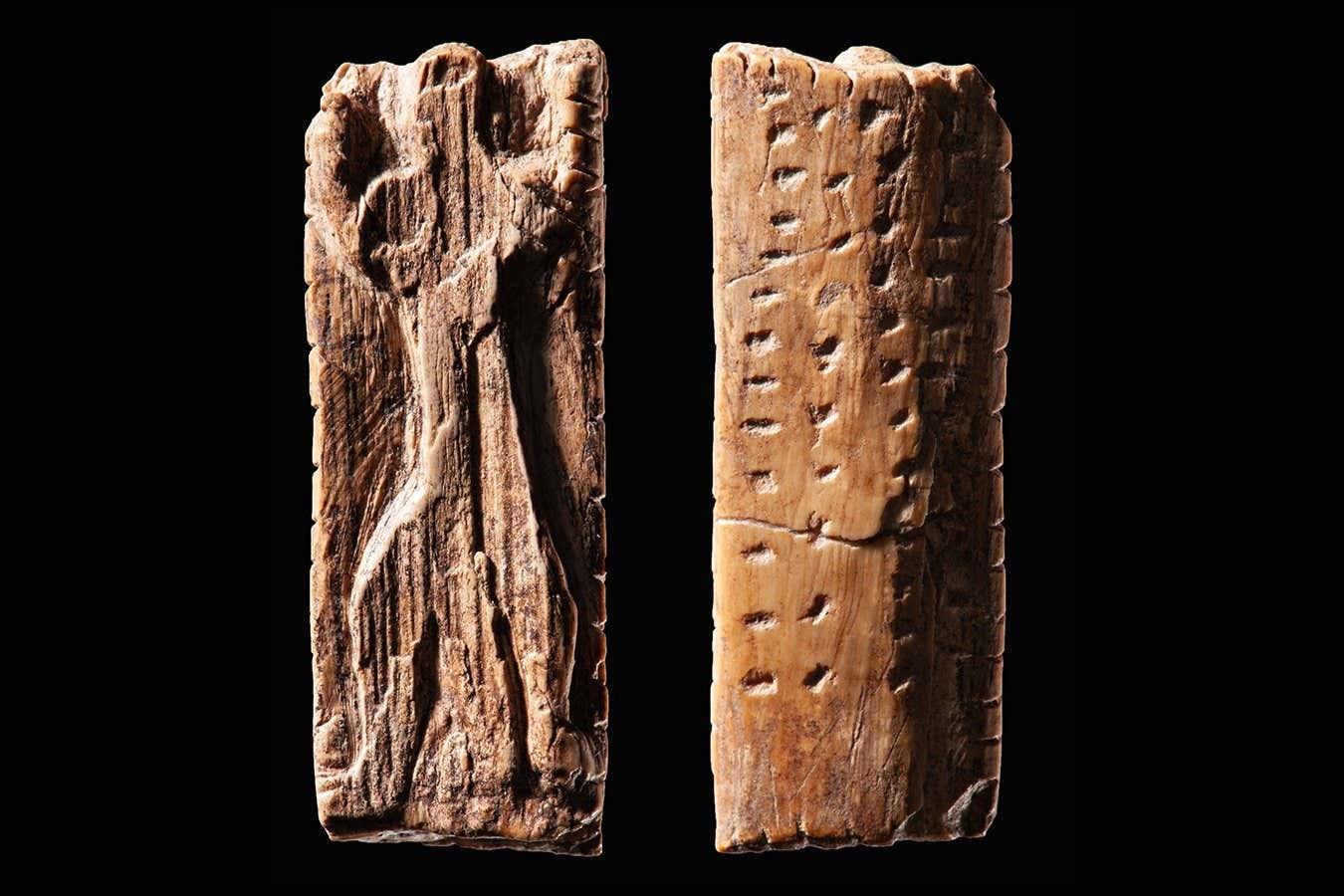
Researchers analyzed thousands of engraved symbols found on artifacts from caves in the Swabian Jura region of southwestern Germany. These objects, created by some of the earliest Homo sapiens groups arriving in Europe, date back between 43,000 and 34,000 years ago. The artifacts include pendants, tools, animal carvings, and hybrid figurines, all systematically marked with repeated sequences of lines, dots, crosses, and other shapes.
This isn’t simply random marking; the repetition and organization of these symbols are what set them apart. As archaeologist Ewa Dutkiewicz explains, “Having this reoccurring, very systematic use of clearly applied marks distinct from each other, put into sequences – that’s completely something different.”
Comparing Ancient Symbols to Modern Writing
To determine the complexity of these ancient markings, researchers compared them to early proto-cuneiform tablets (circa 3500–3350 BC) and modern writing systems using computer models. The analysis revealed a surprising parallel: the statistical properties of the Stone Age sequences were statistically similar to those of the earliest proto-cuneiform.
This suggests that early H. sapiens hunter-gatherers had developed a system for recording information, meeting a basic definition of writing: a convention of visible marks used for human communication. The symbols aren’t random; they follow patterns, suggesting deliberate intent.
Possible Meanings: Calendars and Symbolic Choices
The exact meaning of these symbols remains unknown – there is no “Rosetta Stone” to decipher them. However, researchers have identified potential clues:
- Calendar Tracking: Some objects feature rows of 12 or 13 dots and notches, potentially representing lunar or seasonal cycles.
- Symbolic Association: The placement of symbols varies across different objects. For example, crosses appear frequently on animal carvings but rarely on human depictions, while dots are absent from tools.
This deliberate choice suggests that the symbols were not arbitrary; they conveyed specific meanings to the people who made them. These conventions appear to have been stable over millennia, passed down through generations.
Implications for Understanding Human History
This discovery challenges the conventional narrative that writing emerged solely with the rise of agriculture and civilization in Mesopotamia. The evidence indicates that the capacity for symbolic representation and systematic recording existed much earlier, among mobile hunter-gatherer groups.
This doesn’t mean Stone Age humans had a fully developed writing system like modern languages. However, it does suggest that the foundations for such systems – the ability to encode information through patterned marks – were present tens of thousands of years ago.
This research builds on previous findings suggesting that cave paintings may have contained coded information about animal behavior dating back as far as 20,000 years ago. These findings push back the emergence of symbolic thought and communication to earlier stages of human evolution.