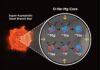
For half a century, astronomers have puzzled over the strange, unpredictable X-ray bursts emanating from the massive star Gamma Cassiopeia (γ Cas). Now, observations from the XRISM space observatory have definitively pinpointed the source: a hidden white dwarf companion stealing material from its larger, more visible partner. This discovery not only resolves a decades-old astronomical enigma but also provides crucial evidence for a previously theorized type of stellar binary system.
The Long-Standing Puzzle
Gamma Cassiopeia, a blue-white Be-type star approximately 550 light-years away, has long been a subject of intense study. Its erratic X-ray emissions – up to 40 times brighter than expected for its class – baffled scientists since the 1970s. The energy levels suggested temperatures as high as 150 million kelvins, but the mechanism driving this extreme heating remained elusive. Competing theories proposed everything from magnetic reconnection on the Be star itself to the presence of a neutron star or an accreting white dwarf companion.
The White Dwarf Revelation
The breakthrough came with XRISM’s high-precision observations in December 2024, February 2025, and June 2025. These data revealed a clear orbital pattern in the X-ray signature, with a period of roughly 203 days. Spectral analysis confirmed that the high-temperature plasma shifted velocity in sync with the orbit of a previously undetected white dwarf, not the Be star. This is the first direct evidence linking the X-rays to a compact companion rather than the larger star itself.
The mechanism involves the white dwarf’s gravity siphoning material from the Be star’s outer layers. This stolen material gets channeled along the white dwarf’s magnetic field lines to its poles, where it superheats before slamming into the star’s atmosphere. The result is the intense X-ray emission that has puzzled astronomers for decades.
Implications for Stellar Evolution
The discovery confirms the existence of Be-white dwarf binary systems, which scientists have long suspected play a role in stellar evolution. The age discrepancy between the stars is notable: the massive Be star, around 15 times the Sun’s mass, is relatively young (expected lifespan of just 10 million years). Its white dwarf companion, a dense remnant of a star up to eight solar masses, is likely billions of years old.
The current system may have formed through a previous, more balanced binary. One star could have grown massive enough to exhaust its fuel and collapse into a white dwarf, while the other expanded until its companion gravitationally siphoned material, transforming it into a Be star.
“We think the key is in understanding how exactly the interactions take place between the two stars,” says astrophysicist Yaël Nazé. “Now that we know the true nature of gamma-Cas, we can create models specifically for this class of stellar systems, and update our understanding of binary evolution accordingly.”
This breakthrough not only solves a longstanding mystery but also provides a new tool for interpreting similar signals from other Be stars, furthering our understanding of how these dynamic systems evolve over time.