Physicists have definitively observed “dark spots” within light waves moving at speeds exceeding that of light itself – a phenomenon predicted for decades but only now captured in action. This doesn’t violate Einstein’s theory of relativity, because these “holes,” known as phase singularities or optical vortices, carry no mass, energy, or transferable information. Instead, their apparent superluminal velocity arises from the unique geometry of the wave pattern, not from any physical object exceeding the speed limit.
The Nature of Light’s Vortices
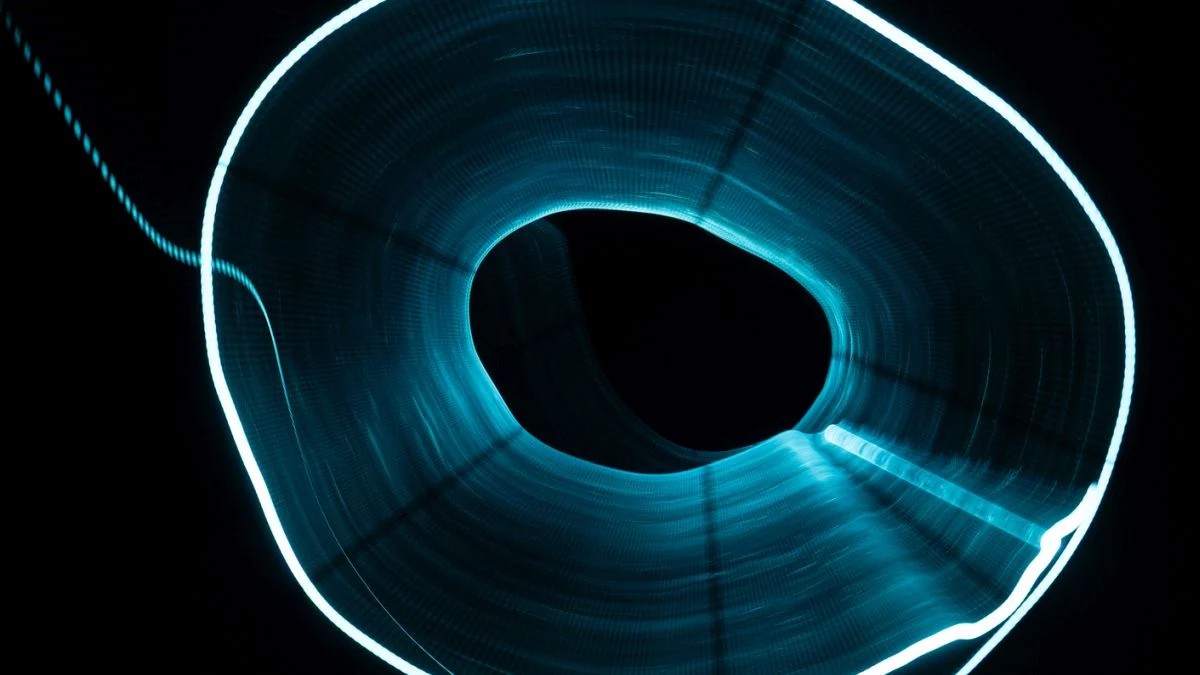
Light isn’t merely a uniform beam; it’s a complex system prone to disturbances akin to whirlpools in water. Optical vortices form when a light wave twists, creating a central point of zero intensity – essentially, a dark “hole” within the light. This isn’t a flaw in light itself but a consequence of its wave-like nature.
Why this matters: Understanding these vortices isn’t just an academic exercise. The behavior of singularities is universal to all wave systems, from sound to fluid dynamics, even superconductors. By studying them in light, we gain insight into fundamental physical laws governing a wide range of phenomena.
The Challenge of Observation
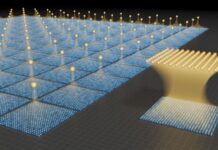
For years, observing these ultra-fast events was impossible. Vortices form and collide on scales of space and time too small for conventional microscopy. The breakthrough came through a combination of specialized materials and next-generation technology:
- Hexagonal Boron Nitride: This two-dimensional material supports “phonon polaritons” – hybrids of light and atomic vibrations – which slow down light waves, allowing for more precise tracking.
- High-Speed Electron Microscopy: Researchers deployed a microscope capable of recording events in just 3 quadrillionths of a second. By stacking hundreds of slightly delayed images, they created a timelapse of the vortices annihilating each other at superluminal speeds.
Implications for Science and Technology
The experiment confirms that opposite-charged singularities accelerate towards each other, briefly surpassing the speed of light before colliding. The researchers emphasize that this behavior isn’t about breaking physics, but about understanding how waves behave in extreme conditions.
“Our discovery reveals universal laws of nature shared by all types of waves… This breakthrough provides us with a powerful technological tool: the ability to map the motion of delicate nanoscale phenomena in materials.” – Ido Kaminer, Technion Israel Institute of Technology.
The team believes this technique will revolutionize microscopy, allowing scientists to observe previously invisible processes in physics, chemistry, and biology. Future work will extend these observations into higher dimensions to study even more complex interactions.
The ability to map nanoscale dynamics with such precision opens new avenues for materials science, potentially leading to breakthroughs in superconductivity, quantum computing, and beyond. This isn’t just about faster-than-light motion; it’s about refining our tools to probe the deepest mysteries of the universe.