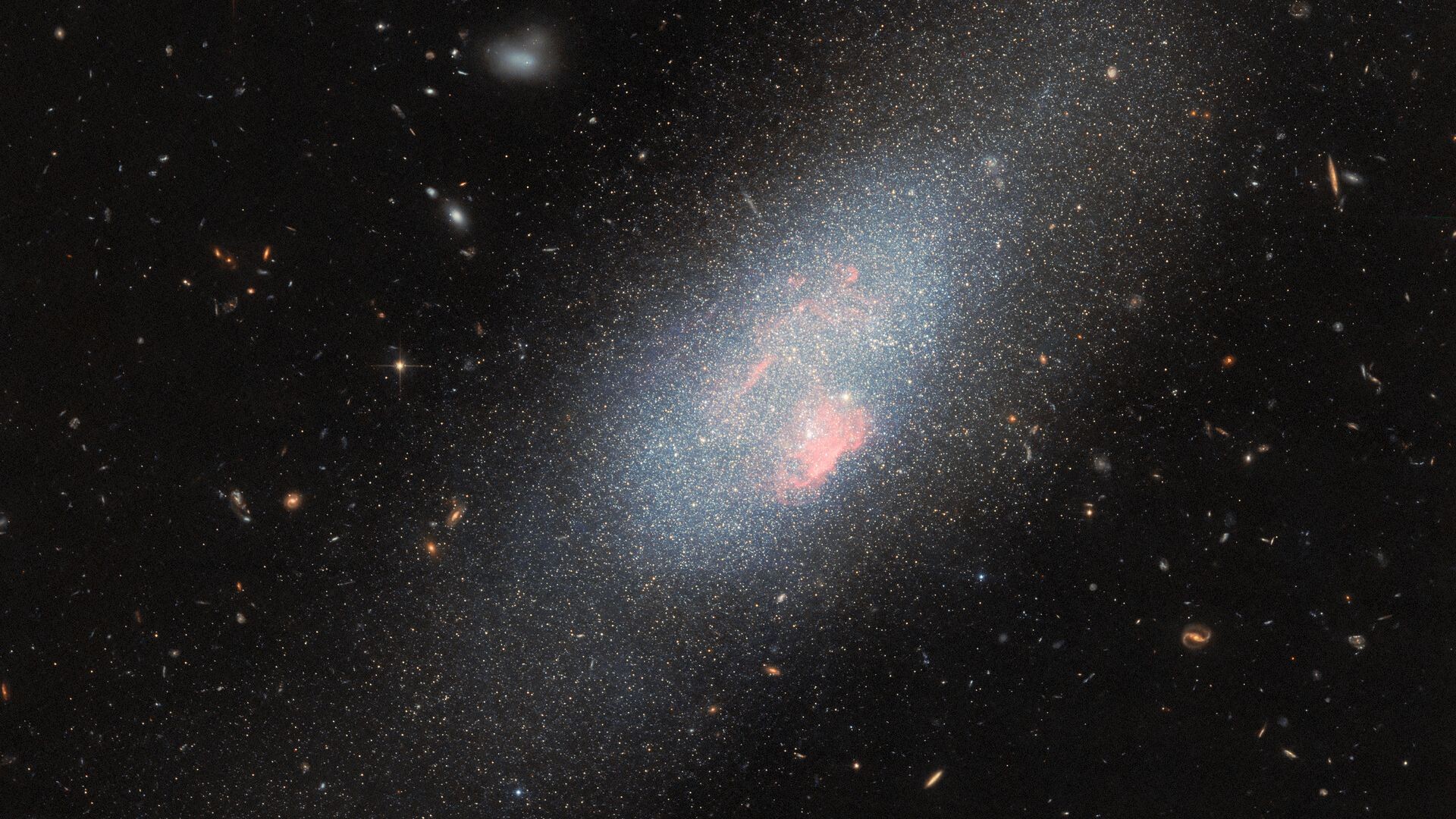
For decades, astronomers have been puzzled by a fundamental mismatch between theory and reality regarding the smallest galaxies in our universe. While our mathematical models predict that dark matter should cluster into sharp, dense peaks at galactic centers, actual observations often reveal something much smoother and flatter.
New research suggests that this discrepancy isn’t necessarily a flaw in our understanding of dark matter, but rather a predictable result of how these tiny galaxies evolve over billions of years.
The Cusp-Core Problem
To understand this mystery, one must look at dwarf spheroidal galaxies. These are small, dim structures dominated by dark matter—the invisible substance that provides the gravitational scaffolding for the universe.
According to the standard “Cold Dark Matter” model, these galaxies should possess a “cusp” : a steep, mountain-like concentration of dark matter at their core. However, when astronomers measure the movement of stars within these galaxies, they often find a “core” : a gentle, plateau-like distribution. This persistent gap between what we predict (the cusp) and what we see (the core) is known as the “cusp-core problem.”
The “Pinball” Effect: Dark Subhaloes
Researchers Jorge Peñarrubia and Ethan O. Nadler have proposed a solution that reframes these galaxies not as static objects, but as evolving systems moving toward a “cosmic resting place” known as a dynamical attractor.
The mechanism driving this evolution is a phenomenon called stochastic force fluctuations. Instead of stars orbiting smoothly like planets around a sun, they are constantly being “jostled” by invisible obstacles:
- Dark Subhaloes: These are smaller, dense clumps of dark matter embedded within the larger galactic halo.
- Internal Heating: As stars encounter these subhaloes, they receive gravitational “kicks,” much like a pinball hitting a bumper.
- Orbital Expansion: These constant collisions add energy to the stars, pushing their orbits outward and causing the galaxy to “puff up” and spread out over time.
Internal Heating vs. External Stripping
A galaxy’s shape is determined by two primary forces:
- Internal Dynamics: Even in total isolation, dark subhaloes will eventually “heat” a galaxy, driving it toward its stable, final form. In a void, this process can take roughly 14 billion years—nearly the entire age of the universe.
- External Tidal Forces: When a dwarf galaxy orbits a massive neighbor like the Milky Way, the larger galaxy’s gravity pulls at its outer layers—a process called tidal stripping. This external force accelerates the “heating” process, pushing the dwarf galaxy toward its stable configuration much faster than internal forces alone.
Evidence from Digital Universes
To test this theory, the researchers utilized N-body experiments —sophisticated computer simulations that track the movement of billions of particles over cosmic timescales.
Their simulations revealed a striking pattern: regardless of how a galaxy begins, it follows a predictable “tidal track.” By applying this “Heating Argument” to real-world data from galaxies orbiting the Milky Way, they found that the velocity of stars consistently matches their mathematical models. This suggests that the diverse shapes we see in the sky today are not random; they are the result of a universal evolutionary journey.
Remaining Challenges
While this framework provides a compelling explanation for why galaxies appear “cored” rather than “cuspy,” significant hurdles remain. Astronomers still struggle with mass-anisotropy degeneracy —the difficulty of determining whether stars are moving in random directions or along specific paths—which makes calculating exact dark matter density incredibly difficult. Additionally, because these galaxies are so dim, determining their 3D orientation and total mass remains a complex task.
Conclusion
The structural diversity of dwarf galaxies is not a collection of random starting points, but a predictable outcome of cosmic evolution. Driven by internal dark matter “bumps” and external gravitational tugs, these galaxies are all marching toward a common, stable destiny.