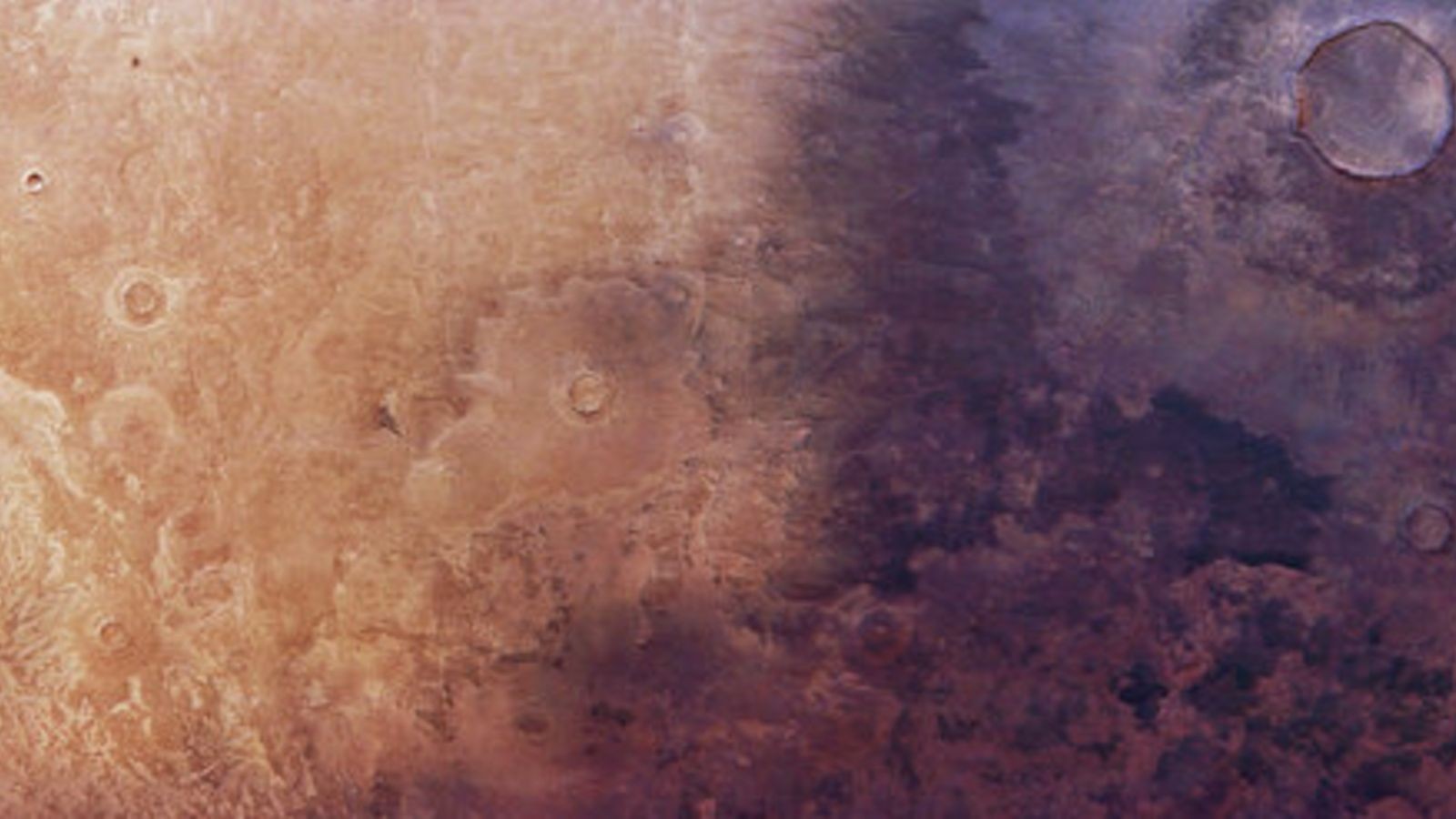
For half a century, a massive, dark anomaly has been slowly expanding across the surface of Mars. First captured by NASA’s Viking probes in 1976, this “shadow” continues to creep across the Martian landscape, leaving planetary scientists with more questions than answers.
A Dark Patch in Utopia Planitia
The phenomenon is located within Utopia Planitia, a vast plain in Mars’ northern hemisphere spanning roughly 2,000 miles (3,300 kilometers). This region is not merely a desert; it is a complex geological landscape characterized by ancient volcanic history and potential water reservoirs.
The dark feature itself is composed of volcanic ash and rocks, such as olivine and pyroxene. These materials are remnants of massive eruptions that occurred millions of years ago, long before Mars was thought to be geologically dormant. Recent imagery from the European Space Agency’s (ESA) Mars Express orbiter, released in April 2024, confirms that this dark terrain is actively shifting.
The Rate of Expansion
While the exact total area of the shadow remains difficult to calculate, the movement is undeniable. Data suggests:
– The southern boundary of the patch has migrated at least 200 miles (320 km) since its discovery.
– This equates to an average expansion rate of approximately 4 miles (6.5 km) per year.
The Scientific Dilemma: Moving Ash or Moving Dust?
Despite decades of observation, scientists remain divided on the exact mechanism driving this movement. The leading theories involve the planet’s atmospheric forces, specifically the Martian winds, but they offer two very different interpretations of the same visual result:
- The Accumulation Theory: Martian winds are actively picking up the dark volcanic ash and depositing it onto new areas of the plain.
- The Erosion Theory: The dark ash has always been there, but it was previously hidden under a layer of light-colored “ochre” dust. In this scenario, the wind is simply blowing the dust away, revealing the dark ground beneath.
Without direct surface measurements, it is impossible to determine whether we are watching a “growth” of new material or the “uncovering” of ancient material.
Why Utopia Planitia Matters
The mystery of the growing shadow is set against the backdrop of one of Mars’ most scientifically significant regions. Utopia Planitia is a focal point for several reasons:
- Ancient Water: Data from China’s Zhurong rover suggests this plain may have once been home to one of Mars’ largest oceans, complete with identifiable shorelines.
- Geological Activity: The region contains “grabens”—large cracks in the crust—which may provide evidence of past tectonic activity.
- The Search for Life: Researchers believe there is a significant amount of buried ice beneath the surface. If true, this makes the region a prime candidate for future human exploration and the search for microbial life.
The expansion of this dark patch serves as a reminder that Mars is not a static, dead world, but a planet still shaped by active atmospheric and geological processes.
Conclusion
The creeping shadow in Utopia Planitia highlights the ongoing dynamic nature of the Martian environment. Whether caused by the movement of ash or the erosion of dust, this phenomenon continues to challenge our understanding of how the Red Planet evolves over time.