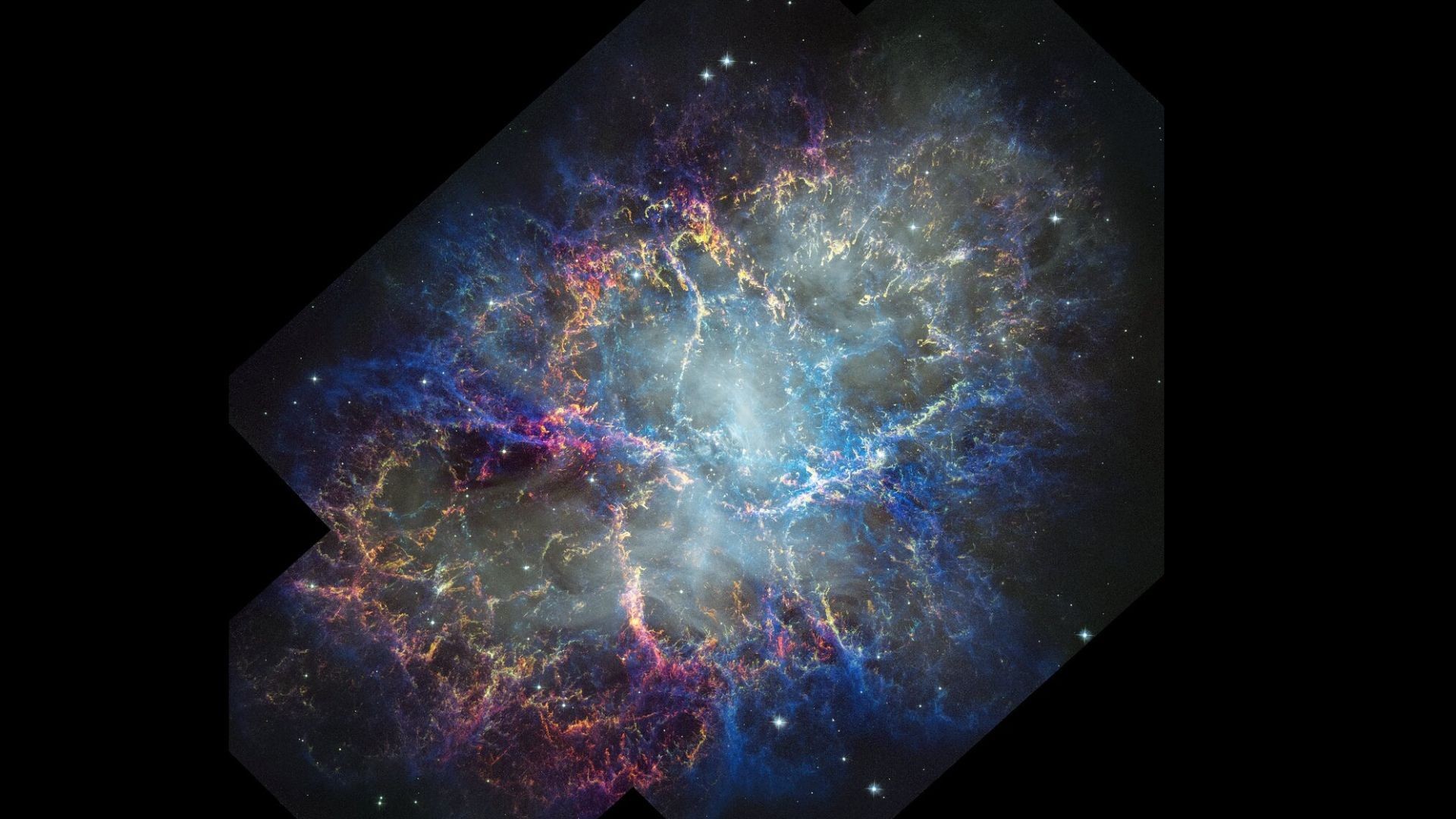
The Crab Nebula, remnant of a supernova observed by ancient astronomers in 1054 AD, continues to expand visibly even today. New images from the Hubble Space Telescope, when compared to photos taken 25 years earlier, demonstrate a clear and measurable outward movement of the nebula’s glowing filaments. This confirms that the nebula is not a static relic of a past event, but a dynamic system still actively evolving.
Historical Origins: A Supernova Seen Across Cultures
The Crab Nebula’s origin is well-documented in historical records. In 1054, a supernova blazed brightly in the Taurus constellation for weeks, visible even during daylight. Astronomers in China, Japan, and the Middle East all meticulously recorded this “guest star,” making it one of the most reliably documented cosmic explosions in history. Centuries later, in the 18th century, the nebula itself was discovered.
Edwin Hubble later linked the nebula to the 1054 event, but the true engine behind its expansion wasn’t understood until the discovery of a pulsar at its center.
The Pulsar’s Role in Continued Expansion
The pulsar, a rapidly spinning neutron star, is the key to the Crab Nebula’s ongoing evolution. Unlike many supernova remnants that expand due to initial shockwaves, the Crab Nebula’s expansion is driven by the pulsar’s powerful magnetic field, which flings charged particles outward at approximately 3.4 million miles per hour (5.5 million km/h). This energy sustains the nebula’s glow and accelerates its growth.
“We tend to think of the sky as being unchanging, immutable,” says William Blair, an astronomer at Johns Hopkins University. “However, with the longevity of the Hubble Space Telescope, even an object like the Crab Nebula is revealed to be in motion, still expanding from the explosion nearly a millennium ago.”
High-Resolution Imaging Reveals Detailed Structures
Hubble’s Wide Field Camera 3 (installed in 2009) provides unprecedented clarity. The new images reveal 3D structures, with color variations indicating gas temperature and composition. Blue regions represent the hottest, least dense gas, while yellow and red hues mark energized sulfur and oxygen. Recent reprocessing of older images ensures a consistent level of detail for accurate comparisons.
The James Webb Space Telescope has also captured stunning images of the Crab Nebula in 2023, providing even more detailed maps of cosmic dust within its expanding shell.
The Crab Nebula’s continued expansion serves as a powerful reminder that the universe is not frozen in time. Even cosmic events centuries old continue to unfold, offering astronomers a unique opportunity to study the long-term evolution of stellar remnants.