In 2024, the International Mathematical Olympiad witnessed a historic milestone. While the competition is traditionally a battle of wits between the world’s brightest students, an unofficial entrant stole the spotlight: Google DeepMind’s AlphaProof. The AI program achieved a silver-medal level score, proving that machines are no longer just calculating numbers—they are beginning to master the art of logical reasoning.
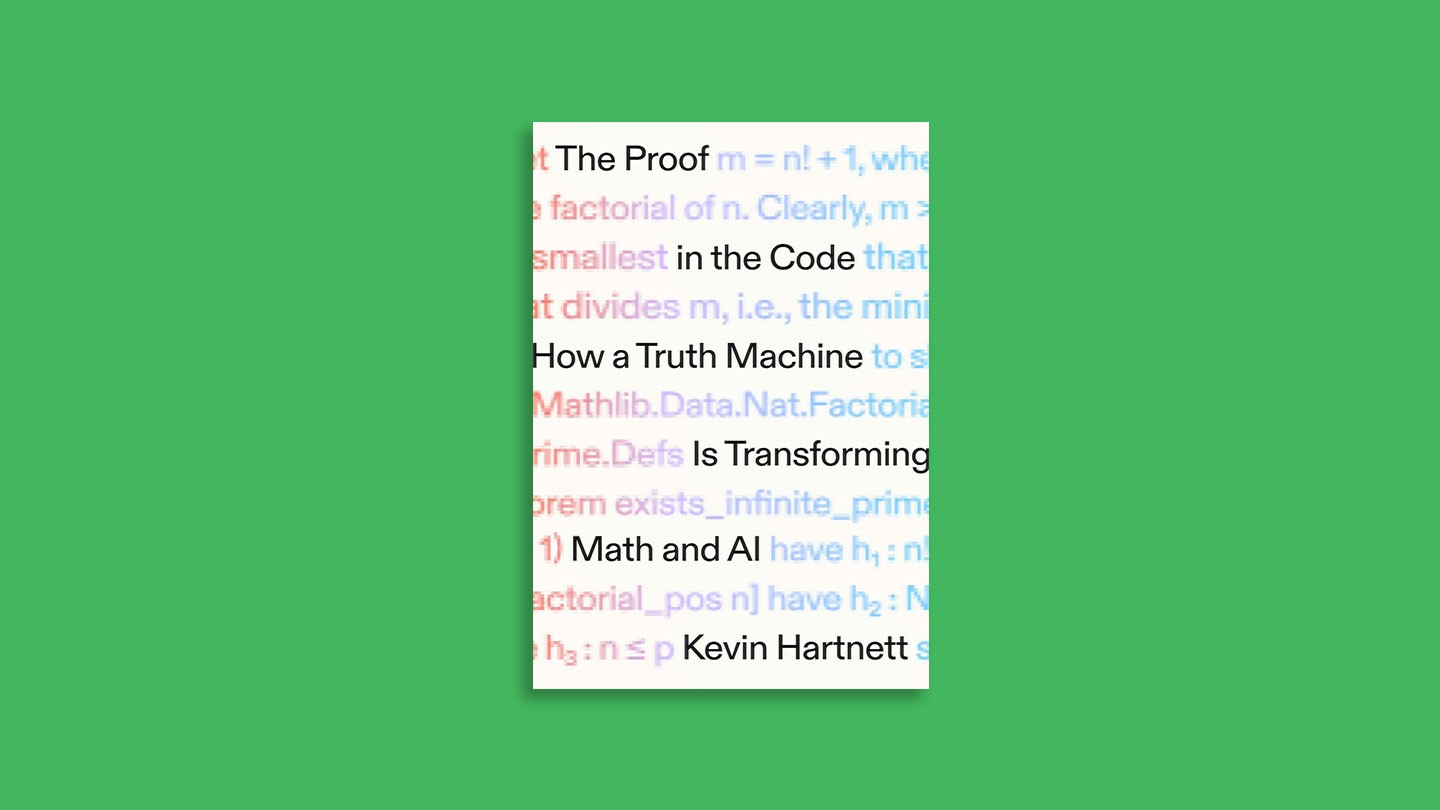
This breakthrough is not an isolated miracle of engineering; it is the result of a decades-long evolution in how we verify truth through code. In his new book, The Proof in the Code, journalist Kevin Hartnett explores the unlikely journey of Lean, a software tool that transformed from a niche coding assistant into the backbone of modern mathematical verification and AI development.
The Bridge Between Code and Logic
The story begins with Leo de Moura, a former Microsoft Research engineer who launched Lean in 2013. Originally designed as a tool to check software code for errors, Lean’s true potential lay in its structural similarity to mathematics.
As Hartnett points out, the two disciplines share a fundamental DNA:
– Syntax: Both require precise, step-by-step instructions.
– Logic: A single error in a line of code is functionally identical to a “gap” in a mathematical proof.
– Execution: Just as a program only runs if the logic is sound, a mathematical theorem is only valid if its proof is airtight.
This realization sparked a movement. While Lean could not “invent” new math on its own, it acted as an interactive theorem prover. It could take a human-written proof—which might span hundreds of pages and take months to peer-review—and verify its absolute correctness in an instant.
The Struggle for a “Mathematical Language”
The transition from traditional math to digital proof was not seamless. For years, mathematicians faced a daunting “chicken and egg” problem: to make Lean useful, they needed vast libraries of coded mathematical definitions; but to build those libraries, they needed mathematicians to use the program.
The friction was often absurdly granular. Hartnett describes how Professor Kevin Buzzard of Imperial College London, while teaching undergraduates, found himself stuck because Lean demanded he prove that 2 is not equal to 1. To a human, this is an obvious truth; to a formal logic system, it is a foundational fact that must be explicitly defined before any further reasoning can occur.
Overcoming these hurdles required massive, collaborative efforts:
* Massive Digitization: In 2018, mathematicians spent months translating complex concepts like “perfectoid spaces” into thousands of lines of code.
* Community Building: A small, dedicated group of researchers worked to make the software user-friendly, moving it from a clunky academic tool to a robust platform.
* Scaling Up: By 2025, the ecosystem had exploded, with tens of thousands of users across academia and the tech industry contributing to Lean’s libraries.
Why This Matters: The Quest for a “Truth Machine”
The convergence of mathematics and AI is the ultimate goal of this movement. For software engineers like de Moura, the prize was a “truth machine” that could guarantee software like Microsoft Word is entirely bug-free. For mathematicians, it is a way to ensure that even the most complex, abstract discoveries are beyond reproach.
For AI researchers, Lean serves as the ultimate training ground. By providing a massive, verified library of mathematical truths, Lean allows models like AlphaProof to learn rigorous reasoning rather than just pattern recognition. This is critical for solving the “hallucination” problem in AI—the tendency for models to confidently state false information. If an AI can be trained to follow the strict, unyielding laws of mathematical logic, it may eventually apply that same rigor to real-world reasoning.
“Both [math and coding] are written in exact syntax as a series of logical steps, each one leading to the next.”
Conclusion
The Proof in the Code chronicles how a specialized tool for software debugging became the foundation for a new era of mathematical certainty and AI intelligence. It highlights a profound shift in science: the movement toward a future where human intuition and digital verification work in tandem to define what is true.