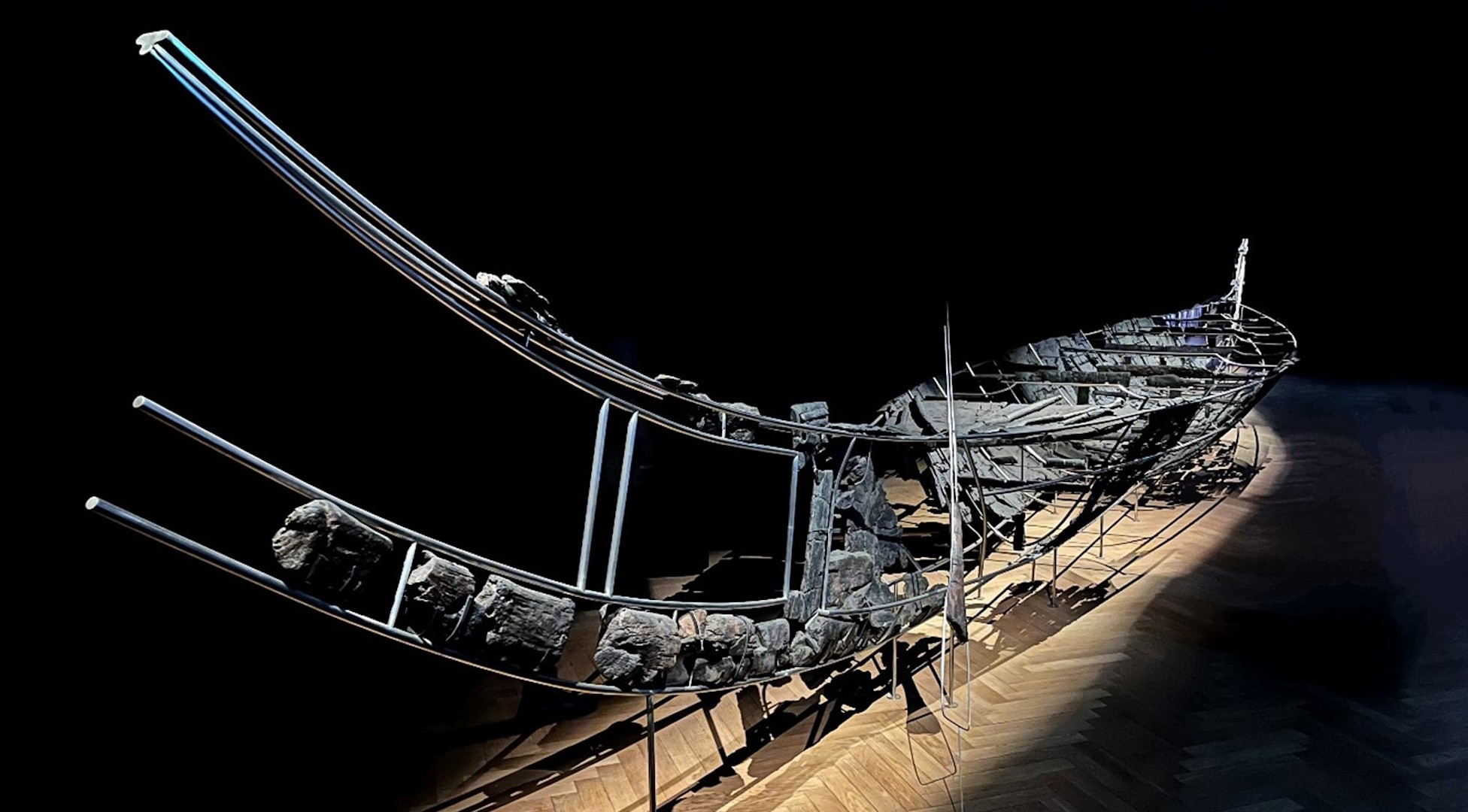
A 2,400-year-old warship, the Hjortspring boat, has yielded an extraordinary clue about its crew: a fingerprint preserved in ancient caulking tar. The discovery, alongside detailed chemical analysis, is reshaping our understanding of who these early seaborne raiders were and where they came from.
The Hjortspring Boat: A Window Into the Past
The Hjortspring boat is the oldest known wooden plank vessel in Scandinavia. Unearthed in 1920 from a bog in Denmark, it sank in the fourth century B.C. after an attack on the island of Als. The local defenders sank the ship as an offering, preserving it in the oxygen-poor environment for millennia. The boat now resides at the National Museum of Denmark, but its origins remained a mystery until recently.
New Analysis Unlocks Ancient Secrets
Researchers re-examined fragments of the boat that had been preserved chemically, including pieces of caulking tar and rope. The fingerprint found in the tar provides a direct link to the ship’s ancient builders or repairers. More importantly, the chemical composition of the tar – a mix of animal fat and pine pitch – indicates that the vessel was constructed in a region with abundant pine forests.
This finding contradicts previous theories that placed the boat’s origin near Hamburg, Germany. The new evidence points instead to the Baltic Sea region, specifically somewhere along the coast east of the island of Rügen. This suggests the raiders sailed a significant distance over open water to reach their target.
Dating and Reconstruction
Carbon dating of the rope confirms the boat’s age between 381 and 161 B.C., placing it firmly in the pre-Roman Iron Age. Researchers even recreated the rope-making process to better understand the ancient technology. High-resolution X-ray scans were used to create digital 3D models, allowing for a detailed analysis of the fingerprint. While the print doesn’t reveal the individual’s identity, its presence is still a remarkable connection to the past.
Implications and Future Research
This discovery sheds light on the extent of ancient maritime warfare and trade in Scandinavia. The raiders were not local, but traveled from a distant region with pine forests, suggesting a well-organized campaign over open sea.
Researchers hope to extract human DNA from the tar to learn more about the crew. Understanding these early raids will help reconstruct ancient maritime networks and the forces that drove them.
The fingerprint, though small, provides a rare tangible link to those who sailed, fought, and ultimately lost their lives in this ancient conflict. It’s a stark reminder that even in the distant past, human stories can be found in the most unexpected places.