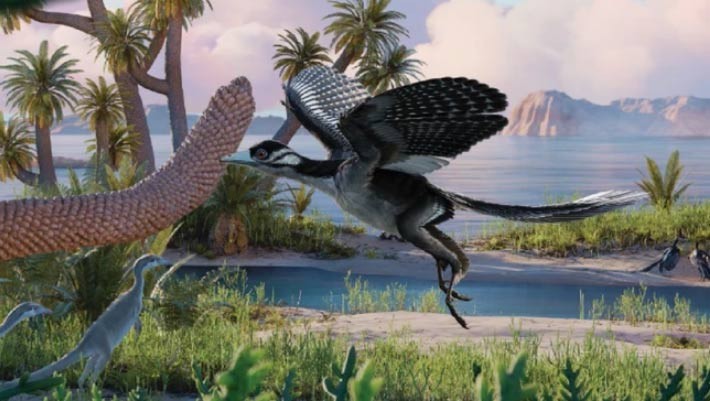
For over a century, Archaeopteryx has held the title of the world’s first bird. But what it actually did remained a subject of intense debate. Was it a clumsy ground-dweller? A graceful glider? Or something else entirely?
A comprehensive new study by paleontologists at the Field Museum of Natural History offers the most complete portrait to date of this iconic creature. By synthesizing evidence from all known fossils—including five recently described specimens—the researchers argue that Archaeopteryx was neither a purely terrestrial hunter nor a fully modern flier. Instead, it was an ecological generalist that navigated a patchwork of Jurassic coastal forests and lagoons by scrambling, perching, gliding, and flapping.
This finding matters because it clarifies the evolutionary transition from dinosaur to bird. Archaeopteryx represents a critical “missing link,” showing how early avian ancestors adapted their bodies to exploit new niches in the air and on trees, rather than simply evolving flight as a singular, instantaneous event.
A New Perspective on Flight Capability
The central question in Archaeopteryx research has always been: Could it fly? The new analysis concludes that yes, it could perform limited powered flight, though it likely relied heavily on gliding when energy efficiency was prioritized.
The evidence lies in the feathers. The primary flight feathers of Archaeopteryx display a degree of asymmetry that matches modern flying birds but is absent in its non-flying dinosaur relatives. Furthermore, the animal possessed large tracts of “tertial” feathers—feathers located on the inner wing that bridge the gap between the body and the outer wing. In non-avian dinosaurs, this area is often aerodynamically “leaky,” preventing lift. In Archaeopteryx, these feathers closed that gap, creating a more efficient airfoil.
However, Archaeopteryx did not launch into the air like a pigeon taking off from the ground. The researchers suggest it likely launched from elevated perches, using runs into headwinds or climbs up inclines to gain initial lift. This “perch-to-air” strategy suggests that the ability to climb and grasp branches was a prerequisite for the evolution of flight.
The Key to Perching: The Reversed Toe
One of the most striking anatomical findings in the study concerns the foot. In non-flying theropod dinosaurs, the first toe (the hallux) points forward and is elevated, offering little utility for gripping. In Archaeopteryx, however, the hallux is reversed, pointing backward to oppose the other toes.
This configuration allows the foot to wrap securely around branches or rocks. The authors argue that this adaptation evolved specifically in response to flight, enabling the animal to utilize elevated perches for rest, predation, and takeoff. This structural change highlights how skeletal anatomy shifted to support new behaviors before full aerial dominance was achieved.
Diet and Daily Life
While Archaeopteryx ’s locomotion is now better understood, its diet remains partially mysterious. No fossilized stomach contents have been found, but its skull provides strong clues. The animal possessed several bird-like feeding adaptations, including:
- A primitive bill-tip organ, a sensory structure modern birds use to manipulate food.
- Evidence of a mobile tongue and oral papillae for handling prey.
These traits suggest Archaeopteryx targeted small, energy-rich foods such as insects and seeds. This diet likely reflected the higher metabolic demands associated with flight.
The environment played a crucial role in shaping this lifestyle. Archaeopteryx lived 150 million years ago on the Solnhofen archipelago (modern-day southern Germany), a warm, seasonally dry landscape with scrubby vegetation. The climate featured occasional wet seasons that created temporary bodies of water. This variability likely favored an opportunistic omnivore capable of switching between food sources as resources fluctuated throughout the year.
Appearance and Activity Patterns
Chemical analysis of the holotype feather—a dorsal wing covert—reveals that Archaeopteryx had black and white plumage. This high-contrast pattern likely served as disruptive camouflage, breaking up the animal’s outline against the dappled light of the scrubby landscape and confusing predators.
Furthermore, analysis of the scleral ring (the bone surrounding the eye) confirms that Archaeopteryx was diurnal, active during daylight hours. This aligns with its role as a visual hunter and perch-user, maximizing its time in the bright light of the Jurassic day.
Conclusion
Archaeopteryx was not a static relic but a dynamic animal that interacted with its environment in multiple ways—on the ground, in the trees, and in the air. Its diverse locomotor behaviors and omnivorous diet allowed it to thrive in a changing ecosystem, serving as a trophic resource for parasites and apex predators alike. This new synthesis underscores that the evolution of flight was not just about wings, but a complex reshaping of anatomy, behavior, and ecology that allowed dinosaurs to conquer the skies.