Chris White couldn’t breathe.
Not because he was running late for a meeting or caught in Houston traffic. But because a photo just popped up on his screen.
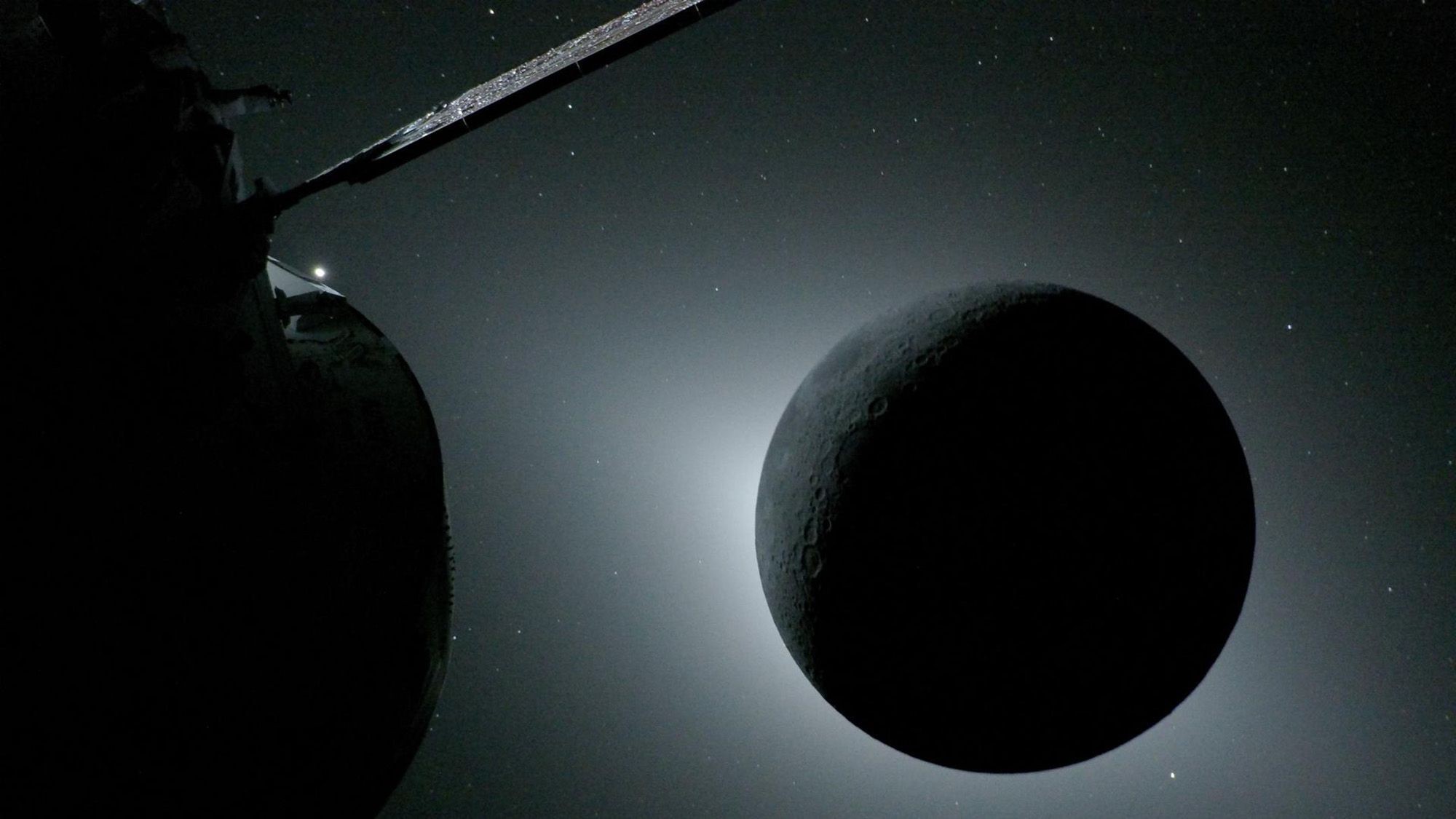
It was an image of the moon’s silhouette blocking the sun. Stars hung behind it like spilled diamonds. Venus. Saturn. Mars. All there, sharp and clear against the black void. The Orion spacecraft glowed faintly in the foreground, lit by Earth’s reflection rather than direct sunlight.
“There’s no way this turned out this well on a first try,” White muttered to himself.
He is the Lead Integrated Communications Officer (INCO) for NASA’s Artemis II mission. For months, he had waited for this specific pixel-perfect moment.
Pacing in Houston
While the four astronauts soared 250,00 miles from home, circling the far side of the moon, White was stuck on the ground.
For about forty minutes, they lost all contact. No voice. No video. No data.
Just silence.
White didn’t sit still during that gap. He paced. He wandered the halls of Mission Control Center. His brain spun with worst-case scenarios. Did the camera configuration stick? Would the signals come back through the celestial blockage?
It wasn’t a relaxed wait.
“I was all nerves,” White said later. “I walked around to keep myself distracted.”
When the Orion capsule reappeared over the lunar horizon—Earthrise—telemetry trickled back in bits and pieces. Voice followed soon after. White finally exhaled. But the high-definition photos? They were stuck in transit.
The optical communication laser had done its job during that brief window before signal loss, but the files needed time to travel. White opened them the next morning. That’s when his breath caught in his throat.
A strange shape
Before the silence, before the stars, the moon itself had bothered him.
As Artemis II approached its closest point, the moon grew fast. Too fast? No, just logarithmic. One minute it’s a disk in the sky; the next, it’s a landscape rushing at you.
But the texture looked… off.
White has watched the moon for years. Usually via International Space Station windows. He knows how it should look from Earth. From the front. The near side.
But Artemis approached at an angle. We saw parts of the far side that we rarely witness. The craters aligned differently. The ridges cut deeper shadows.
“My brain hurt,” White admitted. “It didn’t look correct.”
We are so accustomed to our one view that any deviation feels like an error. Like a glitch in the simulation. But it was real. It was just unfamiliar.
Colors, too.
Space is often painted gray in our minds. The moon, the rock, the suit. But when White tweaked the exposure on the camera feeds—bumping up brightness levels that seemed too dark—nuances emerged. Muted browns. Hints of warmth.
He didn’t expect that. He thought it would stay gray. It didn’t.
“You see it much more in the high-res photos the crew took,” White said. “But it was shocking to see how much color shows up even a bit closer.”
Scripted chaos
There was no improvising the shots.
Not during the flyby, anyway.
White and the INCO team spent over a year planning. They didn’t have the luxury of reaction. When Orion went behind the moon, they couldn’t adjust aperture or zoom. No live feeds to correct framing.
So they scripted it.
Nearly 300 commands.
Time-tagged. Pre-loaded. Sent up on a checklist before the blackout began. The cameras would flip into time-lapse mode. Snap a frame every thirty seconds as Earth shrank into the background behind the moon. Then, during the deep silence on the far side, a slower cadence. One shot every few minutes.
Just clicking through the list.
If you miss the mark? Too late.
The timing had to shift slightly depending on launch day. Tweaked in the final twenty-four hours. Then uploaded. And waited for.
During the eclipse phase, while the crew floated in darkness behind the satellite, the cameras worked alone. Capturing the shrinkage of home. Capturing the emergence from the shadows.
And yes, capturing those stars.
Most space photos lack them. Not because the universe is empty of points of light. But because spacecraft are shiny. Bright. You expose for the metal, you blow out the stars into the void.
But with the sun blocked by the moon, and the spacecraft dimmed, the background could speak. Venus stared back. Saturn wiggled its rings.
A rare balance.
More than a camera button press
White didn’t press any buttons for those final images. Not manually.
This was a machine ballet.
To get the camera pointing right, White had to coordinate with other teams. The solar arrays had to swing forward, out of the frame. That required talking to the power team. The vehicle itself needed rotation for specific angles. That meant asking Guidance, Navigation, and Control to shift Orion’s orientation—a totally different dance than ISS operations.
There was an imagery team handling settings. Engineers who built the lens.
“This wasn’t just me on console,” White stressed.
It was a full-control team effort. Every gear turn mattered. Every degree of rotation.
Artemis II sent humans further away than they have ever gone. It changed perceptions. Maybe it changed the mission controller who paced the halls, worrying over a bad connection that turned out to be legendary.
White is already planning for Artemis III. He’ll stay on the INCO team. Just not as lead. He hopes to take even better pictures.
He probably will.
But for now, the moon looks a little less gray. A little less familiar. And maybe, just maybe, a bit more human than we thought. 🌑✨