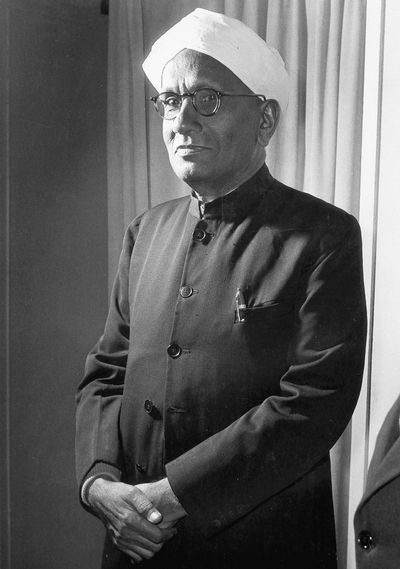
Chandrasekhara Venkata Raman did not just study light. He made it talk.
In 1930, this Indian physicist brought home the Nobel Prize for Physics. It was the first time a scientist from Asia won in the sciences. The award wasn’t for a new machine or a new element. It was for a subtle shift in how light behaves. When light passes through a clear material, some of it scatters and changes its color. This is the Raman effect.
It sounds simple now. Back then, it was a revolution.
Raman’s work gave scientists a way to see the fingerprint of molecules. You don’t need a massive particle accelerator to use it today. You just need a laser and a detector. It is used in everything from pharmaceuticals to art conservation. But before that, you had to understand the man behind the discovery.
From Student to Civil Servant
Raman was born in 1888 in Trichinopoly, now Tiruchirappalli. He came from a Tamil Brahmin family. His father taught physics and math. That matters. It meant young C.V. Raman had science in his dinner conversation.
He moved fast. He finished high school at 11. At 13, he entered Presidency College in Madras. By 18, he had a master’s degree in physics. He even published his first paper while still a student. It appeared in Philosophical Magazine. It was the first paper from his college to hit an international journal.
But jobs for scientists in British India were scarce. So, in 1907, he joined the civil service. He worked in the Indian Finance Service in Calcutta. It was a desk job. A boring desk job, by most standards.
He did not stop.
While filling out spreadsheets, he researched light diffraction and the physics of musical instruments. He did this at the Indian Association for the Cultivation of Science (IACS). His side work got attention. By 1917, he quit the finance service. He became a professor at Rajabazar Science College under the University of Calcutta.
He also started the Indian Journal of Physics in 1926. He built the infrastructure for Indian science.
The Blue Sea and the Sky
The path to the Nobel Prize started with a vacation.
In 1921, Raman traveled to England. He went via the Mediterranean. He noticed something odd. The sea was a deep, rich blue. The sky was a lighter shade.
Scientists at the time said the ocean’s color came from reflecting the sky. Raman didn’t buy it.
He ran experiments with polarized light. He proved the water itself was scattering the light. It wasn’t a mirror. It was molecules. He refined the explanation for why the sea looks blue. It changed how we view optics.
This trip set the stage for his real breakthrough. He was already thinking about how light interacts with matter. He published Molecular Diffraction of Light in 1922. It was the first of many studies on scattered light.
The Raman Effect Explained
In 1928, Raman and his student K.S. Krishnan made the discovery.
They passed monochromatic light—a single wavelength—through a transparent material. Most of the light went through unchanged. But a tiny portion scattered.
Here is the key. The scattered light changed its wavelength.
This shift happened because the light molecules interacted with the material’s molecules. They absorbed or transferred energy. The light lost or gained a bit of energy. That change in energy meant a change in color.
Raman called it “A New Radiation.” It was published in the Indian Journal of Physics.
This phenomenon is now called Raman scattering. It is the result of the Raman effect.
Why does it matter? Because every molecule has a unique signature. If you shine light on a substance and measure the shift, you know what that substance is. It is non-destructive. It is precise. It became a fundamental tool in spectroscopy.
Beyond the Nobel
Raman’s name is tied to physics. But his work spanned several fields.
He looked at acoustics. He analyzed Indian classical instruments like the tabla and veena. He explained how their design produced harmonic overtones. He gave science to tradition.
He looked at crystallography. He studied lattice dynamics. This describes how atoms vibrate inside solids. He advanced the understanding of phonons. These are quantized units of vibration. It was key for solid-state physics.
He also developed the Raman-Nath theory with physicist N.S. Nagendra Nath. Published between 1935 and 1936, it explained how light diffracts when passing through ultrasonic waves. This principle now helps in acousto-optic devices.
A Legacy Built on Mentorship
Raman was knighted in 1929. He won the Hughes Medal and the Franklin Medal. In 1954, he received the Bharat Ratna. India’s highest civilian honor.
But his greatest gift might have been the people he trained.
In 1933, he moved to Bangalore. He headed the physics department at the Indian Institute of Science (IISc). He expanded research programs. He mentored future giants.
Homi J. Bhabha studied under him. Vikram Sarabhai studied under him.
Raman’s nephew, Subrahmanyan Chandrasekhar, was also influenced by him. Chandrasekhar spent time in Raman’s lab. They debated the theoretical aspects of the Raman effect. Chandrasekhar went on to study stellar evolution. He won the Nobel Prize in 1983.
Raman founded the Indian Academy of Sciences in 1934. After retiring from IISc, he founded the Raman Research Institute (RRI) in 1948. He served as its director until he died.
He died on November 21, 1970, in Bangalore.
India now celebrates National Science Day on February 28. It marks the discovery of the Raman effect. The date is not random. It honors the day the world realized light could change its tune.
Raman proved you do not need a perfect lab to change science. You just need curiosity. And the willingness to look at the sea and question what you see.