


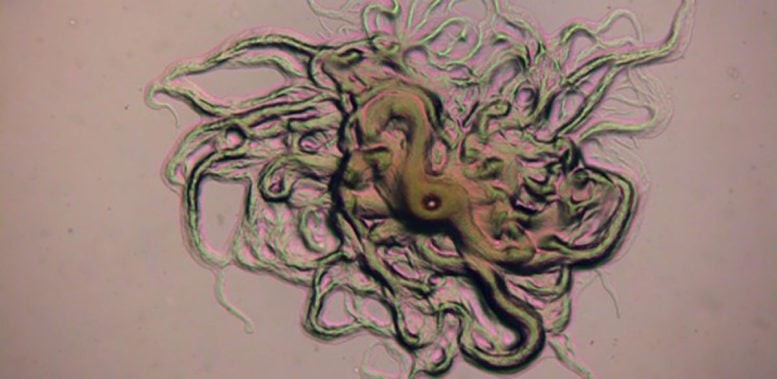
You wouldn’t spot it under a microscope without a close look.
A nearly transparent bacterial colony. That’s what researchers call the culprits behind columnaris disease, a lethal threat to farmed fish. Now, these pathogens—previously restricted to Asia and the United States—have been found in Brazil.
Specifically in samples from São Paulo, Minas Gerais states, and Paraná.
The stakes are high. Columnaris disease ravages the skin and gills. It kills young animals within days. The findings, published in Microbial Pathogenesis, reveal that Flavobacterium species are circulating in Brazilian aquaculture where they shouldn’t be. The bacteria were isolated from Nile tilapia (Oreochromis niloticis ), known locally as Saint Peter, as well native species like tambaqui, pacu, and the Amazon spotted catfish.
This expands the host range significantly. And it demands new surveillance.
Identifying the Invisible Enemy
Standard visual examination is tricky.
“The initial identification of bacteria of this genus… depends on the medium used. The colony can become transparent and almost invisible,” explains Daniel de Abreu Reis Ferreira. He’s the study’s lead author and completed this work at São Paulo State University’s Aquaculture Center (CAUNESP).
Until recently, scientists lumped four of the species involved into one group: Flavobacterium columnare. That name gave columnaris disease its title. The infection causes pale lesions on skin and fins. It causes tissue death in the gills.
Fabiana Pilarski, Ferreira’s supervisor and a professor at CAUNESC, puts it bluntly.
“The bacteria feed on epithelial cells. They kill the fish within a few days. Especially larvae and fry.”
Pilarski also works at the Science Center for the Development of AquaHealth at the Fisheries Institute. Her team’s work highlights just how adaptable these bugs are.
Native Fish Are Now Hosts
The research isolated 11 bacterial strains. Six of them belonged to Flavobacterium oreochromis. Before now, this species was only linked to tilapia—the world’s most farmed fish.
The new data changes that.
Ferreira’s team detected F. oreochromis in tambaqui (Colossoma macropomum ), lambari (Astyanax lacustris ), and pacu (Piaractus mesopotamicus ). These are commercially important native species. The bacteria clearly infect a broader range than previously recognized.
Then there’s the catfish case.
Researchers documented the first known infection of Flavobacterium davisii in an Amazon spotted catfish (Pseudoplatystoma punctifer ). This is huge.
“This case shows that the bacterium infects Siluriformes, a different fish order from those it usually colonizes. It broadens the range of potential hosts,” Ferreira notes.
Heat and Biofilms: The Perfect Storm
Laboratory tests confirmed something alarming.
Pathogens previously seen only in the US and Asia grow well under Brazilian conditions. F. davisii and F. inkyongense hit their optimal growth at 28°C. That’s close to the average temperature in Brazil’s inland waters.
Two other species, F. oreochromis and F. indicum, preferred even hotter water. F. indicum peaked at 35°C. Rising water temperatures could make life easier for the pathogen.
At 28°C, the bacteria produced massive amounts of biofilm.
“A biofilm is a protective matrix. It allows bacteria to remain dormant when conditions are bad. Then multiply again when the environment becomes conducive,” Pilarski says.
Biofilms cling to tanks, nets, and tools. They let bacteria persist between outbreaks. Hygiene isn’t just a suggestion here.
“This underscores the importance of robust hygiene and discharge protocols to prevent equipment colonization,” Ferreira adds.
Here’s the twist.
Biofilm production dropped at 35°C for almost all species tested. Except F. davisii. It kept producing thick biofilms at 35°C, even though it moved less.
“It’s an adaptation. A metabolic trade-off. It loses by moving less, but gains by producing biofilm to survive,” Ferreira explains.
Salt, Vaccines, and Future Protocols
So how do you fight back?
Previous studies suggest Flavobacterium hates salt. Adding salt to farm water might stop the pathogens from taking hold. But scientists still need to figure out the safe concentrations for each specific fish species.
Vaccination is another route.
Researchers are sequencing bacterial genomes to find weak points for vaccines. The goal is autogenous vaccines. These are custom-made from strains found at a specific farm.
Columnaris attacks exposed tissues. So a bath vaccine makes sense.
Instead of injecting every single fish—impractical and stressful—producers could dip groups into water with a weakened bacterium.
“Since the disease primarily affects the skin, bath treatment using weakened bacterium is ideal for young fish,” Pilarski says. “Their immune system is still developing. And because they’re small, you can vaccinate large numbers of fingerlings simultaneously.”
It’s not a silver bullet. Biofilms linger. Temperatures rise. New hosts appear. The bacteria are already here. And they are evolving.


