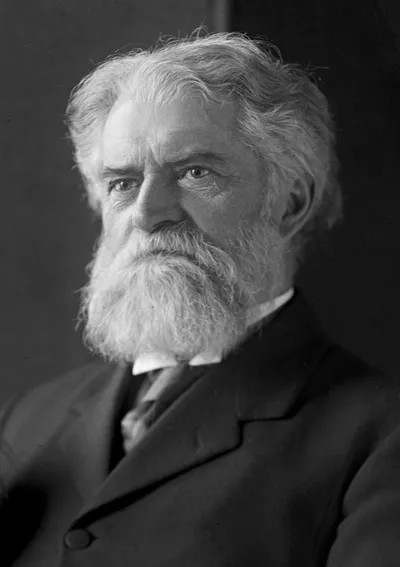
Simon Newcomb didn’t go to college in the traditional sense. He didn’t sit in lecture halls or earn degrees through years of polite attendance. Instead, his education came from stolen hours in Washington, D.C. libraries and a relentless, almost violent, curiosity about numbers.
Born in Nova Scotia in 1835, Newcomb was a prodigy of arithmetic. His father, a traveling schoolteacher, had him counting at four. By five, Newcomb was spending hours on addition and multiplication drills. By seven, he had devoured his arithmetic textbook, including the extraction of cube roots. It was a head start that would define a life spent calculating the movement of planets.
His path was anything but linear. At sixteen, he was apprenticed to a quack herb doctor in New Brunswick. He lasted a few years before running away to find his widowed father in Maryland. There, in the capital’s libraries, he found his true calling. He explored various technical fields but settled on mathematics. Specifically, he became obsessed with the American Ephemeris and Nautical Almanac. This annual handbook predicted where celestial bodies would be. It was a puzzle. He wanted to solve it.
He applied for a job at the American Nautical Almanac Office in Cambridge, Massachusetts. He got it. In 1857, he began working as a computer, crunching the numbers by hand. He also enrolled at Harvard’s Lawrence Scientific School, graduating in 1858. Two years later, he joined the U.S. Navy’s corps of mathematics professors. This assignment landed him at the U.S. Naval Observatory in Washington, D.C.
He stayed there for over a decade. He used meridian instruments and a then-new 26-inch refractor telescope to determine the positions of celestial objects. It was tedious, precise work. But it was necessary. The positions of stars and planets weren’t just academic exercises; they were the backbone of navigation.
In 1877, Newcomb took charge of the American Nautical Almanac Office in Washington. Almost immediately, he began the work that would dominate the rest of his life: calculating the motions of every body in the solar system. This wasn’t a quick project. It was a massive undertaking that required years, even decades, of solitary calculation.
He reached compulsory retirement age for Navy captains in 1897. The distinction? He retired as a rear admiral. An unusual title for a mathematician.
His academic career ran parallel to his Navy service. From 1884 to 1893, he was a professor of mathematics and astronomy at Johns Hopkins University in Baltimore, though he continued living in Washington. He served as editor of the American Journal of Mathematics for many years. He was also a founder of the American Astronomical Society, serving as its first president from 1899 to 1905.
He collected honorary degrees and the highest scientific prizes of his era. He was elected to the National Academy of Sciences in 1869. He served as home secretary (1881–83), vice president (1883–89), and foreign secretary (1903 until his death in 1909).
But his legacy isn’t just in titles. It’s in the tables.
Newcomb’s most significant contribution appeared in the Astronomical Papers Prepared for the Use of the American Ephemeris and Nautical Almanac. He founded this series in 1879 with a clear goal: to systematically determine the constants of astronomy using the best available data. He wanted to reinvestigate the theories of celestial motion. He wanted to create tables, formulas, and rules for building ephemerides.
The result was 36 articles across nine volumes, totaling roughly 4,500 quarto pages. Newcomb was the sole or principal author of 25 of them. These included his tables for the Sun, Mercury, Venus, Mars, Uranus, and Neptune. Tables for Jupiter and Saturn were created by George W. Hill, another American astronomer.
The accuracy of these tables was so high that they were used throughout most of the world to calculate daily positions of celestial objects from 1901 to 1959.
Even after 1959, his calculations for the Sun, Mercury, Venus, and Mars remained in use. The series is remarkable for its sustained quality. Hardly anything in them proved incorrect. By the mid-20th century, they were still worthy of attention for any student of celestial motions.
Newcomb died in Washington, D.C., in 1909. He had mapped the heavens not with a telescope, but with a pencil and a calculator. The sky he left behind was precise. It was reliable. It was his.
The Global Standard for Star Charts
The confusion was real. For decades, astronomers in different countries were looking at the same sky but using entirely different numbers. Newcomb and A.M.W. Downing, superintendent of the British Nautical Almanac Office, saw this diversity of fundamental data as a critical flaw. It wasn’t just a minor inconvenience. It was a systemic error that threatened the precision of exact astronomy.
They pushed for a unified system. This effort didn’t just change some numbers; it laid the groundwork for an international collaboration among the world’s principal almanac makers. That network survived two World Wars. It grew stronger with each conflict.
The push for unified astronomical constants culminated in a pivotal meeting. In May 1896, directors from the national ephemerides of the United States, Great Britain, France, and Germany gathered in Paris. The goal was clear. They needed to stop the fragmentation.
The result was decisive. Starting in 1901, all participating ephemerides would use a specific set of constants. These were substantially Newcomb’s values. The agreement was so robust that it included Newcomb’s work which was not even finished yet. They adopted his future data before it was fully realized.
Decades later, the validity of that choice was tested. A similar conference convened in Paris in 1950. The verdict was unanimous. The system adopted in 1896 remained the preferable option for practical use. No other system had surpassed it.
“Confusion which pervaded the whole system of exact astronomy… arising from the diversity of the fundamental data”
This standardization did more than clean up the math. It created a shared language for celestial navigation. When the British Nautical Almanac Office and its international peers started speaking the same numerical language, the accuracy of global shipping and surveying improved. The stability of the system was proven not by a single paper, but by its endurance. It outlasted political upheavals and global wars.
The 1950 confirmation was not just a nod to tradition. It was an acknowledgment that Newcomb’s foundational work, agreed upon in Paris over fifty years prior, still held the best balance of precision and utility. Other systems were proposed. They were compared. They fell short.
The legacy of that 1896 decision is visible in every modern star chart that relies on standardized data. The confusion was cleared. The sky became a single, coherent map. Or at least, as close as we can get.