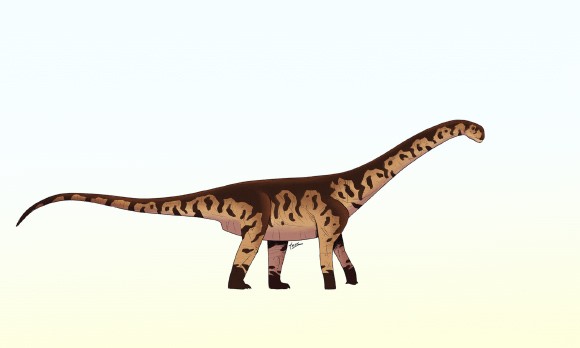
Fossils discovered on a remote ranch in Argentina have revealed a new species of giant, long-necked dinosaur, offering scientists a rare window into the evolutionary history of the southern supercontinent Gondwana. Named Bicharracosaurus dionidei, this massive herbivore roamed the Earth approximately 157 million years ago during the Late Jurassic epoch.
The discovery, led by an international team of paleontologists from Ludwig-Maximilians-Universität München (LMU), challenges long-held assumptions about where the largest dinosaurs evolved and provides critical comparative data for understanding the rise of sauropods.
A Rare Find in the Southern Hemisphere
For decades, our understanding of early sauropod evolution has been heavily skewed toward fossils found in North America and Europe. This “Northern Hemisphere bias” has left significant gaps in the fossil record of Gondwana—the ancient supercontinent that included present-day South America, Africa, Antarctica, Australia, and India.
Until recently, Tanzania’s Tendaguru Formation was the only major Late Jurassic site in the Southern Hemisphere preserving multiple sauropod skeletons. The discovery of Bicharracosaurus dionidei in the Cañadón Calcáreo Formation of Chubut province, Argentina, changes this landscape.
“The fossil site in the Argentine province of Chubut… provides us with important comparative material, allowing us to continuously supplement and reevaluate our understanding of the evolutionary history of these animals, particularly in the southern hemisphere,” said Professor Oliver Rauhut, senior author of the study.
The fossils, which include parts of the spine, ribs, and hip, were first brought to scientific attention by local farmer Dionide Mesa in March 2001. The dinosaur’s specific name, dionidei, honors his role in the discovery.
Anatomy of a Giant
Bicharracosaurus dionidei was a formidable creature, stretching roughly 20 meters (65 feet) in length. It belongs to the Sauropoda lineage, a group that dominated the Mesozoic era as the largest terrestrial vertebrates ever to exist.
While sauropods first appeared in the late Triassic and survived until the end of the Cretaceous, the Late Jurassic was a pivotal time for their diversification. During this period, early branching groups were largely replaced by more advanced lineages known as Neosauropoda.
Neosauropods split into two major clades:
1. Diplodocoidea : Known for long, whip-like tails and necks (e.g., Diplodocus ).
2. Macronaria : Characterized by complex nasal structures and often larger body sizes (e.g., Brachiosaurus ).
Determining which group a new fossil belongs to is often complex, especially for Jurassic-era specimens where the evolutionary split was still refining itself.
Resolving the Family Tree Mystery
The anatomy of Bicharracosaurus dionidei presented a puzzle for researchers. While it clearly belonged to the Macronaria group—massive herbivores that later produced giants like Brachiosaurus —it also shared surprising physical similarities with Diplodocidae, a different branch of sauropods entirely.
To resolve this ambiguity, the research team conducted rigorous phylogenetic analyses using two separate datasets. The results were decisive:
- Bicharracosaurus dionidei is firmly placed within the Macronaria.
- It shows specific affinities with Brachiosauridae, the lineage that includes Brachiosaurus and the African giant Giraffatitan.
This classification is significant because it makes Bicharracosaurus the first confirmed Brachiosauridae from the Jurassic of South America.
Why This Matters
This discovery does more than add a new name to the dinosaur catalog; it corrects a geographical blind spot in paleontology. By providing a robust specimen from the Southern Hemisphere, scientists can now better compare evolutionary trends between Gondwana and the Northern Hemisphere.
The findings suggest that the evolutionary radiation of brachiosaurids was more widespread and diverse in the Jurassic period than previously thought. As lead author Alexandra Reutter noted, these insights help clarify the “problematic early evolution of macronarians,” showing that the ancestors of the giants we know today were already establishing distinct lineages across different continents.
“Our phylogenetic analyses… indicate that Bicharracosaurus dionidei was related to the Brachiosauridae, which would make it the first Brachiosauridae from the Jurassic of South America.”
The full study, detailing the anatomical features and evolutionary significance of Bicharracosaurus dionidei, was published in the journal PeerJ.
Conclusion
The identification of Bicharracosaurus dionidei marks a milestone in understanding sauropod evolution, proving that the Southern Hemisphere played a crucial role in the diversification of these giants. By filling a critical gap in the fossil record, this discovery allows scientists to reconstruct a more accurate and global picture of life during the Late Jurassic.