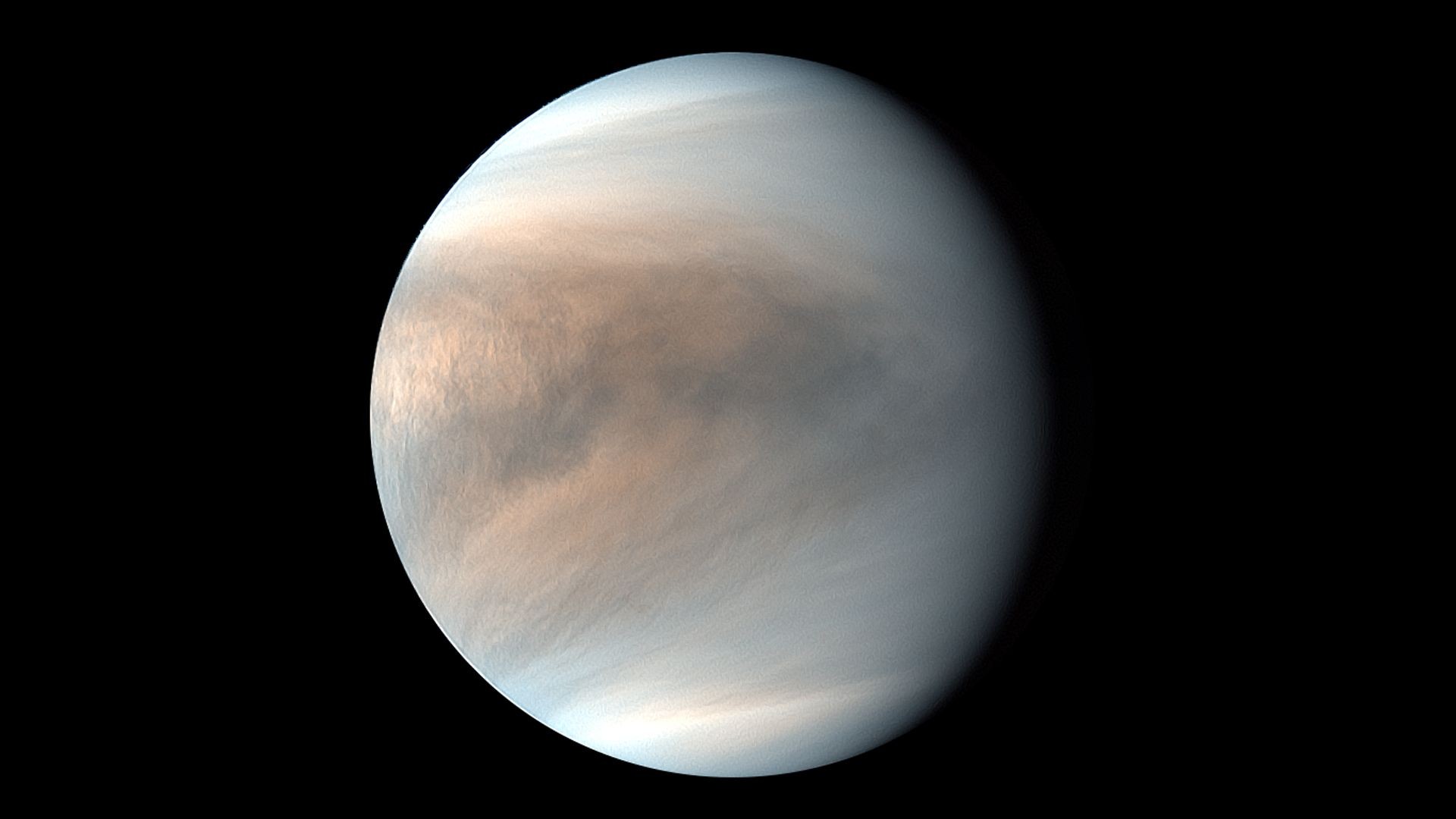
A towering bank of sulfuric acid clouds stretching 3,700 miles (6,000 kilometers) across Venus is not a random weather anomaly. It is the result of a massive atmospheric phenomenon known as a hydraulic jump —the largest ever observed in the solar system.
This discovery solves a decade-old mystery regarding the formation of these immense cloud structures, which sit 31 miles (50 km) above the planet’s surface. By analyzing data from the Japanese Aerospace Exploration Agency’s (JAXA) Akatsuki mission, an international team of astronomers has linked the clouds to a specific fluid dynamic process that connects large-scale horizontal winds with powerful vertical updrafts.
The Mystery of the Equatorial Cloud Bank
In 2016, the Akatsuki orbiter identified a distinct, monstrous cloud bank aligned with Venus’s equator. The structure was striking for its sheer scale and its sharp, well-defined leading edge. For ten years, scientists struggled to explain how such a massive, fast-moving weather system could maintain its shape and velocity within Venus’s dense atmosphere.
The key to unlocking this mystery lies in understanding planetary waves. Specifically, the researchers identified an eastward-moving atmospheric disturbance known as a Kelvin wave. On Earth, Kelvin waves occur in both oceans and atmospheres, but on Venus—with its scorching surface temperatures exceeding 860°F (460°C)—this wave exists purely in the air.
What Is a Hydraulic Jump?
To understand the mechanism behind the clouds, consider a common household scenario: turning on a kitchen faucet.
When water hits the bottom of a sink, it flows outward rapidly in a thin, shallow layer. Suddenly, it spreads out, slows down, and piles up into a deeper, slower-moving ring. This transition from shallow/fast to deep/slow is called a hydraulic jump.
Venus experiences this same physics principle, but on a planetary scale.
- The Wave Propagates: A large-scale Kelvin wave moves eastward through the lower atmosphere.
- The Jump Occurs: As the wave slows down, it triggers a hydraulic jump.
- Vertical Lift: This sudden change in flow dynamics forces a powerful updraft of sulfuric acid vapor upward.
- Cloud Formation: The vapor rises to an altitude of roughly 31 miles (50 km), where it condenses into the massive, visible cloud bank trailing behind the wave.
Why This Matters for Planetary Science
The discovery is significant not just for Venus, but for our broader understanding of atmospheric physics. This is the first time a hydraulic jump has been identified on a planet other than Earth.
“Our discovery of the hydraulic jump on Venus connecting a very large-scale horizontal process with a strong localized vertical wave is unexpected, as in fluid dynamics these are usually disconnected,” said study leader Takeshi Imamura of the University of Tokyo.
Venus presents a unique laboratory for atmospheric study. Its atmosphere is composed primarily of carbon dioxide with trace amounts of nitrogen and sulfur dioxide. It is incredibly dense, creating a surface pressure 92 times that of Earth’s, and it “super-rotates,” meaning the atmosphere circles the planet in just four Earth days while the solid planet itself takes 243 days to rotate once.
The fact that Venus’s hydraulic jump behaves differently than theoretical models predicted highlights how wildly atmospheric phenomena can vary across different planetary environments. It challenges the assumption that Earth-based fluid dynamics models can be directly applied to other worlds without significant adjustment.
Refining Climate Models
This finding addresses a critical gap in current scientific models of Venus. Until now, global circulation models for Venus were largely based on Earth-like patterns and did not account for hydraulic jumps.
Imamura notes that the next step is to integrate this new understanding into more comprehensive climate simulations. However, this presents significant technical hurdles. Simulating the complex interplay of atmospheric processes on Venus requires immense computational power.
“We will face some challenges due to the huge amount of processing power required to run such simulations. Even with modern supercomputers, it isn’t easy,” Imamura stated.
By refining these models, scientists hope to gain a more accurate picture of Venus’s weather systems, which may also offer insights into the atmospheric evolution of other exoplanets with similar dense, hot conditions.