New paleontological research is reshaping our understanding of prehistoric marine ecosystems. For decades, the prevailing scientific consensus held that the oceans of the Mesozoic era—the age of the dinosaurs—were dominated by vertebrates like fish and marine reptiles, while invertebrates played secondary, supporting roles.
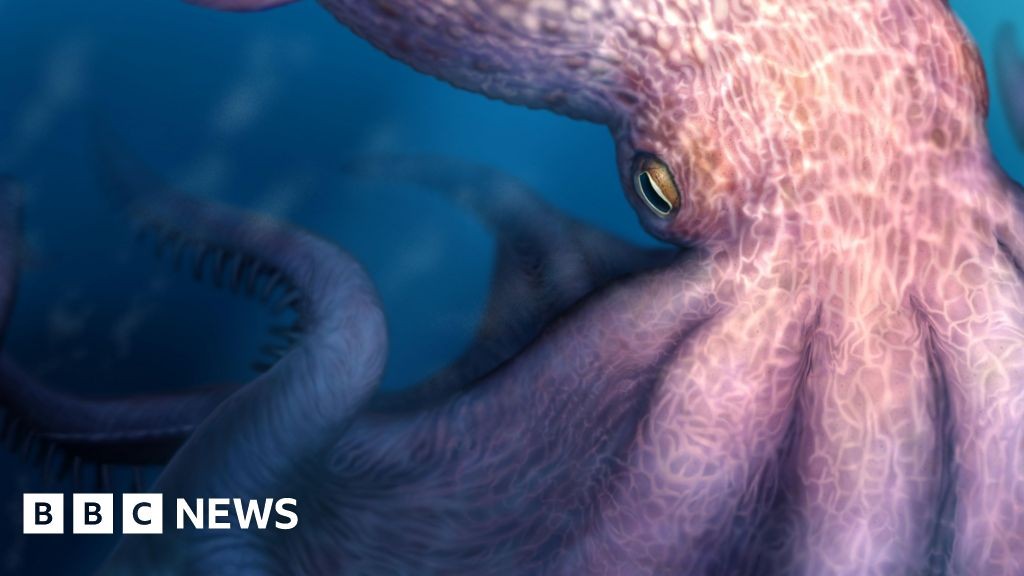
However, a recent study by scientists from Hokkaido University suggests a much more formidable presence: giant octopuses that may have been among the largest invertebrates to ever exist.
The Discovery of a Prehistoric Titan
The breakthrough comes from the analysis of remarkably well-preserved fossilized jaws. By examining these structures, researchers have reconstructed a creature of immense proportions.
While the central body of these ancient cephalopods is estimated to be between 1.5 and 4.5 meters long, the addition of their powerful tentacles brings their total length to a staggering 7 to 19 meters. To put this in perspective, the modern Giant Pacific Octopus—one of the largest living species today—has an arm span of just over 5.5 meters.
Evidence of Advanced Predation
The fossilized remains do more than just indicate size; they reveal a sophisticated way of life. The study highlights several key features that suggest these creatures were apex predators:
- Powerful Feeding Mechanics: The presence of beak-like jaws indicates these animals were capable of crushing hard shells and even the bones of other marine life.
- Specialized Hunting: The jaws were equipped to handle the shells of large fish and marine reptiles, allowing them to access nutrient-rich prey that other invertebrates could not.
- Complex Brain Function: Interestingly, the wear on the fossilized jaws is uneven from left to right. This suggests the animals favored one side while feeding—a behavior seen in modern octopuses that is linked to advanced neurological processing and lateralized brain function.
“With their tentacles and their suckers, they could perfectly hold on to such an animal and there is no escape,” noted Christian Klug, a paleontologist at the University of Zurich.
Unanswered Mysteries of the Deep
Despite these significant findings, the exact nature of these giants remains shrouded in mystery. Because soft tissues like fins and skin rarely fossilize, scientists are still working to understand how these animals moved through the water or how fast they could swim.
Furthermore, while researchers have not yet found a fossil containing stomach contents to confirm their diet, experts have developed strong hypotheses:
- Ammonite Specialists: Dr. Nick Longrich of the University of Bath suggests they may have primarily preyed on ammonites (extinct coiled mollusks).
- Opportunistic Hunters: Like their modern descendants, these giants were likely voracious and opportunistic, consuming whatever prey was available, from small fish to larger marine reptiles.
Why This Matters
This discovery challenges the traditional “vertebrate-centric” view of ancient ocean hierarchies. It suggests that the evolutionary arms race in the prehistoric seas wasn’t just between fish and reptiles, but also involved highly intelligent, massive invertebrates capable of dominating their environments.
As paleontologists continue to piece together this puzzle, these findings remind us that the history of life on Earth is often much more complex—and much larger—than previously imagined.