A remarkable archaeological discovery in central Spain has provided a rare, intimate glimpse into the lives of Roman soldiers. A broken bronze cup, known as the Berlanga Cup, has been identified as a 1,900-year-old souvenir featuring detailed depictions of Hadrian’s Wall—located nearly 1,200 miles away in northern England.
An Artistic Map of the Frontier
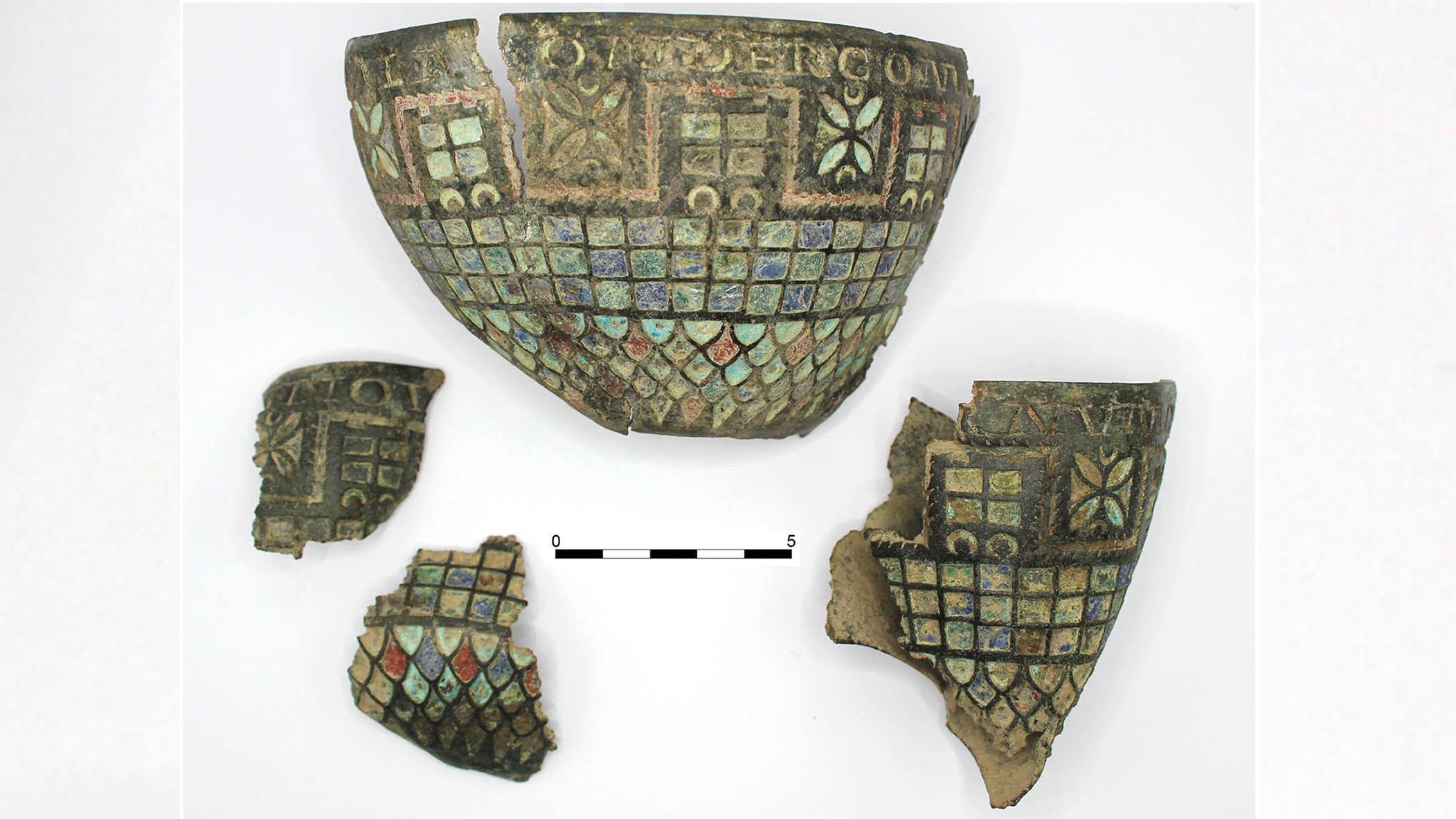
The vessel, a type of Roman drinking cup known as a trulla, is roughly 4.5 inches wide and 3.2 inches tall. Far from being a mass-produced item, the cup is a highly customized piece of craftsmanship. It features:
- Colorful Enamel Work: The design includes bands of red, green, turquoise, and navy-blue enamel.
- Schematic Forts: The cup depicts four specific forts located on the eastern side of Hadrian’s Wall using geometric shapes—squares and half-moons—to represent turrets or gateways.
- Latin Inscriptions: The text explicitly names four Roman forts: Cilurnum (Chesters), Onno (Halton Chesters), Vindobala (Rudchester), and Condercom (Benwell).
This level of detail makes the Berlanga Cup unique; while similar vessels exist, it is the only one known to specifically reference these eastern frontier fortifications.
Tracing the Journey from Britain to Spain
For years, the presence of such a specific British artifact in central Spain posed a historical puzzle. However, recent scientific analysis has begun to connect the dots.
Material Origins
Metallurgical testing revealed that the cup is composed of bronze (copper and tin) with a significant amount of lead. Researchers believe this lead likely originated from mines in northern England, suggesting the cup was manufactured by a local artisan near Hadrian’s Wall between A.D. 124 and 199.
The Human Connection
The mystery of how the cup traveled from the cold northern frontiers of Britain to the sunnier plains of Spain may lie in the movement of Roman military units. Archaeologists propose a likely scenario involving the Cohors I Celtiberorum —a Roman auxiliary unit composed of soldiers from the Celtiberia region (modern-day Spain).
Historical records indicate this unit was stationed near Hadrian’s Wall during the Roman Empire. The most probable theory is that a veteran from this unit, after completing his service, returned to his homeland in Spain, carrying the cup as a memento of his time on the frontier.
Why This Discovery Matters
Most military memorabilia from the Roman era consists of weapons or official insignia. The Berlanga Cup is different because it is a functional, everyday object.
By choosing a trulla —a simple cup used for drinking water—the owner created a lasting connection to the daily life and camaraderie of the barracks. Whether it was purchased as a souvenir or gifted as a reward for bravery, the cup serves as a profound symbol of the personal connections forged within the vast, often impersonal machinery of the Roman Empire.
The Berlanga Cup acts as a bridge between two distant corners of the Empire, illustrating how individual soldiers carried their history and identity across thousands of miles.
Conclusion: The discovery of the Berlanga Cup highlights the deep interconnectedness of the Roman world, proving that even the most remote frontiers left a lasting impact on the lives and memories of those who served there.