Hubble and Webb caught one.
The Omega Centauri cluster was supposed to be full of them. Ten thousand black holes. Missing. Silent.
For a long time, they just weren’t there. At least not on our radar.
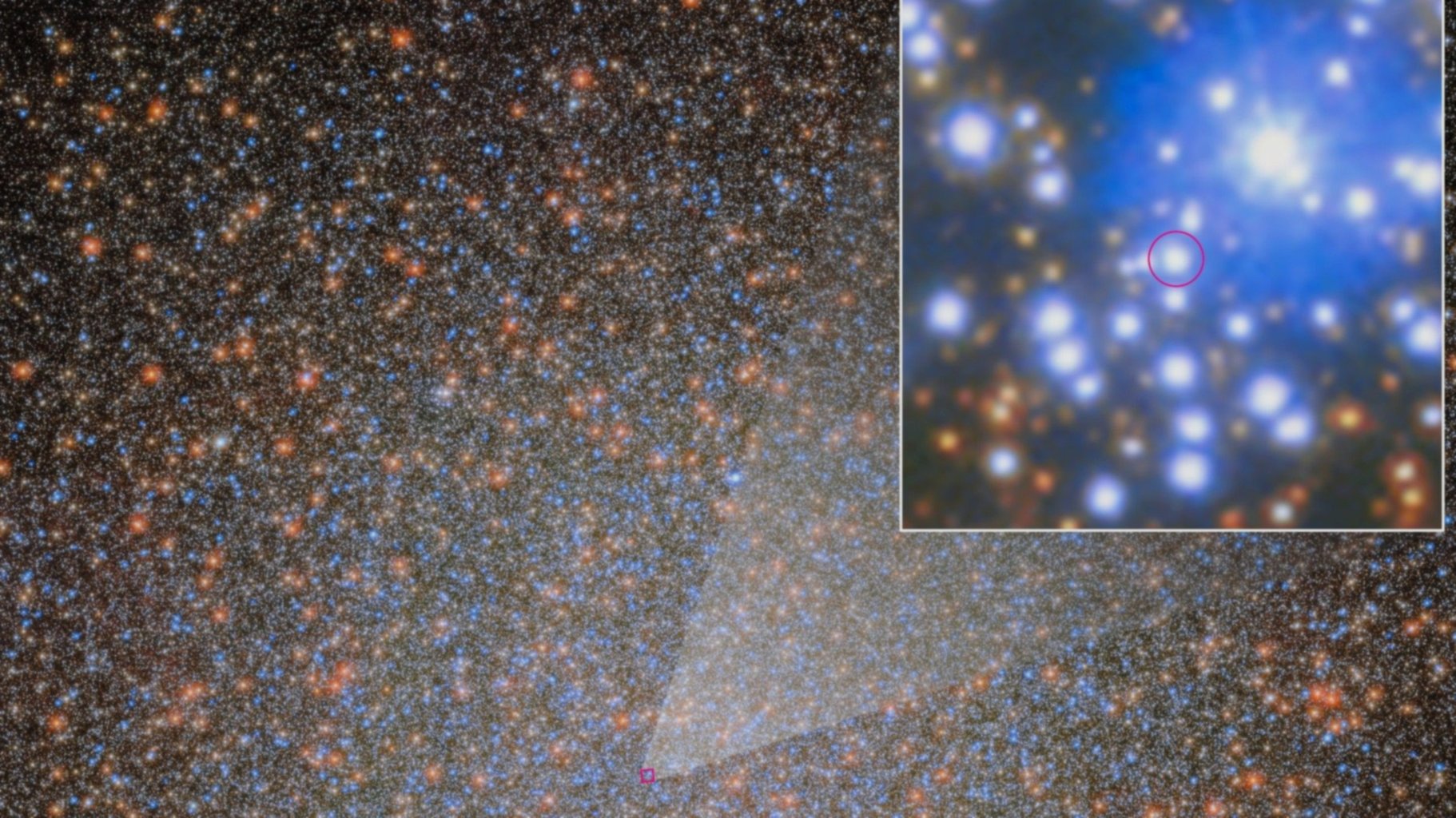
A star named oMEGACat-307140063689213408-018 orbits something unseen. It dances around dark space. Hubble watched from 2003. It kept watching until 2023. The James Webb Space Telescope took the baton from there, tightening the measurements.
It wasn’t a neutron star. People thought that at first. No. It’s four times heavier than our Sun. Well. 4.46 times. That’s too heavy for a dead star of normal density. So it collapsed. Completely. Into a black hole.
Omega Centauri isn’t just any star cluster.
It’s huge. The biggest globular cluster in the Milky Way. Maybe it’s not even a cluster anymore. Some think it’s the ghost of a dwarf galaxy. A core. What’s left after the Milky Way ate its neighbor. Tides pulled strips away. Eons of cosmic cannibalism.
There are still 10 million stars there. 18,000-light-year commute.
And in the middle? An intermediate-mass monster. Found in 2024. Eight thousand two hundred times the Sun’s mass. That’s the signature of a galaxy nucleus, not a cluster. It fits the “eaten dwarf galaxy” theory nicely.
But galaxies don’t just have central monsters. They have litter. Stellar-mass black holes. The kind born when big stars blow themselves apart. We expected 10,000 of them here.
Zero.
That was the record until Matthew Whitaker decided to look closer.
He combed through two decades of Hubble data. He mixed in Webb’s sharper eyes. The trick? Astrometry. Mapping tiny shifts in position.
The visible star in the binary has 78% of our Sun’s mass. It moves. The invisible companion pulls it. You can’t see the pull. But you can measure the wobble.
“The precision of these measurements is incredible,” Whitaker said. Down to fractions of a pixel. Without both telescopes working together? We wouldn’t have found this.
The orbit is long. Ninety-four years.
The widest ever seen for this type of system.
Hubble only saw less than a quarter of it. But that quarter included the closest approach. The moment when the star flies fastest under the black hole’s gravity. That speed gave them the mass.
Will this relationship last? Probably not.
Space is crowded there. Within a billion years, another star will likely crash into their dance floor and steal the companion away. Or kick them both out. It’s chaos, but slow chaos.
Here’s the weird part.
The mass is odd. Four and a half solar masses?
We have an eleven-year dataset of gravitational waves now. Merging black holes sing. They make waves we can detect.
There’s a gap in those songs. A quiet zone.
Black holes between 2.5 and 5 solar masses shouldn’t really exist. At least, that’s what the mergers suggested. Neutron stars cap out around 2.5. Anything bigger should have jumped the gap. Straight to ten solar masses.
oMEGACat BH-1 (the new one) sits right in that silence.
Anil Seth says this matters. Globular clusters are breeding grounds for binaries. They squeeze stars together until they merge. Those merges make the gravitational waves. If we don’t understand how the black holes form there—how the physics works in those primitive, low-metallicity environments—we’re flying blind on the wave data.
“These environments are primary places where we think binaries merge,” Seth says.
The stars in Omega Centauri are ancient. Primitive. Poor in heavy elements compared to the Sun. That scarcity complicates things. Which stars collapse? Which explode? The answer isn’t clear yet.
One found. Nine thousand, nine hundred ninety-nine to go.
Whitaker isn’t stopping. The data pile keeps growing. And NASA has a new eye launching later this year: the Nancy Grace Roman Space Telescope.
It’s wide. Wider than Hubble.
Roman will scan the crowded center of our galaxy. Regularly. With Hubble-like resolution.
“We’re hoping,” Whitaker says, “we’ll find more systems like this.”
If Roman can see the pattern in the bulge, maybe we can fill in the gaps in the rest of the sky too.