The James Webb Space Telescope (JWST) has uncovered a galaxy that shouldn’t exist—at least, not yet. Deep in the early universe, astronomers have identified a massive, ancient-looking galaxy that lacks the orderly rotation seen in most cosmic structures of its time. This discovery challenges our understanding of how galaxies evolve, suggesting that some cosmic systems matured far faster than current theories predict.
The Unexpected Discovery
In the modern universe, galaxies generally fall into two categories: fast rotators, which spin like pinwheels (such as our Milky Way), and slow rotators, where stars move in chaotic, random directions. Slow rotators are typically the end-stage products of galaxy evolution. They form after billions of years of mergers and gravitational interactions, usually appearing only in mature, local galaxy clusters.
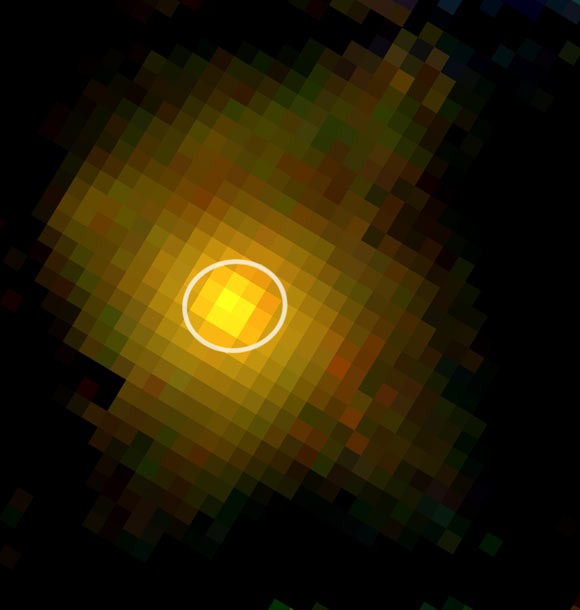
However, JWST observations have revealed XMM-VID1-2075, a massive galaxy located at a redshift of z = 3.449. This means we are seeing it as it existed approximately 12 billion years ago, when the universe was less than 2 billion years old.
Despite its youth, XMM-VID1-2075 exhibits the characteristics of a “slow rotator”:
* It shows no significant overall rotation.
* Its stars exhibit chaotic, random motion.
* It has ceased forming new stars, indicating it is already “dead” or quenched.
“That’s something only seen in the most massive, mature galaxies that are closer to us in space and time,” said Dr. Ben Forrest of the University of California, Davis. “This one in particular did not show any evidence of rotation, which was surprising and very interesting.”
Why This Matters
Standard cosmological models suggest that galaxies gain angular momentum from inflowing gas and gravity as they form, causing them to spin. To become a slow rotator, a galaxy typically needs to undergo multiple mergers over billions of years. These collisions scramble the orderly rotation, turning it into chaotic stellar motion.
Finding a galaxy with this chaotic structure so early in cosmic history raises a critical question: How did it achieve such a mature state so quickly?
The discovery implies that the timeline for galaxy evolution may be compressed in certain environments, or that alternative mechanisms for creating chaos are at work. It suggests that the early universe was capable of producing complex, dynamically hot systems much earlier than previously thought.
A Singular Collision?
Dr. Forrest and his team, part of the MAGAZ3NE (Massive Ancient Galaxies at z >3 NEar-Infrared) survey, used JWST’s high-resolution capabilities to analyze the internal kinematics of XMM-VID1-2075 and two similar galaxies. While one of the comparison galaxies was rotating normally and another was “messy,” XMM-VID1-2075 stood out as a true slow rotator.
The team proposes a specific mechanism for this rapid transformation: a single, major collision rather than a series of small mergers.
- The Hypothesis: Two galaxies collided while rotating in nearly opposite directions.
- The Result: Their opposing angular momenta canceled each other out, creating a system with high random motion but little net rotation.
- The Evidence: JWST detected a large excess of light off to the side of the galaxy, suggesting a recent interaction with another object that disrupted its dynamics.
Pushing the Frontiers of Observation
Studying the internal motion of distant galaxies has historically been nearly impossible. From Earth-based observatories like the W.M. Keck Observatory, these early-universe objects appear too small and faint to resolve in detail. Previous observations confirmed XMM-VID1-2075’s mass—several times that of the Milky Way —but could not determine its rotational status.
JWST’s infrared sensitivity and resolution have changed the game. As Dr. Forrest noted, while such kinematic studies are routine for nearby galaxies, they are now becoming feasible for high-redshift targets, allowing astronomers to probe the dynamic history of the universe’s first structures.
Conclusion
The discovery of XMM-VID1-2075 forces a reevaluation of galaxy formation timelines. It demonstrates that massive galaxies could reach a quenched, chaotic state within the first billion years of the universe, likely driven by violent, singular collisions rather than gradual evolution. This finding, published in Nature Astronomy, highlights JWST’s role in uncovering the unexpected complexities of the early cosmos.