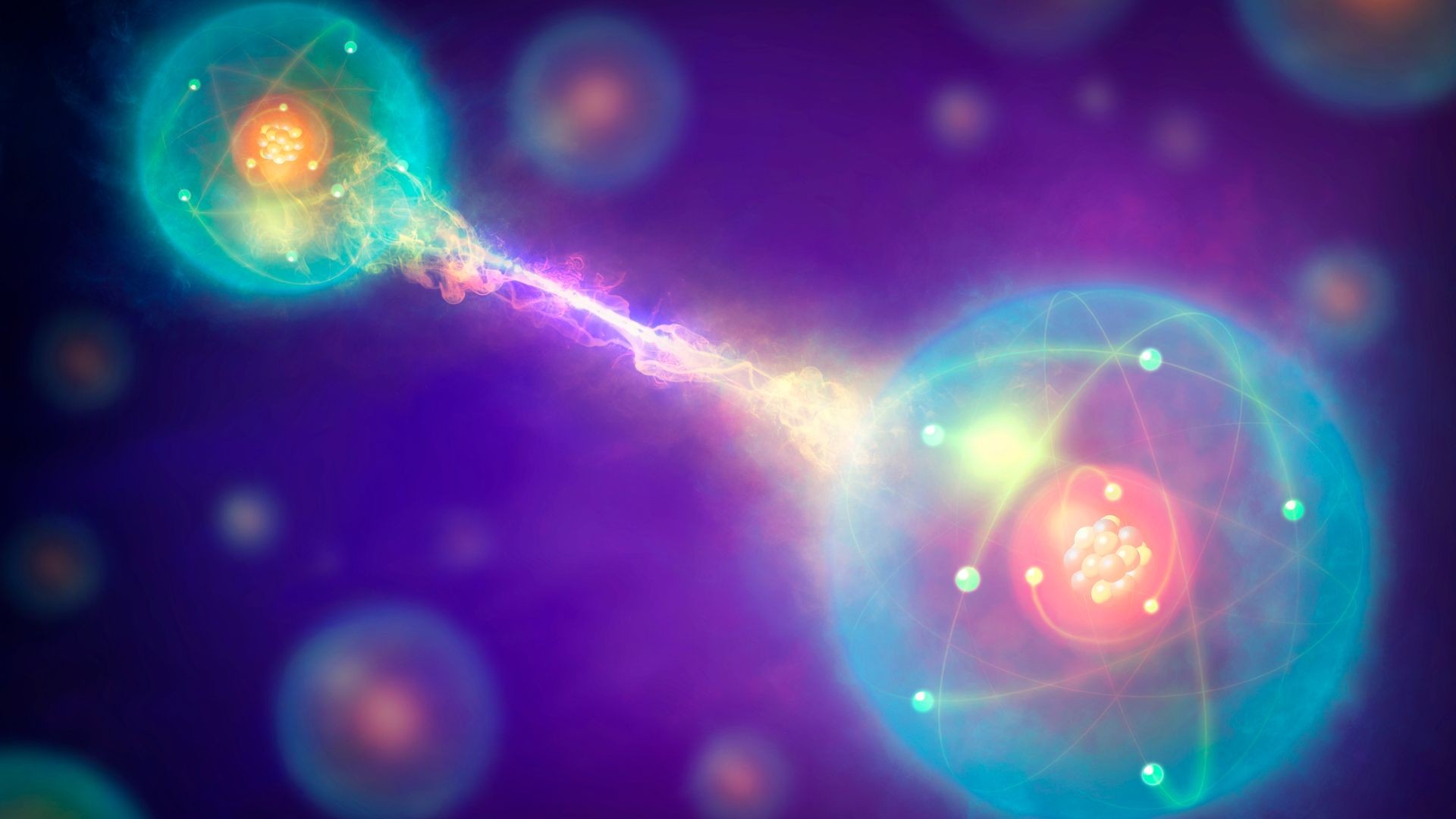
For decades, the concept of quantum entanglement —what Albert Einstein famously called “spooky action at a distance”—has been primarily demonstrated using light particles (photons) or the internal “spin” of atoms. However, a groundbreaking new study published in Nature Communications has achieved something fundamentally different: scientists have successfully entangled the physical motion of atoms.
By linking the momentum of two moving atoms, researchers have moved beyond the realm of light and into the realm of matter, opening new doors for how we understand gravity and precision measurement.
The Breakthrough: Entangling Momentum
In a recent experiment, a team of researchers demonstrated that pairs of ultracold helium atoms can be quantum mechanically linked through their momentum —the combination of an object’s mass and its velocity.
While entanglement has been observed in other forms, this experiment is unique because it involves particles with mass. This distinction is critical:
– Photons (light particles) have no mass and are unaffected by gravity.
– Atoms possess mass and respond directly to gravitational forces.
By proving that momentum can be entangled, scientists have validated that the strange, counterintuitive rules of quantum mechanics apply not just to light, but to the physical movement of matter itself.
How the Experiment Worked
The research, led by physicists including Sean Hodgman from the Australian National University, required extreme conditions and meticulous precision.
1. Creating a “Quantum Cloud”
The team began with a cloud of helium cooled to near absolute zero. At these temperatures, atoms slow down so much that they lose their individual identities and merge into a single collective state known as a Bose-Einstein condensate.
2. The “Scattering Halo” Method
To create the entangled pairs, the researchers used precisely tuned laser pulses to manipulate the condensate. They split the cloud into three groups: one kicked upward, one downward, and one left stationary. As these clouds moved, atoms collided and scattered in opposite directions, creating “scattering halos”—spherical shells of correlated atom pairs.
3. Proving the “Spooky” Connection
To ensure the connection was truly quantum and not just a classical coincidence, the team used a Rarity-Tapster interferometer. By reflecting the atoms back onto themselves to create interference patterns, they proved the atoms existed in a “superposition”—a state where they are essentially in multiple places or states at once until measured. The data collected over a month of continuous testing confirmed that these correlations could not be explained by classical physics.
Why This Matters: From Sensors to Quantum Gravity
This isn’t just a theoretical victory; it has profound implications for the future of technology and our understanding of the universe.
- Ultra-Precise Sensors: Momentum-entangled atoms could lead to the development of quantum sensors capable of detecting minute gravitational waves or mapping the Earth’s interior with unprecedented accuracy.
- Testing the Limits of Physics: The next frontier involves colliding different isotopes of helium (helium-3 and helium-4). This would create particles entangled in both momentum and mass simultaneously.
- The Gravity Puzzle: Such an experiment would push the boundaries of modern science. Current frameworks like General Relativity struggle to describe states where mass and quantum entanglement overlap. This could provide the essential data needed to develop a theory of quantum gravity, the “holy grail” of physics that seeks to unite the very large (gravity) with the very small (quantum mechanics).
“Our brains aren’t really equipped to process it,” noted Hodgman. “Atoms appear as smeared out at small scales, not concrete blobs… And that just seems really, really weird.”
Conclusion
By successfully entangling the momentum of massive atoms, physicists have bridged a gap between light-based quantum mechanics and the physical world of matter. This milestone paves the way for next-generation sensors and provides a new, challenging testing ground for the ultimate laws of gravity and quantum theory.