Spiders. Frogs. Lizards. Sparrows. Wasps. Even some plants want to eat a housefly. Humans are not far behind, armed with swatters and sprays. To survive this gauntlet, a fly cannot afford a single mistake. It needs sensory awareness that borders on paranoia and aerial maneuvers that defy physics.
The foundation of this survival kit starts at the top.
The Exoskeleton and Body Plan
Like every other insect, a housefly is wrapped in a hard outer shell. It is an exoskeleton made of chitin. This armor covers the entire body and splits it into three distinct sections: the head, the thorax, and the abdomen.
But the head is where the action happens. It is a command center packed with sensors designed to keep the insect alive in a chaotic world.
Compound Eyes and Mosaic Vision
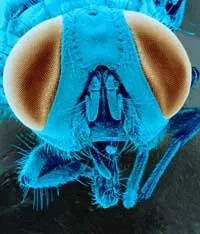
A housefly’s head is dominated by a pair of large complex eyes. These take up most of the skull space. Each eye is not a single lens like yours or mine. It is a cluster of 3,000 to 6,000 simple eyes.
Vertebrates focus on details. We zoom in. We read the label. We see the individual face. Flies don’t. They cannot focus on the particulars of their environment. Instead, their vision is a mosaic. It is a wide-angle mosaic of everything to the left, right, front, and above.
Think of a security guard in a casino. He sits in front of a bank of monitors. He is not looking at one screen. He is scanning dozens of feeds simultaneously. He is looking for cheating, drunkenness, loitering. Any threat.
A fly does this with thousands of “monitors.” The result is a 360-degree threat detection system. It catches the slightest movement from nearly every direction. You can rarely sneak up on a fly. You do not exist in its blind spots because there are no blind spots.
Navigational Ocelli
Between those massive compound eyes sit three additional simple eyes. They are called ocelli.
They are not for seeing images. They are a navigational device. A compass for the sky.
The ocelli keep the fly oriented. They tell it which way is up. The fly does this by tracking sunlit areas. It moves toward the light. This is why you often find houseflies buzzing around windows. They are not trying to escape. They are following the brightest patch of sky they can find.
“The fly accomplishes this by keeping track and moving towards sunlit areas.”
This is not just biology. It is engineering. A six-legged aircraft with a cockpit made of thousands of lenses. And it is still trying to survive your hand.
The Biology of a Bite
You might have swatted a nuisance at this moment, but understanding how a housefly operates changes everything. Their world is defined by scent and taste. This starts with the antennae, which provide a remarkably keen sense of smell. It is the primary way they navigate their environment, locating rotting matter or human waste from a distance.
Once they land, the proboscis does the heavy lifting. This plunger-like appendage extends from the bottom of the head. It is not a stinger. It is a feeding tube designed to slurp up liquids. You cannot get a blood meal this way. The structure ends in the labellum, a spongy mouth part. Here, the fly soaks up nutrients like a sponge soaks up water.
Then there are the maxillary palps. These two small, antenna-like feelers sit near the proboscis. They allow the fly to taste its food before it commits to consuming it. They essentially act as a quality control check. If the substance is not suitable, the fly moves on. If it is, the proboscis extends further to begin the slurping process.
Why You Can’t Get Bit
Did that housefly just bite me? The short answer is no. Houseflies do not have piercing-sucking mouthparts like mosquitoes or bedbugs. They lack the specialized structures needed to break skin or draw blood. The proboscis is strictly for external digestion and absorption.
This means the irritation you feel after a fly lands on you is not a bite. It is likely an allergic reaction to the enzymes they regurgitate onto your skin to pre-digest food. Or perhaps it is just the physical sensation of their feet walking on you. Their mouthparts are not designed for pain. They are designed for waste.
Navigating the Next Move
But how does the housefly get to its food? The mouthparts are only half the story. The ability to locate your leftovers relies on movement and aerial precision.
On the next page, we’ll examine its amazing legs and wings.