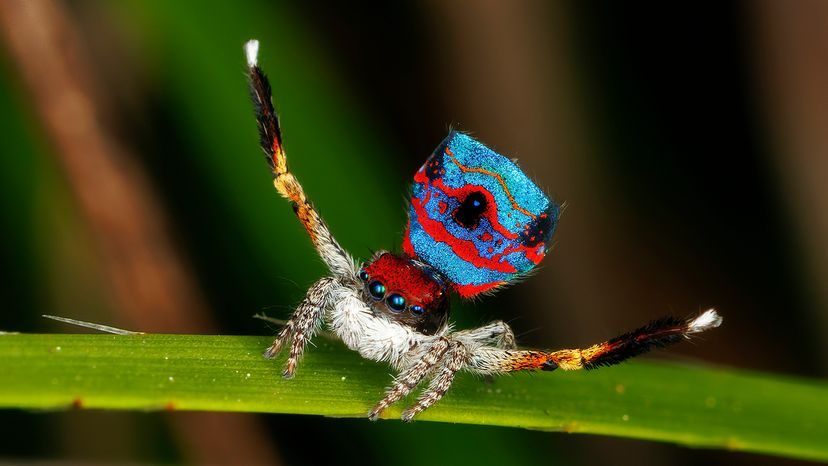
It’s not a piece of jewelry. It’s not a dessert. It’s a spider.
But the sparklemuffin peacock spider (Maratus jactatus ) wears its nickname with pride. Discovered in the Wondul Range National Park in southern Queensland, Australia, this tiny arachnid was formally named in 2015 by UC Berkeley PhD student Maddie Girard. The name stuck because the creature is as flashy and vivacious as its title suggests.
Pop culture caught up to the spider in 2024 when singer Suki Waterhouse named her album Memoir of a Sparklemuffin. The inspiration came from the dark lore surrounding these arachnids: if a male’s courtship dance fails to impress a female, she might eat him. It’s high stakes. It’s deadly. It’s also beautiful.
The Visuals: Small Size, Huge Impact
On a casual glance, you might miss it. Peacock spiders are unassuming. Adult Maratus jactatus measure just 0.16 to 0.2 inches (4 to 5 millimeters) long. They are smaller than your fingernail.
But look closer through a microscope, and the creature transforms into a social media sensation.
The males are the showstoppers. Their abdomens are painted in psychedelic swirls of red, blue, and orange. These aren’t just decorative scales; they are biological billboards designed for one purpose: mating.
Females, meanwhile, are the pragmatists. They wear muted browns and grays. Their job isn’t to dazzle. It’s to survive. Camouflage keeps them hidden in soil and leaf litter while they hunt.
Jumping Jacks with Sharp Eyes
These spiders belong to the Salticidae family, commonly known as jumping spiders. It is the largest spider family on the planet.
What makes them distinct isn’t just their size. It’s their mobility. They can jump distances up to 50 times their own body length. That’s like a human clearing a football field in a single bound.
They achieve this precision because of their eyes. Jumping spiders have exceptional vision, particularly with their large front eyes. This visual acuity is essential for two things: spotting prey from afar and dodging predators that want to eat them. They don’t rely on webs to catch food. They stalk. They jump. They strike.
Where to Find Them in the Wild
You won’t find these arachnids in rainforests or deserts. Maratus jactatus prefers open woodlands, scrublands, and grasslands across Australia.
They need structure. Specifically, they need vegetation and leaf litter. These environments provide cover from predators and hunting grounds for small insects. Their small size allows them to hide effectively, blending into the background until the moment is right. They thrive in habitats where other predators might struggle to navigate the dense undergrowth.
The Courtship Dance: Life or Death
Spiders are generally solitary. But during mating season, the rules change. Males become highly social, driven by the need to reproduce.
The sparklemuffin peacock spider male performs an intricate courtship routine. He raises his brightly colored abdomen. He waves his legs. He vibrates his body. The result is a visual and auditory spectacle that rivals any choreographed ballet.
This isn’t just about looks. It’s a test of coordination and stamina.
If the female is impressed, she mates with him. If she is bored, she chases him away. In some cases, she eats him. Every performance is a high-stakes gamble.
What They Eat
Maratus jactatus are carnivores. They eat small insects and other arthropods.
They don’t spin webs to trap dinner. They use their excellent vision to locate prey. Once they are within range, they use their jumping ability to pounce.
Despite their miniature stature, they play a vital role in their ecosystem. They help control local insect populations, acting as tiny, efficient predators in the underbrush.
A History of Discovery
Peacock spiders have been known for over a century. The first species, Maratus volans and Maratus speciosus, were discovered in 1874 by British arachnologist Oktavius Pickard-Cambridge.
New species are still being found. In 2020, citizen scientists discovered Maratus nemo in Mount Gambier, Australia. Named after the clown fish from Finding Nemo, it features a vibrant orange face with white stripes.
The sparklemuffin is just the latest addition to this dazzling, ever-growing family. And while we may never know if Suki Waterhouse’s album captures the full depth of their emotional landscape, one thing is clear: these spiders are far more than tiny monsters. They are artists. Performers. Survivors.
The next time you walk through a scrubland in Queensland, keep your eyes open. You might not see them. But they are watching. And waiting.