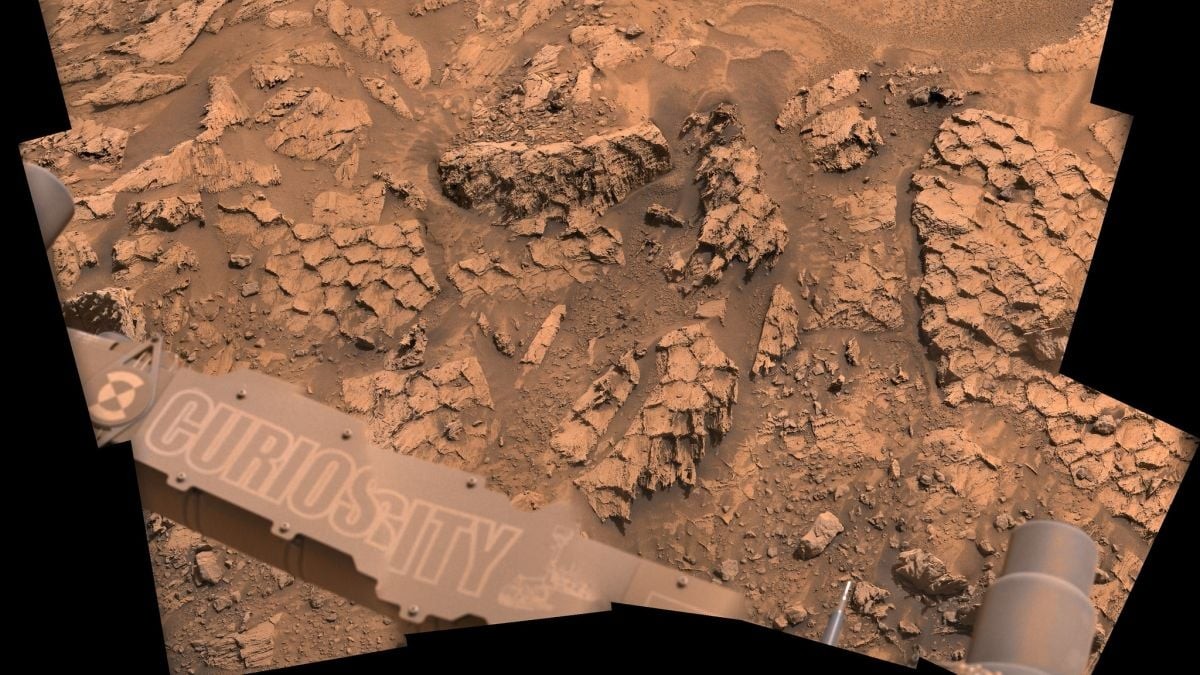
NASA’s Curiosity rover has captured striking images of a uniquely textured landscape within the Antofagasta crater on Mars. The discovery, characterized by thousands of repeating, honeycomb-shaped polygons, has sparked significant interest among planetary scientists due to what these patterns reveal about the Red Planet’s ancient climate.
The Discovery: A Landscape of Polygons
While the textures bear a resemblance to reptilian scales—leading some to describe them as “dragon scales”—NASA scientists use more technical terms. Project scientist Abigail Fraeman of the Jet Propulsion Laboratory describes the find as “honeycomb-shaped polygons” that appear in massive, repeating tessellations.
What makes this find particularly notable is its scale. While polygonal rock patterns have been observed on Mars previously, Fraeman noted that the sheer abundance and extent of these patterns—stretching for meters across the rover’s Mastcam mosaics—is unprecedented.
Decoding the Pattern: How Rocks “Grow” Shapes
To understand what these shapes mean, scientists look to Earth for geological parallels. On our planet, such polygonal patterns typically form through two primary processes:
- Desiccation: When mud or wet soil dries out, it shrinks and cracks. Repeated cycles of wetting and drying turn simple cracks into complex geometric networks.
- Cryoturbation: In freezing environments like Antarctica, the expansion and contraction of ice within the ground creates similar polygonal cracks.
Why this matters for Mars:
Mars lost most of its liquid surface water billions of years ago. Because desiccation cracks require moisture, finding them on Mars is a rare “smoking gun” for ancient water activity. The presence of these patterns suggests that the Antofagasta region was once subject to cyclic environmental changes —periods of wetting followed by drying.
Connecting the Dots: From Pontours to Antofagasta
Scientists are currently investigating whether this new site is related to the Pontours formation, a Martian location identified in 2023 that also featured regular hexagonal patterns.
Research on Pontours suggests a specific evolutionary process for these shapes:
1. Initial Stage: A single drying event creates simple, T-shaped cracks.
2. Mature Stage: Repeated cycles of wetting and drying transform those cracks into Y-shaped intersections.
3. Final Stage: These interconnected cracks eventually form a stable, hexagonal “honeycomb” pattern.
The Antofagasta site shows some variations, specifically raised ridges. These ridges often form when minerals seep into ancient cracks; once the surrounding material erodes, the mineral-filled cracks remain as elevated structures. This could indicate a slightly different geological process or a different stage of environmental transition than what was seen at Pontours.
The Path Forward
While the visual evidence is compelling, scientists cannot yet confirm if the two sites are identical. A crucial piece of the puzzle remains: mineral composition. At the Pontours site, salts were found, suggesting the presence of evaporating brines (salty water).
Curiosity has already collected data from the Antofagasta crater. As researchers analyze these samples, they aim to determine if the chemical makeup of these “dragon scales” matches the salt-rich history of other wet Martian sites.
The discovery of these extensive patterns reinforces a growing scientific consensus: Mars was once a much more dynamic and watery world than its current arid surface suggests.
Conclusion
The discovery of massive polygonal patterns at the Antofagasta crater provides fresh evidence of ancient, recurring wet-dry cycles on Mars. As scientists analyze the collected data, these “dragon scales” may offer vital clues into the complex history of water and climate on the Red Planet.