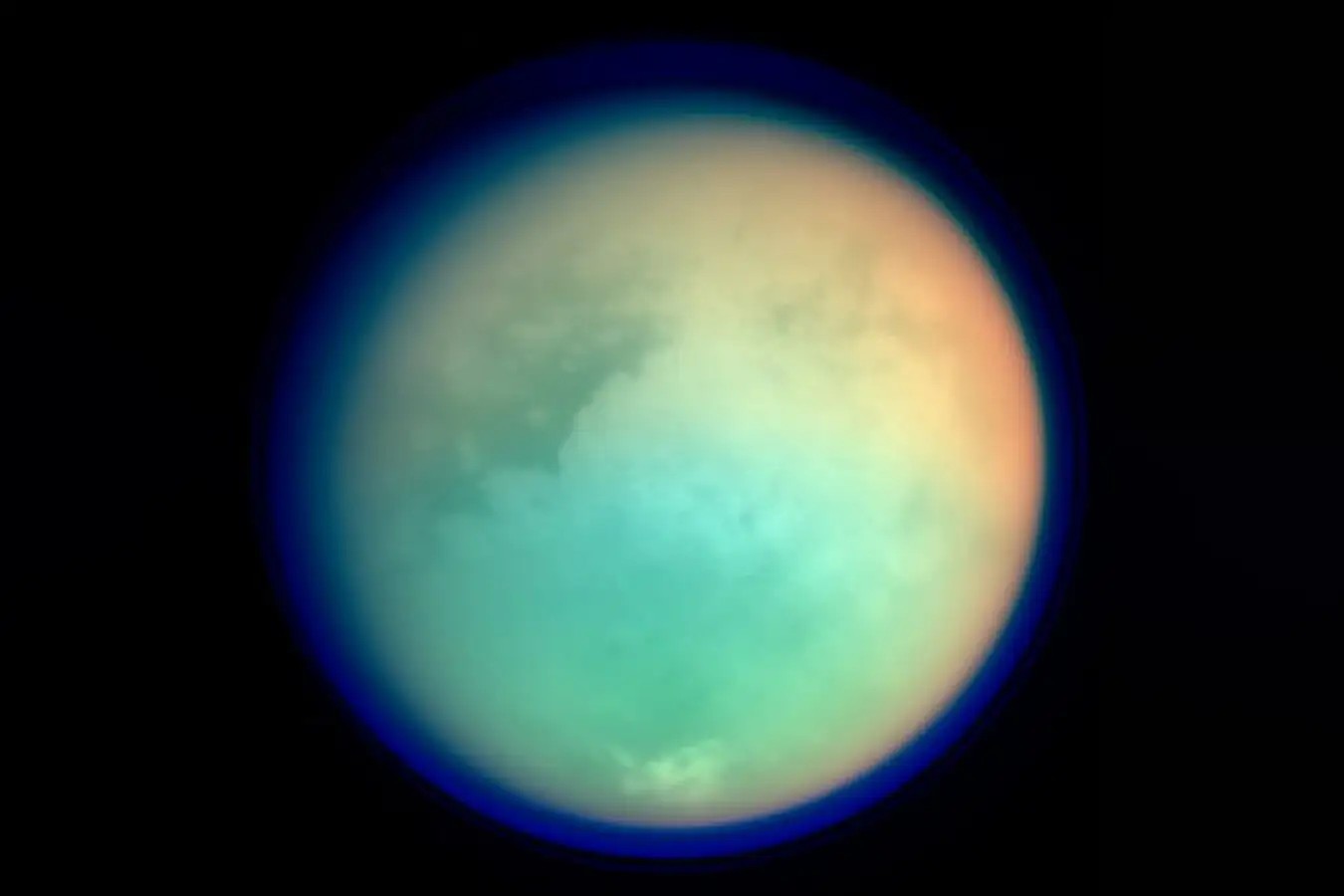
Something weird is sitting on Pluto. It’s also on Titan. And nobody knows what it is.
Titan’s atmosphere is thick, a choking fog of nitrogen and methane. Studying the ground there is hard. Almost impossible without the right tools. But if we want to find aliens there, we have to know the chemistry. The chemistry tells us everything.
Enter the James Webb Space Telescope.
Bruno Bézard, from the Paris Observatory, and his team looked at the data. They used spectroscopy—the art of watching light get absorbed, reflected, or emitted. Chemicals leave fingerprints in light. Most of them do.
On Titan, they saw a narrow band of missing light. A specific wavelength vanishing into the haze. Then they looked at Pluto. Cold Pluto. Empty, dry Pluto. With an atmosphere 15,00 times thinner than Titan’s.
They saw it again. The same wavelengths were being swallowed by the surface. Although on Pluto, the signature is broader, fuzzier. Like the same word written in a shaky hand.
It doesn’t make sense. Not on the face of it.
Titan has lakes of liquid hydrocarbon. Pluto has ice. One is a moon, the other a dwarf planet. The conditions are wildly different. Yet the atmospheres share a twin soul. Both are nitrogen-heavy. Both drip methane haze down onto their surfaces. It snows chemicals there. Layer upon layer.
“You have, in both, this chemistry where haze particles are produced and can snow down,” says Bézard.
That’s the likely birthplace of this mystery substance. The snow falls, accumulates, changes.
The researchers ran a comparison game. They pulled up spectra from labs and archives. Known ices. Known atmosphere compounds. Every candidate for a match.
None fit.
Well. A few came close.
Maybe the known molecules got mixed with something else. Maybe the grains of the material changed size on Pluto compared to Titan. Physics changes things. But none of the matches were exact.
“We have a few candidates,” Bézard says. “It will not be a simple compound. Whatever it is, it will be a surprise.”
A surprise in astronomy is just another word for “we have no idea.”
So now? Three steps.
First, they are digging into more JWST data. Trying to pinpoint where exactly the stuff is hiding on Titan’s crust. The geology might help. If you know where it lives, you can guess what it eats.
Second, lab experiments. They will take the “near matches” and twist them. Squeeze them. Change the conditions. See if the spectrum lines up.
Third, the long game.
NASA’s Dragonfly spacecraft launches in 2028. It lands in 2034. It flies across Titan. It samples the surface. It might finally solve this. Or it might complicate it further.
Do we really want to know what it is?
Probably.
Because if we don’t, we’re blind. Blind to the chemistry that could host life. Or destroy it. Pluto sits in the dark, keeping its secrets. Titan hides under its orange shroud. Two worlds, one mystery.
And somewhere, in the ice and the haze, something waits to be named.
Want more? Sign up for Launchpad to get the latest on exoplanets, weather, and the hunt for life. Join Nathan Mayne. Explore the unknown.