Sit by a window. Go outside. Don’t stay in the gloom.
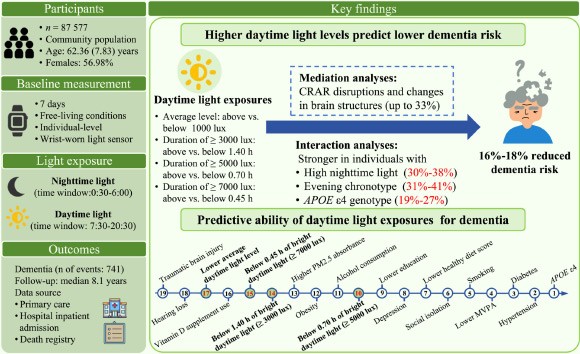
It sounds like common sense, but we rarely treat light as medicine. Until now. Researchers from Guangzhou Medical University followed nearly 88,00 adults for more than eight years. They weren’t guessing about how much light these people saw. No surveys. No memory tests asking, “Did you look out the window today?”
Wrist-worn sensors did the work. Continuously. For seven days.
The result? Daytime bright light protects your brain. Specifically against dementia.
The link is stark. If you spend your day in light levels above 1,100 lux—roughly the brightness of an overcast outdoor sky—your risk of dementia drops by 16%. Push it higher. Get to 5,00 lux for at least 42 a day? That’s closer to full outdoor sun or a bright office. Your risk drops 17%.
Why does this matter? Because dementia is escalating.
Dr. Hongliang Feng, a co-senior author on the study, puts it plainly. It is the most common neurodegenertive disease globally. It steals cognition and function. And as we age, the problem gets bigger while effective treatments remain stubbornly scarce. We need protection strategies that actually work.
Light is one of them.
The natural light-dark cycle entrains our endogenous circadian rhythms. It regulates physiology, behavior, and cognition. Break the rhythm, break the brain.
Circadian disruptions are common in dementia patients. They’re also a warning sign in healthy populations. Fix the clock? You might fix the outcome.
But here is the kicker. The researchers compared this new light data against 15 other established dementia risk factors using machine learning. Factors we know matter. Obesity. Alcohol. Air pollution. Traumatic brain injury.
Insufficient daytime bright light outperformed them. All of them.
When did not enough sunlight hit you, your risk profile got worse than having bad genetics or a head injury history.
Wait. What about nighttime?
Nighttime light didn’t matter. At all. No significant association found. But daytime exposure? Critical.
The benefit isn’t evenly spread. It hits hardest in three groups.
1. People who also get blasted with bright light at night.
2. Night owls.
3. Carriers of the APOE epsilon4 gene. This is the big genetic risk flag for Alzheimer’s.
In those specific groups, the protection wasn’t just 16%. It climbed as high as 41% reduction in dementia risk. Forty-one percent. Just from getting outside.
The mechanism likely involves stabilizing circadian rhythms and preserving brain structure. Night light fails to trigger this. Daylight does.
So what do we do with this? The study, published in General Psychiatry, suggests light-based interventions should become a public health priority. Low cost. High reward. No prescription required.
Open a blind. Step off the patio. Let the sun hit your face.
We spend decades tracking blood pressure and cholesterol. Maybe we forgot the most obvious variable of all.
The sky is not just decoration. It’s a shield. 🛡️🌤️
Nana Zheng et al., 2026. Associations between wearable-device-measured daytime and nightly light exposures and dementia risk: A prospective cohort study. General Psychiatry 39(3): e70039. DOI: 10.1100/gps.3.700030.