Light does not always travel in straight lines. It bends.
When a light beam passes from one material to another, it changes direction. This bend is due to the change in speed. The index of refraction is a number that researchers use to measure exactly how much this bending occurs. It’s a simple relationship, but it determines everything from why your eye focuses to how lenses correct your vision.
Defining the relationship
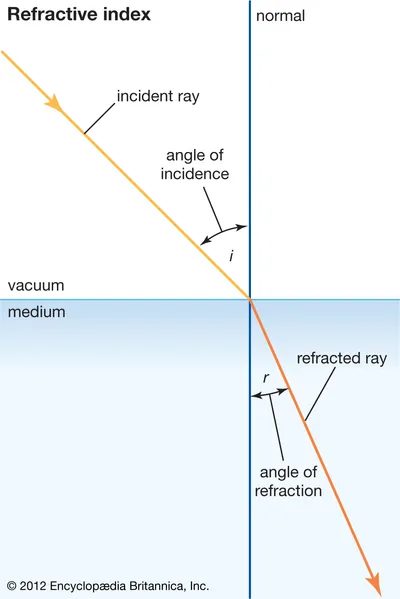
The index of refraction, often called n, is defined by the angles of light when it crosses the boundary between two media. More specifically, it compares the angle of incidence to the angle of refraction. The angle of incidence is the angle between the incident ray and the perpendicular (normal) to the surface. The angle of refraction is the angle between the ray in the new medium and the same normal line. Mathematically, the refractive index is the ratio of the sine of the angle of incidence to the sine of the angle of refraction.
n = sin i / sin r
This formula assumes that light comes from a vacuum. In practice, air is often compared to glass or water, but the vacuum baseline keeps the standard constant.
Lightspeed connection
There is a more physical way to look at this number. It’s not just about angles. It’s all about speed. Light travels in empty space at its maximum speed, constant c. When light enters a substance – such as water, glass or diamond – it slows down. The speed in the substance is v.
The index of refraction is simply the speed of light in a vacuum divided by the speed of light in the medium.
n = c / v
A higher refractive index means that light travels more slowly in this material. This also means that light is refracted more when it enters.
Why it matters
This is not just theoretical physics. The refractive index determines how the lenses function. Glasses use materials with certain refractive indices to bend light precisely enough to correct vision. Camera lenses rely on it to focus images. Fiber optics use it to trap light inside thin strands for Internet data. Even the sparkle of a diamond is due to its high refractive index, which causes the light inside to be refracted and reflected, creating brilliance.
Beyond the basics
The value of n depends on the wavelength of the light. Therefore, the prism splits the white light into a rainbow. Different colors spread through the glass at slightly different speeds and thus bend to different degrees. The refractive index is usually given for a specific wavelength, often the yellow line for sodium or the blue C line for hydrogen.
It also varies with temperature and pressure. Change the conditions and the density of the medium changes, changing the way light travels through the medium. This is how mirages are created on hot roads. Air near the ground is less dense, has a lower refractive index and bends light upwards, creating the illusion of water.
Understanding the index of refraction is key to understanding how we see and process light. It combines the abstract mathematics of sine ratios with focused images, colorful spectra and our way of perceiving the world into concrete reality.

Speed of light in different materials
Most people believe that light always slows down when it hits matter. The same goes for visible light. But X-rays tell a different story.
Let’s look at the refractive index of yellow light at a wavelength of 589 nm. Air sits is around 1.0003. Water jumps rose to 1.333. Crown Glass touched 1,517. Dense flint glass has a goes up of 1.655. diamond? It spikes to 2,417. The higher the number, the slower the light travels. This is why diamonds shine so brightly.
This change can cause chromatic aberration. Blue light bends differently than red light. Lenses have difficulty focusing all colors to the same point. This is a fundamental flaw in glass optics.
X-rays break the rules. The refractive index is slightly below 1.0. What does this mean in practice? When X-rays enter the glass from the air, they bend “away from” the normal. Visible light bends towards it.
The formula n = c/v still applies. If n is less than 1, v must be greater than c. The speed of X-rays in glass exceeds the speed in vacuum. It seems impossible. it is not. Phase velocity can exceed the speed of light without violating causality. Energy does not move faster than c. The wavefronts do.
This difference is why a special mirror is needed to focus the X-rays. A standard lens cannot be used. You need grazing incidence optics is needed. The light skims the surface. It reflects rather than refracts.
We rely on this property for medical imaging. And for looking deep into space. Chandra and XMM-Newton use nested shells. They catch X-rays at a low angle. Without understanding this counter-intuitive physics, we would still be blind to the high energy universe.
The math works. The physics holds. But our intuition that “slower is denser” fails here.