


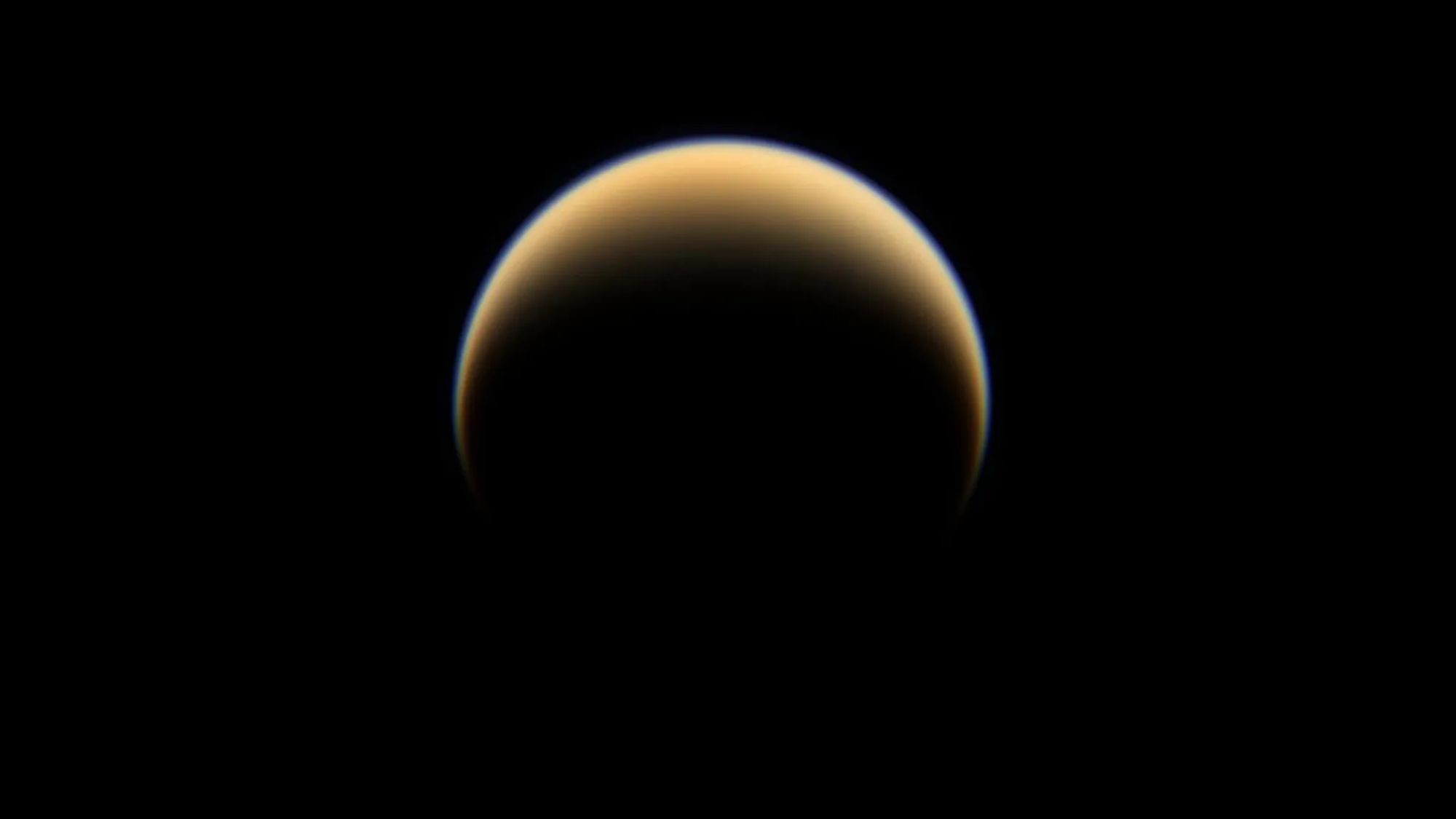
It makes no sense on paper. Pluto is a frozen dwarf planet, a cold outpost with a thin atmosphere hovering over ice. Saturn’s moon Titan is a smoggy, geologically active world buried under a dense sky, with seas of liquid methane and dunes of organic sludge.
They are separated by billions of miles. Their environments couldn’t be more different.
And yet, they are hiding the same secret.
Recent data from the James Webb Space Telescope has revealed an identical, unexplained infrared signature on both worlds. Two disparate bodies, sharing the exact same chemical fingerprint. We cannot say what it is.
Chasing a spectral ghost
The mystery started with Bruno Bézard at the Paris Observatory. He was analyzing Titan observations from late 2022 when he saw something odd. JWST had gathered infrared light leaking through Titan’s haze. Bézard used spectroscopy — the standard technique for identifying compounds by the specific light wavelengths they absorb.
Usually, this works perfectly. Every molecule leaves a unique spectral fingerprint. You can find water ice or complex organics across the solar system by reading those lines.
But this signal didn’t match the library.
It wasn’t hardware error either. The same absorption feature showed up in two completely different JWST instruments: NIRSpec and MIRI. If it were a glitch, it wouldn’t replicate that consistently.
So Bézard did what any good scientist does when stuck. He called his colleague.
Emmanuel Lellouch had been observing Pluto. Bézard asked the obvious question: Do you also have a signature at this exact wavelength?
They looked. They found it. Right there on Pluto’s surface, at precisely the same infrared wavelength as Titan.
It’s not life, but it’s close
Let’s get one thing straight immediately: there is zero evidence this mystery molecule is a biosignature. No one is claiming aliens.
Instead, this likely reflects prebiotic chemistry. The kind of complex organic reactions that have been brewing in Titan’s oxygen-free environment for over 4 billion years.
One leading suspect? Allenes.
This is a family of hydrocarbons that exhibits strong absorption bands in the same 5-micron range where the mystery signal sits. But here’s the catch: the allene family is massive. It has many complex variations. We simply don’t have complete spectral libraries for them yet.
“We only have spectra for the simplest of them,” Bézard admitted. “But it is possible that within this family you find one or several compounds… which make such an absorption feature.”
It’s also possible the signature belongs to a known molecule, but one that has shifted because it’s mixed with other uncataloged planetary ices. We’re looking at a composite ghost, not a clean signal.
Why it has to be on the surface
How do we know it’s not just floating in the atmosphere?
For Titan, the team looked at the geometry. They scanned the moon from the center of its face out to the edge, or limb. The signal steadily weakened as it approached the horizon.
This is exactly what you expect from a surface deposit. When you look at the edge of a sphere, you’re looking through a thicker slice of atmosphere. If the signal came from the sky, it would behave differently. In fact, when the team checked for atmospheric carbon monoxide, it stayed constant from center to limb. The mystery signal didn’t.
Pluto offers even harder evidence. Its atmosphere is a near-vacuum. It’s too thin, too sparse, to create an absorption feature that deep. There’s simply not enough gas to block that much light. The source has to be the ground.
To rule out random chance, the team checked Jupiter’s moon Ganymede. Ganymede lacks the nitrogen-methane atmosphere required for this specific photochemical engine. Did they find the molecule there? No. It appears unique to the nitrogen-methane sky environment of Titan and Pluto.
The recipe for organic snow
So, what is happening up there?
Both bodies have atmospheres dominated by nitrogen and methane. In the upper reaches, ultraviolet sunlight shatters these molecules. This triggers a cascade of highly reactive fragments. They reassemble into complex organic compounds. Then, they condense and snow down to the surface.
That’s where JWST is detecting them.
It’s a pipeline from sky to ground. Photochemistry in the upper atmosphere generates the compounds, which then fall and accumulate on the surface.
Waiting for ground truth
More clarity might arrive in the coming months. The team is analyzing newer JWST observations as Titan rotates. This data will help map the signature across the moon’s surface. Will it cluster in the dune fields? Will it avoid the lakes? Knowing where it sits could hint at what it is.
But true answers may have to wait.
NASA’s Dragonfly mission offers the real hope. This car-sized rotorcraft is set to launch in 2028, arriving at Titan in the mid-203os. It won’t carry an infrared spectrometer. Instead, it will use a mass spectrometer to physically “taste” the organic molecules.
It will fly to various geologically interesting sites. It will tell us exactly which compounds are present on the surface. That list of candidates can then be replicated in Earth labs to see if they match JWST’s mystery signature.
For now, the molecule remains undefined. A ghost in the data.
“It’s always exciting when you discover something that wasn’t seen before,” Bézard said.
It is, certainly. But it’s also a reminder of how much we still don’t know. The solar system is keeping its cards close to its chest. And for all the technology we’ve built, sometimes the universe just refuses to be labeled.


