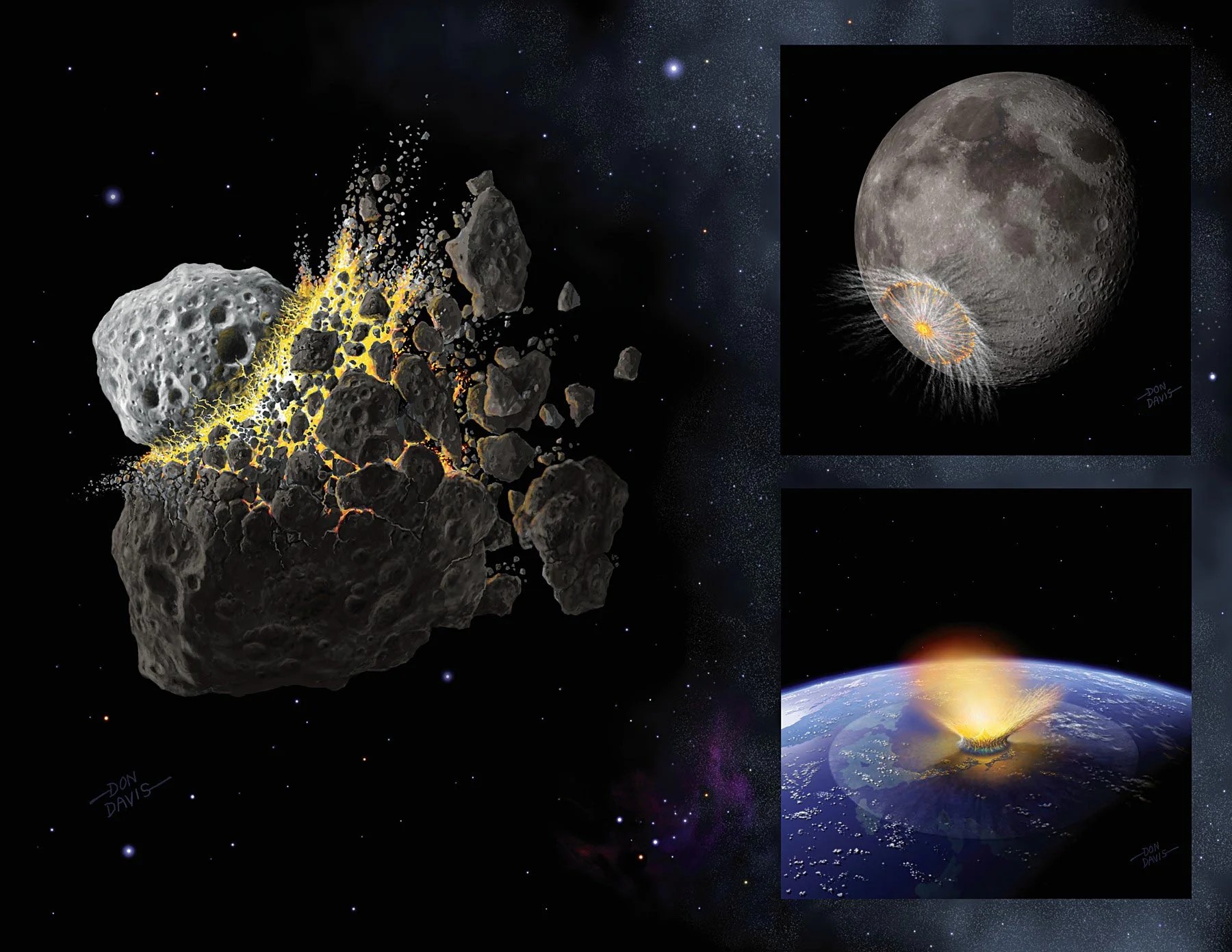
One smash-up in the asteroid belt may have triggered a cosmic shotgun blast across the inner solar system 800 million years ago.
It wasn’t a single event. It was a shower. Debris from a shattered parent body rained down on the Moon, Earth, and Mars for tens of millions of years. New research connects this ancient bombardment directly to the breakup of the Eulalia parent body, a massive object residing in the main asteroid belt.
The implications are significant. This collision explains a spike in large lunar craters. It might also explain why Earth cooled down or why Mars went volcanic. Direct evidence on Earth is scarce—geology eats its history. But the Moon keeps score. And the Moon remembers.
Why We Can’t Trust Earth’s Geologic Record
Let’s be honest. Earth is terrible at keeping memories.
Plate tectonics churns the crust like a slow oven. Volcanoes bury the past under fresh lava. Wind and water erode everything until only dust remains. Finding an impact crater older than 650 million years here is like finding a needle in a hurricane-blown haystack.
Most ancient craters are gone. Distorted. Buried. Destroyed.
The Moon, by contrast, is a frozen time capsule. No plate tectonics. No atmosphere to speak of. No flowing water to wash away the scars. When you look at the Moon’s surface, you are looking at a receipt of violent history.
“The heavily cratered surface of the Moon serves to remind us of large impacts in Earth’s past,” says Dr. William Bottke of the Southwest Research Institute (SwRI). But so far, the only link we have firmly made is the Chicxulub impact 66 million years ago. That one killed the dinosaurs. Clear. Obvious.
This new study suggests the 800-million-year-old event was far more complex.
The J3/1 Resonance: A Gravitational Escape Route
The culprit is the Eulalia asteroid family.
Specifically, the breakup of its parent body near the J3/1 mean motion resonance with Jupiter.
Here’s how it works. Jupiter’s gravity is the dominant force in the outer solar system. But its influence stretches inward. In the J3/1 resonance, an asteroid orbits the Sun exactly three times for every single orbit Jupiter completes.
It’s a gravitational sweet spot. Or a trap.
Repeated gravitational tugs from Jupiter destabilize orbits in this zone. They kick objects out of the main asteroid belt entirely. The Eulalia parent body broke apart right on the edge of this resonance.
“Location of the parent asteroid was key,” Bottke explains.
Once shattered, roughly half the fragments immediately fell into the J3/1 resonance. Jupiter grabbed them. Threw them inward. Straight toward Earth, Mars, and Venus.
This isn’t just theory. Near-Earth asteroids today still use this same pathway to reach us. It’s a proven highway.
The Yarkovsky Effect: Slow-Motion Destruction
The initial barrage was fierce. But it didn’t end there.
The models show a second wave of debris arriving over the next 100 to 150 million years. About 25% of the fragments made it to the resonance later.
How? Heat.
The Yarkovsky effect is a subtle force caused by thermal emission. An asteroid absorbs sunlight. It heats up. Then it rotates into shadow. The heat radiates away as infrared light. That tiny push of thermal energy acts like a thruster.
It’s incredibly weak. But over millions of years? It works. It nudges small asteroids into the J3/1 resonance where Jupiter can pick them up and fling them inward.
So you have a prolonged bombardment. Not a single hit. A sustained assault lasting hundreds of millions of years.
What Happened on Earth and Mars?
The timing is suspicious. The peak of this bombardment aligns with a period of global cooling on Earth. Also, significant shifts in the biosphere. The global collection of life and ecosystems.
Does correlation equal causation? Not necessarily. But the possibility is tantalizing.
“Ideally, we want to know if the former produced the latter,” says Bottke.
On Earth, the numbers are staggering. For every large object hitting the Moon, Earth takes about twenty hits. It’s bigger. It has stronger gravity. It’s a wider target.
The atmosphere would have been hammered. Climate records would show disruption. Oceans might have been stirred. Evolutionary pressures could have shifted wildly.
Mars fared differently. The impacts there would have triggered massive seismic events. Powerful earthquakes. The study links this timing with a surge in volcanic activity. The ground shook. The pressure changed. Magma moved.
“Together, this showcases how certain catastrophic collisions… could have had far-reaching consequences,” Bottke notes.
Why This Matters Now
We often think of impacts as rare, catastrophic outliers. The Chicxulub event gets all the press because it’s clean. Dinosaurs die. Mammals rise.
But the 800-million-year event tells a messier story.
It suggests that life’s history on Earth may be shaped by long-term environmental stress. Stress induced by space rocks. Not just one big bang. But a prolonged period of shaking, cooling, and volcanic activity.
The Moon’s static surface allows us to reconstruct this chaos. Apollo mission samples of impact glass help anchor the timeline. When rock melts during a collision, it cools and locks in a date. Scientists can use that timestamp to estimate impact age.
Without the Moon’s record, we’d be guessing. With it, we have a roadmap.
One shattered asteroid. A gravitational trap. A million-year bombardment. And a planet that barely kept its cool.
We’re still trying to figure out how much of our existence was shaped by the chaos of the early solar system. The Eulalia breakup gives us a concrete anchor point. 800 million years ago.
The question now isn’t just what hit us.
It’s what those impacts did to the living world below.