Stop trying to memorize the whole sky. It doesn’t work. Your brain isn’t built to store a catalog of ten thousand points of light at once. Instead, you need an anchor. A single, unshakeable reference point that tells you exactly where everything else is.
For anyone looking at the northern sky in late summer, that anchor is the Summer Triangle.
It sounds too simple. Three bright stars. A big triangle overhead. Is that it? Yes. And that simplicity is its superpower. It cuts through city light pollution. It pierces the lingering twilight of early evening. Once you spot these three stars, the rest of the cosmos snaps into focus.
Why the Summer Triangle is the best starting point for beginners
Most people think of the night sky as flat. A dark ceiling sprinkled with glitter. That’s a mistake. The sky has depth. Immense, terrifying depth. The Summer Triangle is the best tool we have for proving it.
The asterism—technically a large star pattern, not a true constellation—consists of three stars that look like they are close neighbors. They aren’t. Not even close.
Look at Altair. It’s the lowest point of the triangle. It’s bright because it’s nearby. About 17 light-years away. That’s practically next door in cosmic terms. Its light left the star’s surface when the first skyscrapers were being designed in Chicago and New York.
Then there is Vega. Higher up. Blue-white. It sits roughly 25 light-years from Earth. Still close. Still local. Vega was Earth’s North Pole star about 12,000 years ago. It will be again in another 12,000. Thanks to the slow wobble of our planet’s axis, these stars cycle through prominence over millennia.
Now look at Deneb. The top point of the triangle.
Here is the kicker: Deneb is roughly 2,600 light-year away.
Its light began its journey toward your eyes while the Roman Empire was still rising. The fact that you can see it with the naked eye is absurd. It’s only visible because Deneb is a supergiant. It radiates tens of thousands of times more energy than our sun. It is screaming light across the void.
When you realize this, the triangle changes. It’s no longer a flat shape on a dome. It becomes a three-dimensional arrow. Altair and Vega are right here in the foreground. Deneb is shoved back thousands of light-years. The pattern collapses into perspective.
How to find the Summer Triangle this week
You don’t need a telescope. You need to look up.
Right now is ideal timing. Aim for mid-latitudes in the Northern Hemisphere. Around 11 p.m., look to the southeast.
- Find Vega. It’s usually the brightest, high and brilliant with a slight blue tint.
- Look lower and left of Vega. That’s Deneb.
- Look far south, almost down toward the horizon relative to the other two. That’s Altair.
By midnight, the triangle is directly overhead. It stays dominant until October.
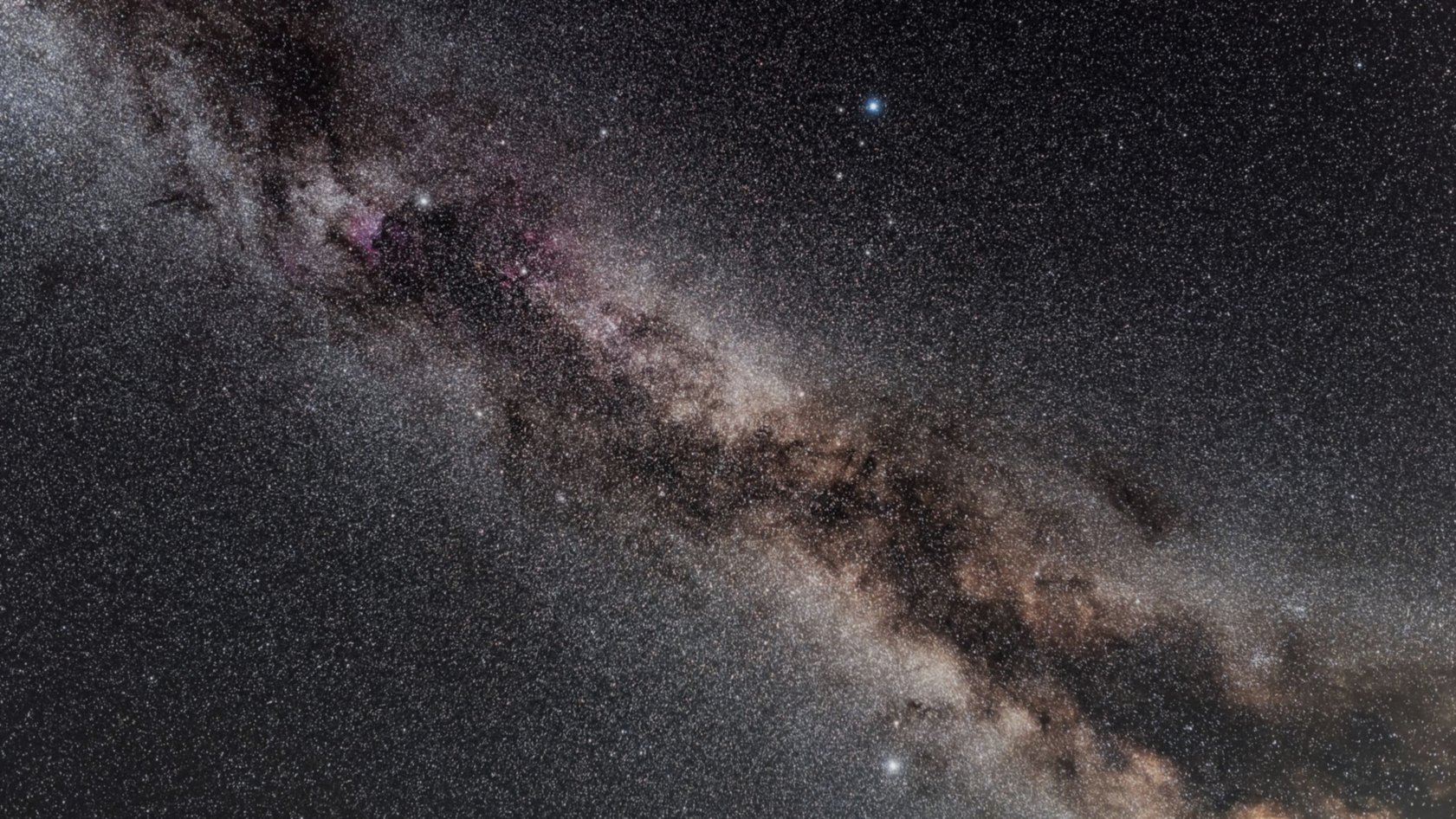
Underneath this geometric frame lies the Milky Way itself. Specifically, the Orion Arm. The glowing band of starlight stretches through the triangle. If you have dark skies, you can see the galactic river stream behind Deneb and pour through Altair. It connects visually to the galactic core, which hides low on the horizon near Sagittarius and Scorpius.
What you’ll see through binoculars in the Summer Triangle
Once you get past the naked-eye view, things get messy. And messy is good.
Take binoculars. Sweep them across the triangle. You will lose structure. You’ll stop seeing stars and start seeing clouds. Dense star fields spill out everywhere. Dark lanes—gaps in the gas and dust—slice through the bright patches.
The region between Deneb and Altair is arguably the best casual viewing spot in the sky.
- Cygnus Star Cloud: Located inside the triangle. One of the richest sections of the Milky Way available to northern observers.
- Albireo: Found at the “beak” of the Swan constellation (Cygnus). It’s a double star. One is yellow. The other is faint blue. Through small optics, it looks like a jewel.
- Small Constellations: Look left of Altair for Delphinus (the Dolphin). Look above it for Sagitta (the Arrow). They are tiny but distinct.
Astronomy improves when you stop hunting specific objects. Stop chasing nebulas like targets. Start exploring regions. It feels like travel.
Stargazer’s corner: July 24–31, 2026
The moon interferes, but it also offers alignment opportunities.
- July 24 (Friday): The moon is 81% illuminated, waxing gibbous. It shines near Antares, the red supergiant in Scorpius. Antares is below the Summer Triangle.
- July 29 (Wednesday): The night before the full Buck Moon. The Summer Triangle points directly at the bright moon. The lunar glare will wash out fainter stars, so focus on the triangle itself.
- Meteor Showers: The Perseids are waking up. Early meteors appear after midnight. The Southern Delta Aquariids and Alpha Capricornids peak around July 30–31. Expect reduced visibility for these due to the moon’s brightness.
Constellation of the week: Sagitta
You likely missed Sagitta. It’s small. Very small.
It sits between Cygnus and Aquila (the Eagle). It looks exactly like what it is: an arrow. Five stars form a short line with an arrowhead. They are all between 450 and 650 light-years away.
It isn’t bright. It doesn’t demand attention. But once you spot it, it anchors a patch of sky that otherwise feels empty. Finding these small constellations fills the gaps. It turns a blank space into a map.
We often obsess over the best gear. The latest telescope deals. The perfect camera lens for astrophotography. They help. But they don’t teach you how to see. The Summer Triangle does that. It teaches you depth. It teaches you patience.
It teaches you that the sky isn’t a backdrop. It’s a window.
Where do you look after the triangle fades?