It took Christmas Day. Just one glimpse.
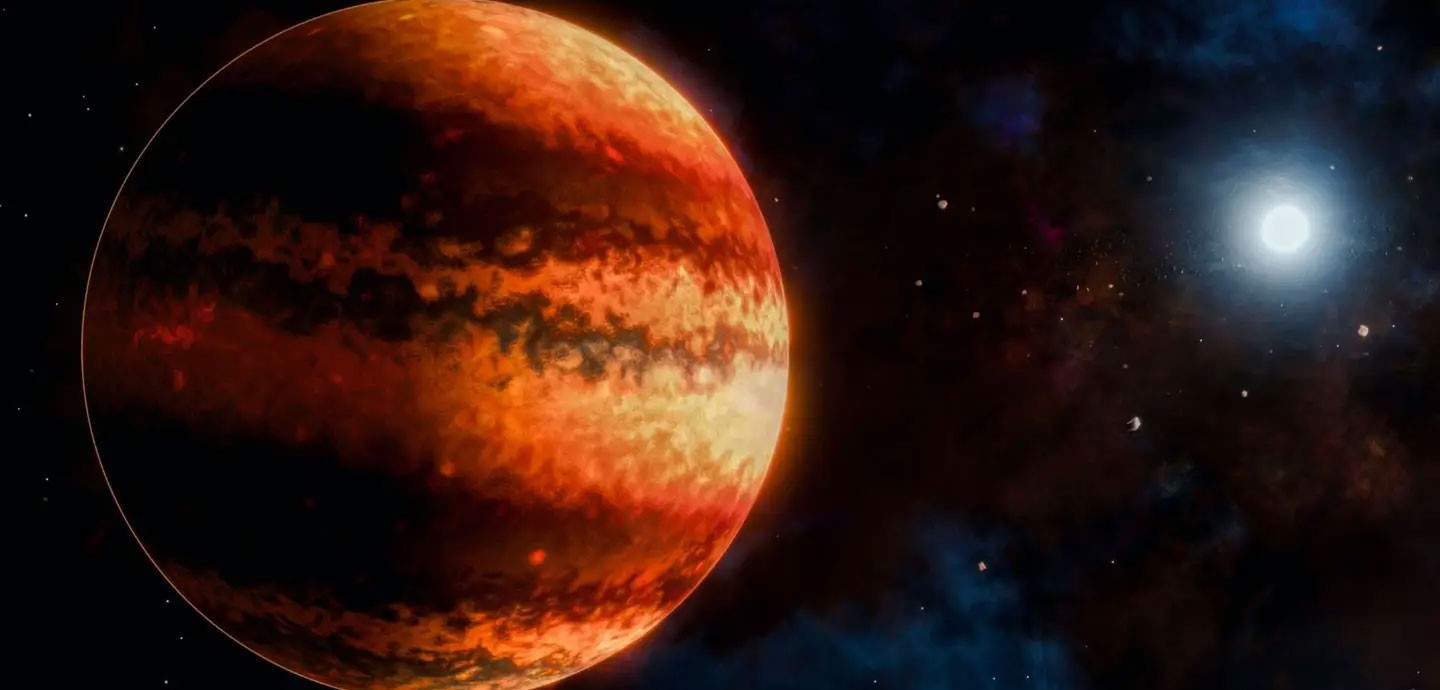
NASA’s Transiting Exoplanet Survey Satellite, TESS, spotted a dip in starlight on December 25, 2020. That single transit launched a hunt for NGTS-38 b, a world that turns out to be nearly five times more massive than Jupiter.
For years, astronomers chased planets orbiting close to their stars. Short orbits. Frequent transits. Easy data.
This one was different.
NGTS-38 b takes 180 days to complete one orbit. It’s a “Super-Jupiter.” The term usually implies bulk, not necessarily speed, but here the sheer mass—combined with an orbit almost as long as half a year—makes it a statistical outlier in transit detection.
“This has been an incredible discovery… finding one much further out at 100 days is a big deal!”
Actually, 180 days. Toby Rodel, the PhD student who led the discovery from Queen’s University, didn’t just find it. He waited for it.
Why long-period transiting planets are so hard to catch
Think about the geometry.
To see a planet via the transit method, it must pass directly between its star and Earth. If the orbit is wide, that crossing happens rarely. A 180-day period means you might see one transit every six months.
Rodel’s team pointed the Next Generation Transit Survey (NGTS ) telescopes in Chile at the target star for over 200 consecutive nights.
Why?
To catch the tail end of a second transit.
They needed it. One transit gives you timing and size estimates. Two transits confirm the period. Without that confirmation, the data is just a maybe.
But even with two transits, you don’t get mass. Not directly.
The team split the star’s light to measure tiny wobbles. The planet’s gravity pulls on the star. The star moves slightly. By analyzing that movement alongside the transit data, they calculated the planet’s true mass: 4.5 times that of Jupiter.
Its radius? About 8% larger than Jupiter’s.
That’s a dense object. A compact giant.
The orbit is weird. And it matters
Most exoplanets found this way orbit tightly. They’re hot. They’re stripped atmospheres.
NGTS-38 b is different.
Its orbit isn’t a circle. It’s an ellipse.
At its closest point, it’s only slightly further from its star than Mercury’s distance from our Sun. At its farthest, it’s almost as distant as Earth is from the Sun.
The host star is bigger and hotter than ours, so the planet stays warm. But it’s cooler than the ultra-hot Jupiters we usually study.
Why does temperature matter?
“This planet has a much cooler temperature… it’s a great opportunity to study what holds on to moons or rings.”
That’s the kicker.
Most known exoplanets are too close to their stars for stable moon systems. Tidal forces tear them apart. NGTS-38 b sits further out. Its gravity is strong.
Could it hold moons?
Could it have rings?
We’ve never confirmed either outside our solar system. If they’re there, this planet might be the best candidate to prove it.
Two teams. One planet. No coincidence
Science hates lone wolves.
While Rodel’s team published their findings in the Monthly Notices of the Royal Astronomical Society, a separate group led by Felipe Rojas of Universidad Adolfo Ibáñez independently identified the system.
They called it TIC-659102228 b.
Same planet. Same method. Same result.
Rojas noted the “mild eccentricity” and the mass as key features. Worlds like this preserve fingerprints of how they formed. They don’t look like the planets we’ve been seeing for twenty years.
The field has moved on.
Detecting planets with long orbital periods wasn’t possible when Kepler first launched. Now it is.
Does this mean we’re close to finding an Earth twin?
Not quite.
Professor Christopher Watson was clear: “This planet is nothing like the Earth.”
But proving we can detect massive planets on wide orbits? That’s a technical leap. It pushes the boundaries of what’s observable.
What makes NGTS-38 b unique
Here’s the breakdown:
- Mass: 4.5x Jupiter.
- Radius: ~1.08x Jupiter.
- Orbital Period: 180 Earth days.
- Eccentricity: Moderate (oval-shaped orbit).
- Detection Method: Transit + Radial Velocity (star wobble).
It’s a “warm” Super-Jupiter. Not hot. Not cold.
It sits in a gap we’re only just beginning to explore.
Most transit surveys filter for short periods. They look for quick returns on investment. NGTS-38 b forced the wait.
And it paid off.
The data is out. The independent confirmation is there. The planet is real.
Now, we watch the star. We wait for the next transit. And maybe, just maybe, we’ll find the shadow of a moon crossing the disk alongside it.